My Child Is Bored in Traditional School: What Now?
Boredom is not a personality flaw. When a bright, curious child dreads Monday mornings, stares through classroom windows, and comes home with nothing to say except "fine". That is not a child who needs more discipline. That is a child whose mind is outrunning the system built to contain it. And for families across South Orange County, from Mission Viejo to Ladera Ranch to San Juan Capistrano, there is finally a named answer to what that boredom is asking for.
The Boredom Signal Most Parents Miss
Every parent has heard it. "School is boring." "We just did worksheets again." "I already know this." The instinct is to reassure. School is important, pay attention, it gets better. But what if the boredom is not a problem with your child's attitude? What if it is accurate feedback about what is happening in the room?
The structure of conventional schooling was designed in an era when information was scarce and compliance was the primary workforce skill. Children sat in rows, absorbed content delivered by a single adult, and were tested on their ability to recall it. That model made sense once. It does not make sense now. And children, with their unfiltered honesty, are the first to say so.
Research on student engagement consistently shows that children learn deepest when they are doing, not watching. When they are building something, solving a real problem, leading a team, or communicating an idea to an audience that actually cares. Passive reception. The dominant mode of most traditional classrooms. Is not just inefficient. For many children, it is genuinely painful. The boredom your child is reporting is not ingratitude. It is a nervous system accurately reporting that nothing meaningful is being asked of it.
"Boredom in a bright child is not a behavioral problem. It is a curriculum problem, and it deserves a curriculum solution."
What Traditional Schools Are Actually Optimizing For
It is worth being honest about what conventional schools are built to produce. Not leaders. Not entrepreneurs. Not young people who can walk into a room, read a situation, and build something from nothing. Traditional schools. Both public and many conventional private options. Are optimized for one primary output: a student who can perform acceptably on standardized assessments.
That is not a cynical reading. It is structural. When a school's reputation, funding, and teacher evaluations are tied to test scores, the curriculum bends toward what is measurable. The result is that creativity, initiative, persuasion, resilience, and entrepreneurial thinking. The skills that actually predict life outcomes. Are crowded out by content that fits neatly into a multiple-choice format.
For families in Laguna Hills, Aliso Viejo, Rancho Santa Margarita, and across South OC who are watching their children disengage, this is the root cause. The school is not failing because the teachers are bad or the building is wrong. It is failing because it was never designed to build the kind of human your child is becoming.
What a Different Kind of School Actually Looks Like
Wonderstorm Academy, a private K-12 micro-school in Laguna Hills, was built as a direct answer to exactly this frustration. It is a full-time, on-site learning center serving children ages 5 through 18, located at 25332 McIntyre St. Not a virtual program, not a hybrid homeschool co-op, but a real campus where children show up every day and do real work.
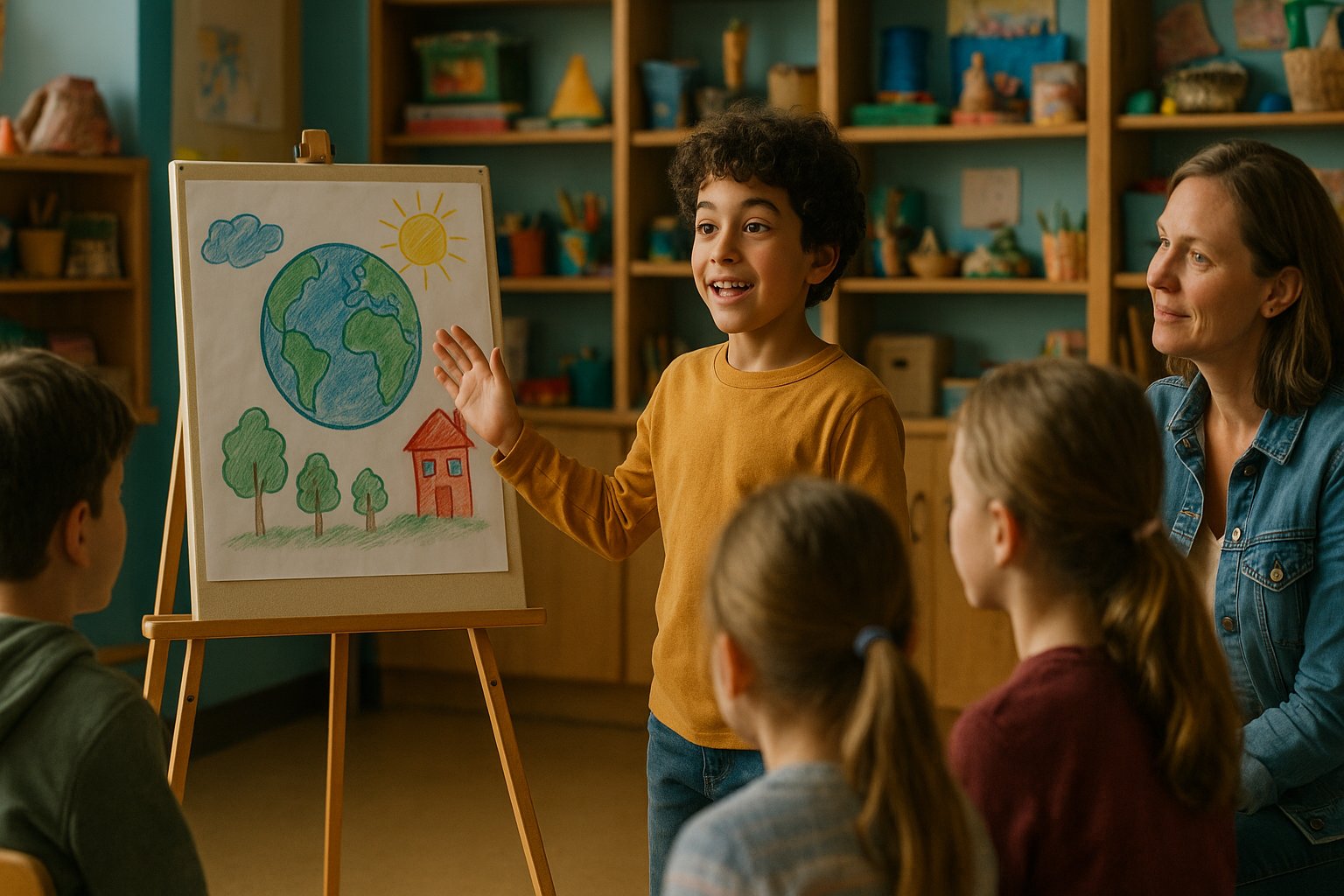
The entire educational model at Wonderstorm is organized around three core lenses: Leadership, Entrepreneurship, and Powerful Communication. These are not electives or enrichment programs tacked onto a traditional schedule. They are the architecture of the school day. Every project, every challenge, every learning sprint is designed to develop a child who can think independently, build something tangible, and communicate it with confidence.
A child who is bored in a conventional classroom because they are always waiting. Waiting for the lesson to catch up to them, waiting for permission to go deeper, waiting for someone to ask them something hard. Finds a fundamentally different experience at Wonderstorm. The model is student-led, meaning students take real ownership of their learning path. They are not managed through a curriculum. They are challenged to pursue it.
One parent, Elizabeth Hoefer, describes what happened when her daughter. Who left the public school system after 6th grade carrying what she called a "tremendous amount of educational trauma". Enrolled at Wonderstorm. As a 10th grader, her daughter completed four college classes through the dual enrollment program at Saddleback College and is on track to finish all high school requirements an entire year early. "Her love of learning has been restored," Hoefer wrote. That restoration did not happen by drilling her harder. It happened by finally asking something real of her.
The Difference Between a Learning Center and a Micro-School
Parents searching for alternatives to traditional schooling in South Orange County often encounter a range of options: tutoring centers, enrichment programs, learning centers, hybrid homeschool pods, and online academies. It is worth being precise about what Wonderstorm is and is not.
A learning center, in the most common usage, is a supplemental resource. A place children go after school or on weekends to fill gaps or accelerate in specific subjects. These serve a real purpose. But they are not a school. They do not replace the primary educational environment; they patch it.
A micro-school is something categorically different. It is a full-time, full-curriculum educational institution that simply operates at a small scale by design. Wonderstorm Academy is a private K-12 school in the truest sense. With a structured daily campus environment, a coherent pedagogical framework, qualified mentors, and a clear developmental arc from kindergarten through 12th grade graduation. The "micro" part is not a limitation. It is the point. Small cohorts mean every child is genuinely known. No one disappears into the middle. No one is managed as a number.
"The micro in micro-school is not a constraint. It is the feature that makes everything else possible."
Why Entrepreneurship Education for Kids Is Not What You Think
When parents first hear that entrepreneurship education for kids is a central pillar of the Wonderstorm model, a reasonable question arises: are we talking about lemonade stands, or are we talking about something rigorous? The answer is both. And the sophistication scales with the child.
For younger students, entrepreneurship at Wonderstorm looks like designing and selling a real product at the school's Kids Market events, where students build, pitch, and operate actual small businesses for a live community audience. For older students, it looks like real-world apprenticeships, community-facing projects, and the kind of sustained problem-solving that requires research, iteration, failure, and recovery.
This is not soft-skills programming dressed up in business language. Entrepreneurship, as Wonderstorm teaches it, is the daily practice of initiative. Of identifying a problem and deciding to solve it. Of communicating an idea well enough that other people want to join it. Of building something and defending it. These are the skills that matter in an AI-driven economy. Not because they are trendy, but because they are the specifically human capacities that technology cannot replicate.
For families in Lake Forest, Laguna Niguel, Dana Point, and Coto de Caza who are thinking seriously about what their child will need to thrive in the next twenty years, the question is not whether entrepreneurship education belongs in school. The question is why it took this long to get there.
The School Choice Conversation in California
California's school choice landscape is evolving, and families across Orange County are paying close attention. The broader national conversation around Education Savings Accounts and ESA programs in California reflects a growing recognition that families deserve more agency over where and how their children learn. While specific ESA mechanisms in California continue to develop, the underlying principle is gaining momentum: parents should not be locked into a single educational option by geography alone.
For families in Portola Hills, Trabuco Canyon, Las Flores, and Newport Coast who are actively exploring alternative K-12 education in Laguna Hills and the surrounding area, Wonderstorm Academy represents exactly the kind of differentiated, values-aligned institution that the school choice conversation is pointing toward. It is not a franchise. It is not a corporate chain. It is a founder-led, community-embedded school built by people who believe so deeply in the model that they enrolled their own children in it.
Holly Yarbrough, School Director and Co-Founder of Wonderstorm Academy, built this school from a conviction that the conventional system was not designed for the children most worth building. The ones who ask too many questions, who need to make something with their hands, who light up when someone finally asks them to lead. That conviction is not an abstraction. It shows up in the daily life of the campus.
Is Wonderstorm Academically Rigorous Enough?
This is the objection worth naming directly, because it is the one most parents carry quietly. If the school is focused on entrepreneurship and leadership, are the foundational academics. Reading, writing, mathematics, science. Being taken seriously?
The short answer is yes, and the longer answer is that Wonderstorm redefines what rigor looks like. Traditional schools equate rigor with homework volume, test frequency, and AP course load. Wonderstorm measures rigor by the depth of real-world application. A student who can write a persuasive business proposal, analyze a market, defend a position in front of an audience, and iterate a product based on real customer feedback has demonstrated more academic and intellectual capacity than a student who memorized the same content for a Friday quiz.
The Apogee Strong network framework that supports Wonderstorm's model is not a homegrown experiment. It is a nationally validated student-led education system with a track record of outcomes. Families who have watched their children go from disengaged and anxious in conventional settings to confident, self-directed, and academically ahead. Sometimes by a full year. Are the most credible evidence available. Lindsey Jaleh, whose daughter enrolled at Wonderstorm, described the transformation plainly: her daughter is now "confident, engaged, joyful, and genuinely loves going to school." That is not a soft outcome. That is the foundation everything else is built on.
What to Do If Your Child Is Bored Right Now
If you are reading this from Mission Viejo, San Clemente, Aliso Viejo, or anywhere across South Orange County, and the description in this article sounds like your child and your household, the next step is simple and low-commitment: have a conversation.
Wonderstorm Academy's enrollment process begins with a call. Not a sales pitch, but an honest conversation about your child, what they need, and whether the Wonderstorm model is the right fit. From there, a campus tour lets you see the environment, meet the mentors, and watch students in action. Words about micro-school education are useful. Watching a room full of children who are genuinely engaged, building real things, leading each other, and loving the work. That is something else entirely.
Your child's boredom is not a personality trait to be managed. It is a signal worth listening to. And in Laguna Hills, there is a school that was built specifically to answer it.
Book a call today at Wonderstorm Academy and take the first step toward a school experience that finally matches your child's potential.