Your School Is Invisible. Here Is Why.
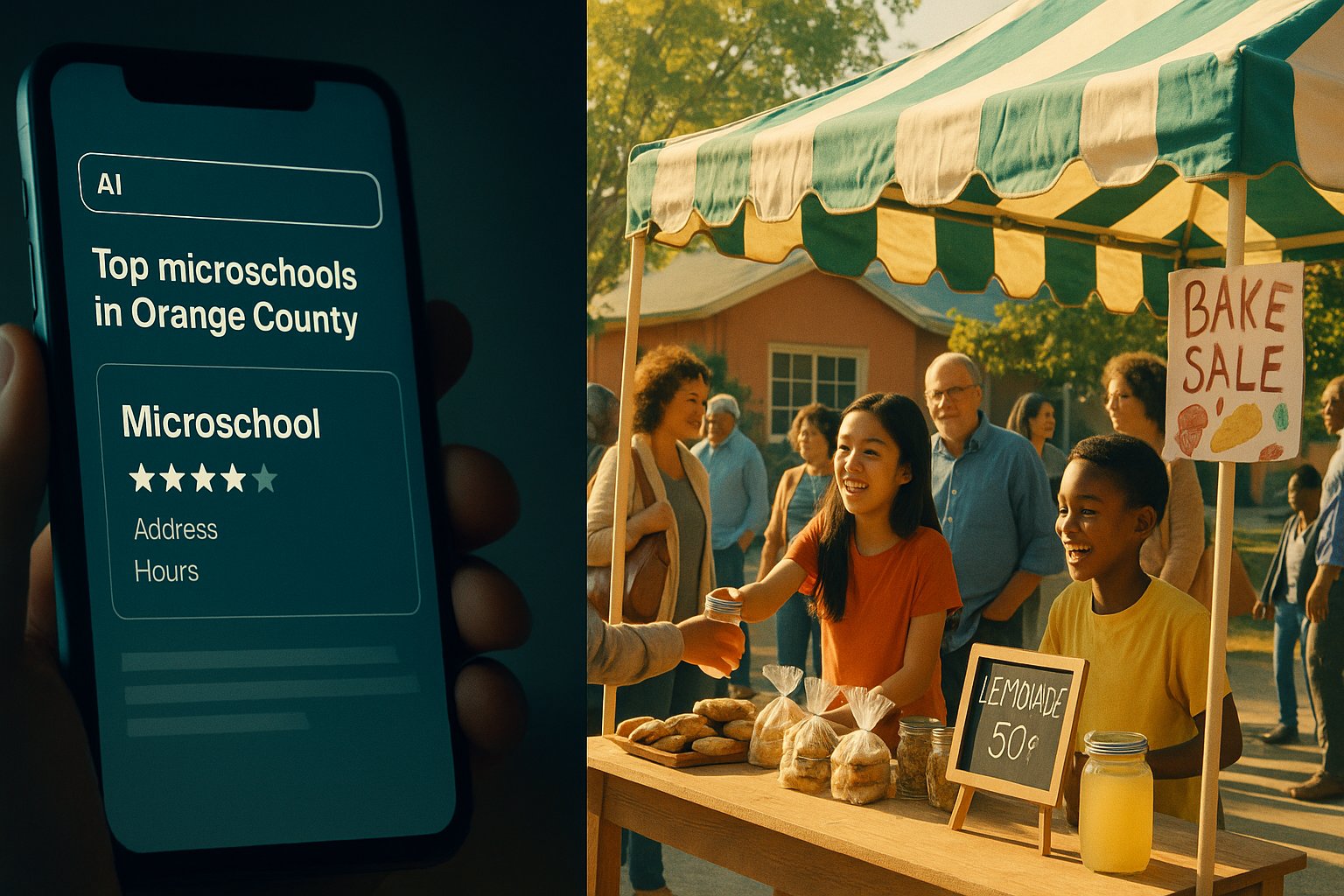
A parent in South Orange County is asking an AI assistant right now which school in Laguna Hills teaches entrepreneurship to kids. She is not browsing a list. She is trusting a machine to tell her. If that machine cannot confidently describe Wonderstorm Academy. Its model, its mission, its age range, its address, its differentiators. She will enroll somewhere else. Not because another school is better. Because another school gave the algorithm better data.
This is not a content problem. It is not a branding problem. It is an entity clarity problem. And solving it may be the highest-leverage action a values-driven school can take before the fall enrollment window closes.
The Quiet Competition No One Is Talking About
Every private school in Orange County is competing for the same pool of intentional, disillusioned parents. Those parents are doing what all modern consumers do before a major decision: they research. They search. They ask AI assistants. They cross-reference. And the schools that appear in those answers. Clearly, specifically, confidently. Are not always the schools with the best programs. They are the schools with the best-structured information.
This is the quiet competition. It does not happen on a stage or in a brochure. It happens inside the ranking logic of Google's AI Overviews, inside the knowledge graph that ChatGPT draws on when a parent types 'What is the best student-led school in South OC?', inside the local discovery layer that Perplexity assembles when someone asks 'Is there a microschool near Laguna Hills that focuses on leadership?'
The schools winning this competition right now are not winning because they are superior. They are winning because they are legible. To an algorithm. Before a human ever sees them.
The school that gets found is not always the best school. It is the best-described one. And that gap is entirely closeable.
What Entity Clarity Actually Means
The term sounds technical. The concept is not. Entity clarity is the degree to which an AI model or search engine has enough structured, consistent, unambiguous information about your organization to describe it accurately to a stranger.
For a school, that means: Does every major platform that indexes you. Google Business Profile, your website's structured data, third-party directories, review platforms, local citations. Agree on what you are? Does your Google Business Profile say 'private school' while your website says 'learning center' while Yelp says 'tutoring'? That inconsistency is not a minor clerical issue. It is a signal to every AI model that you are ambiguous. Ambiguous entities get deprioritized. Deprioritized schools become invisible.
For Wonderstorm Academy specifically, the entity clarity score currently sits at 8 out of a possible higher threshold. A number that reflects real gaps in how the school is categorized, described, and indexed across the platforms that matter most. Those gaps are not a reflection of the quality of education happening on that campus. They are a reflection of how that education has been communicated to machines. And machines are now the gatekeepers between a searching parent and an enrollment conversation.
The good news is that entity clarity is one of the most actionable problems in modern school marketing. Unlike brand reputation, which takes years to build, or word-of-mouth, which cannot be manufactured, entity clarity can be meaningfully improved in weeks. It requires consistency, specificity, and a willingness to describe your school in structured language that both humans and algorithms can process.
The Five Pillars of a Legible School
For any private school or micro-school trying to win the entity clarity game, the work lives in five concrete areas.
The first is category consistency. Every platform where your school appears should use the same primary category. If you are a private K-12 school, that phrase. Or its closest approved equivalent. Should appear on your Google Business Profile, your schema markup, your directory listings, and your own website's metadata. Variation is noise. Noise becomes invisibility.
The second is attribute specificity. Vague language like 'innovative learning environment' tells an AI model nothing it can act on. Specific language like 'project-based K-12 micro-school in Laguna Hills serving ages 5-18 with a curriculum built around leadership, entrepreneurship, and communication' gives it everything it needs. The more specific you are, the more confidently an AI can surface you for specific queries.
The third is geographic anchoring. This means claiming and fully completing your Google Business Profile, ensuring your NAP. Name, address, phone number. Is identical across every platform, and creating content that names your city, your neighborhood, and your county explicitly and often. 'Laguna Hills.' 'South Orange County.' 'The 92653.' These are not just keywords. They are the geographic pins that tell a local discovery algorithm exactly where to place you.
The fourth is review density and recency. AI models weight social proof. A school with twelve reviews from three years ago looks stale to an algorithm. A school with a steady stream of recent, detailed, keyword-rich reviews. From parents describing specific outcomes, specific teachers, specific programs. Looks alive, trusted, and relevant. The Wonderstorm reviews that already exist are extraordinary. Elizabeth Hoefer's account of her daughter arriving with educational trauma and leaving a year early with four college credits is exactly the kind of specific, emotionally detailed testimony that both humans and algorithms find credible. More of that, consistently, changes a score.
The fifth is structured data markup. This is the technical layer: the schema.org code embedded in your website that explicitly tells search engines 'this is a school, it serves these grades, it is located here, it offers these programs.' Most school websites do not have it. The ones that do have a measurable advantage in AI-generated answers.
Five specific improvements. Category, attributes, geography, reviews, and schema. Can move a school from invisible to unmissable in the time it takes most schools to plan a brochure.
Why This Matters More Right Now Than It Did Two Years Ago
The shift from keyword search to AI-assisted discovery did not happen gradually. It happened, and then it accelerated. Google's AI Overviews now appear above traditional search results for a significant portion of queries. ChatGPT has over 100 million active users, many of whom use it for local and consumer research. Perplexity is growing rapidly as a research-first search alternative. And every one of these tools pulls from the same underlying data infrastructure. Structured information, consistent categorization, and trusted third-party signals.
For a micro-school in Laguna Hills, this means the stakes of entity clarity have never been higher. Orange County private school enrollment reached 50,294 students in 2023-24, up 4.1 percent from 2020-21. That is a growing market of families actively choosing alternatives to public school. OC public school enrollment, meanwhile, fell 1.7 percent in 2025-26, continuing a multi-year decline. The families leaving public school are searching. They are using AI. They are asking questions that Wonderstorm is the perfect answer to. If the algorithm can find it.
The competition is not standing still. Alpha School opened in Lake Forest with an AI-powered learning model and is actively marketing to South OC families. Traditional private schools are launching professional marketing campaigns specifically designed to compete with school choice alternatives. The window to establish clear, dominant entity presence in the local AI discovery layer is open right now. It will not stay open.
The Human Story Behind the Technical Work
It would be easy to read all of this and feel like the soul of a school is being reduced to metadata. That concern is worth taking seriously. And then setting aside. Because the entity clarity work described here is not about turning a living, breathing community into a data set. It is about making sure the data set is accurate enough to reflect the living, breathing community.
When Lindsey Jaleh writes that her daughter arrived at Wonderstorm struggling with transitions and left a year later 'confident, engaged, joyful, and genuinely loving school,' that is not a review. That is a proof point. When Elizabeth Hoefer describes three generations of her family attending the same school. Children, grandchildren. And credits it with restoring a child's love of learning after years of educational trauma, that is not a testimonial. That is an outcome. These stories deserve to be found. Entity clarity is what makes them findable.
The goal is not to optimize a school. The goal is to make sure the parents who are already looking for exactly what Wonderstorm offers. The intentional parents who read labels, choose neighborhoods deliberately, and are done outsourcing their child's formation to a broken institution. Can actually find it when they search.
The First Step Is the Simplest One
If you are a school leader reading this and the gap between what your school is and what the algorithm thinks your school is feels overwhelming, start with one action. Open your Google Business Profile today. Check the primary category. Read the description. Ask yourself: if a parent read only this, would they understand that this school teaches children to lead, build businesses, pitch ideas, and develop into the kind of humans the world actually needs? If the answer is no, that is the first thing to fix.
Entity clarity is not a one-time project. It is a practice. It is the ongoing discipline of describing your school accurately, specifically, and consistently across every surface where a searching parent might encounter you. It is the work that makes the word-of-mouth scalable. It is the infrastructure that turns a great school into a findable one.
Wonderstorm Academy is already the school that intentional Orange County parents are looking for. The work now is making sure the machines that answer their questions know it.
If you want to understand exactly where your school's entity clarity gaps are and what it would take to close them, the conversation starts with a campus tour. Book yours at the link below. And bring your questions about how families in Laguna Hills are finding you, and how many more could.