15,000 Hours of School. What Did They Build?
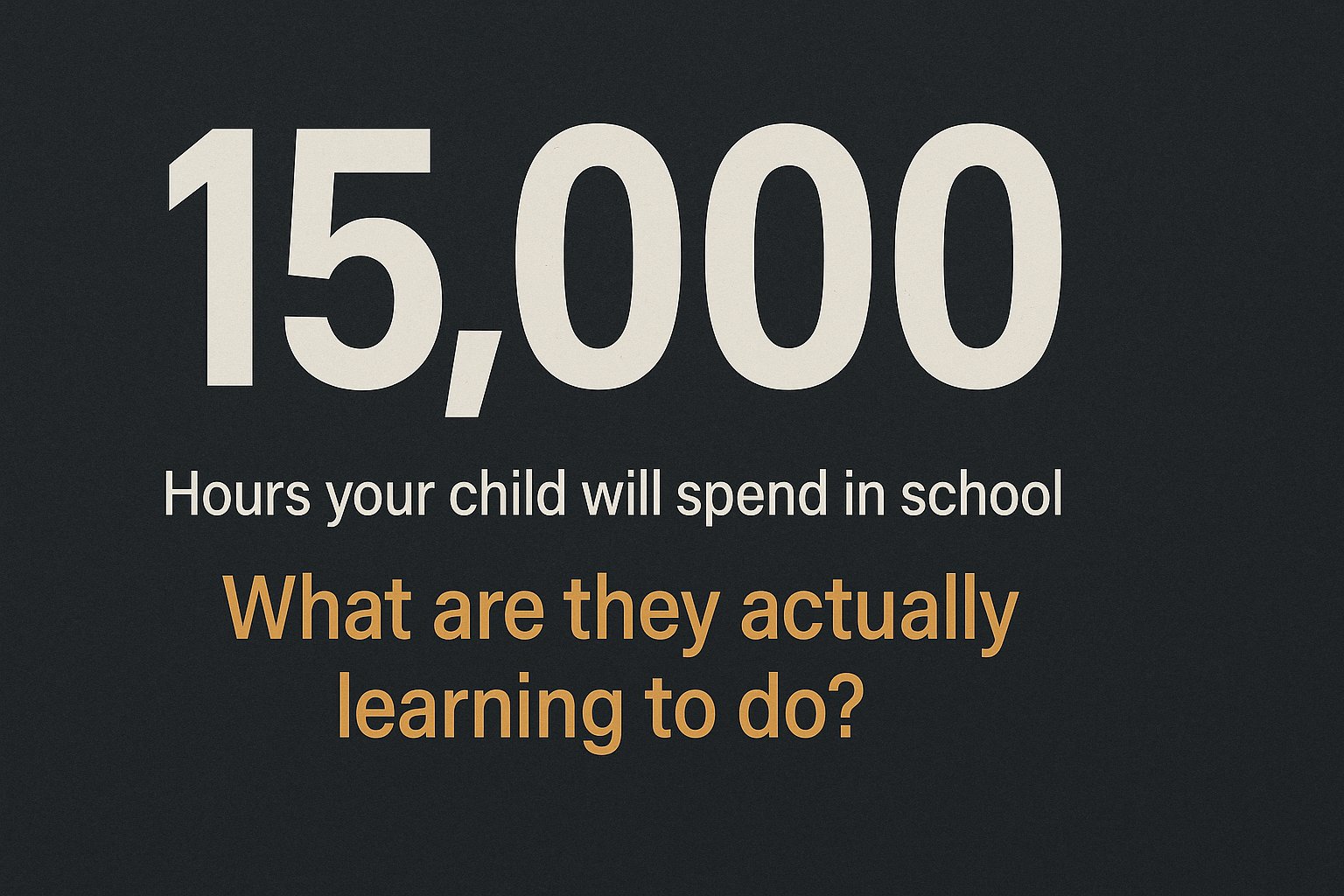
Your child will spend roughly 15,000 hours inside a school building between kindergarten and graduation. That is more time than most adults spend at a first career. It is more time than it takes to become a licensed pilot, a certified electrician, or a conversational speaker of Mandarin. And for the vast majority of students moving through the traditional K-12 system right now, those hours will produce something specific: a transcript, a test score, and a diploma that certifies they sat still and complied.
Not a business they launched. Not a team they led. Not a problem they solved without a teacher telling them the answer first.
If you are a parent who has felt that quiet, persistent unease about what your child is actually getting from school. You are not wrong. The feeling is not anxiety. It is pattern recognition. And if you are searching for a private K-12 school, a learning center, or an alternative K-12 education in Laguna Hills or anywhere in Orange County that takes this question seriously, this article is for you.
The 15,000-Hour Problem Nobody Is Talking About
The statistic is not dramatic for effect. The National Center for Education Statistics estimates that the average American student accumulates between 13,000 and 15,000 instructional hours across thirteen years of K-12 schooling. That number is enormous. It represents the majority of a child's waking hours during the most neurologically plastic, identity-forming, habit-building period of their life.
Now ask yourself: what does the traditional model do with those hours?
It asks students to receive. To absorb a curriculum designed by committees, tested by standardized instruments, and delivered in age-segregated cohorts where the pace is set by the slowest acceptable rate of progress. The implicit message, repeated every single day for thirteen years, is this: your job is to learn what we have already decided matters, demonstrate it on our schedule, and wait for permission to move forward.
This is not a criticism of teachers, who are often extraordinary people working inside a deeply constrained system. It is a structural observation. The industrial-era school model was designed to produce compliant, literate workers for a manufacturing economy. That economy is gone. The compliance-and-recall model remains.
Parents who are now searching for school choice and ESA options in California, exploring microschool alternatives in Orange County, or researching entrepreneurship education for kids are not being contrarian. They are being accurate. They have looked at the model and recognized that it is optimized for the wrong outcomes.
What the Research on Real-World Readiness Actually Shows
A 2019 survey by the Association of American Colleges and Universities found a striking gap between what employers say graduates need and what graduates demonstrate. Employers ranked critical thinking, communication, and the ability to apply knowledge to real-world problems as their top three hiring criteria. Fewer than half of recent graduates were rated proficient in any of them by their employers. Even graduates from selective institutions.
This is not a college-prep failure. It is a K-12 pipeline failure. The habits of mind that produce real-world readiness. Initiative, persuasion, iteration, leadership under uncertainty. Are not built in a single capstone class senior year. They are built over years of practice, starting young, in environments that require students to actually do things rather than merely study them.
Entrepreneurship education for kids is not, in this light, a luxury enrichment program for future tech founders. It is the most direct available answer to the question every employer, every admissions officer, and every parent is quietly asking: does this young person know how to build something, lead someone, and communicate under pressure?
The answer, for most graduates of traditional schooling, is no. Not because they are not capable. Because they were never asked to try.
What a Learner-Driven Model Actually Does Differently
Wonderstorm Academy is a private K-12 micro-school in Laguna Hills, California, serving children ages 4 through 18. It is not a tutoring center, not a homeschool co-op, and not an online learning platform. It is a full-time, on-site campus school built around a fundamentally different premise: that children are the heroes of their own educational journey, and that adults serve as guides rather than authorities who dispense information and grade compliance.
The curriculum is organized around three interlocking lenses that run through every year of the K-12 experience: Leadership, Entrepreneurship, and Powerful Communication. These are not electives. They are not Friday afternoon enrichment blocks. They are the architecture of every project, every challenge, and every real-world experience the school designs for its students.
What does that look like in practice?
A seven-year-old at Wonderstorm is not filling out a worksheet about community helpers. She is designing a product, setting a price, and preparing to sell it at a Kid's Market event in front of a live community audience. A twelve-year-old is not writing a five-paragraph essay about a historical event and filing it in a binder. He is building an argument, presenting it to peers who will push back, and iterating based on what landed and what did not. A sixteen-year-old is not shadowing an adult in a career exploration program. She is completing a real-world apprenticeship that produces an actual outcome for an actual stakeholder.
This is what alternative K-12 education in Laguna Hills looks like when it is taken seriously as a full replacement for the traditional model, not a supplement to it.
Why Orange County Parents Are Rethinking School Choice Now
The timing of this conversation matters. Orange County public school enrollment fell approximately 1.7 percent in the 2025-26 school year, continuing a multi-year decline. Families are not simply moving away. They are leaving the default track by choice. And the search volume for terms like microschool Orange County, private school alternatives, and school choice ESA California has been climbing steadily.
The macro forces driving this are not mysterious. The pandemic exposed the fragility of systems built on passive compliance. The AI revolution has made it viscerally clear to any parent paying attention that the jobs their children will compete for will not reward memorization or rule-following. What they will reward. What they will require. Are exactly the skills that most traditional schools treat as extracurricular: leadership, creativity, persuasion, the ability to build something from a blank page.
At the same time, a new competitive landscape is emerging in Orange County's private K-12 market. Schools are marketing personalized learning and real-world skills with increasing frequency. The language is becoming common. What remains rare is a school that has built its entire academic architecture around these outcomes from age four through graduation, inside a genuinely small and intentional community, backed by a nationally validated framework.
Wonderstorm Academy is part of the Apogee Strong micro-school network, described as a leading model of K-12 innovation in the United States, and aligned with the same learner-driven philosophy that has produced documented outcomes across campuses nationwide. This is not a local experiment. It is a proven model delivered with local roots and founder-level care.
The Objection Every Intentional Parent Carries
Here is the fear that lives underneath every conversation about alternative education: what about college?
It is the right question, and it deserves a direct answer rather than a pivot to feel-good language about self-discovery.
Learner-driven micro-schools produce students who are, in documented patterns across the Apogee Strong and affiliated networks, academically competitive and often significantly ahead of grade-level benchmarks in core subjects. This is counterintuitive only if you believe that passive instruction is the most efficient path to academic mastery. It is not. Intrinsic motivation, which is the engine that learner-driven models build deliberately, produces faster and deeper learning than external pressure and rote repetition. Students who want to learn because learning serves goals they have chosen for themselves outlearn students who are learning to satisfy a requirement.
Beyond academics, the profile that selective universities say they are looking for. Initiative, leadership, independent thinking, a portfolio of real accomplishments rather than just grades. Is precisely the profile that a school like Wonderstorm is designed to produce. Entrepreneurship education for kids is not a detour from college readiness. For the coming generation, it is the most direct path to it.
One parent, Lindsey Jaleh, described her daughter's year at Wonderstorm this way: 'She is confident, engaged, joyful, and genuinely loves going to school. Watching her thrive has been emotional for my husband and me because she feels truly seen, respected, and valued for who she is. Not expected to fit into a predetermined mold.' Another family, the Hoefers, enrolled multiple generations and reported that a daughter who arrived with an IEP and significant educational trauma not only restored her love of learning but completed four college courses through dual enrollment at Saddleback College as a tenth grader and will finish all high school requirements a full year early.
These are not outliers. They are what happens when a school is built around the actual developmental needs of actual children rather than the administrative convenience of a system designed for scale.
The Three Lenses That Change Everything
It is worth being specific about what the three core lenses at Wonderstorm Academy actually produce, because the language of leadership, entrepreneurship, and communication can sound abstract until you see it rendered in daily practice.
Leadership at Wonderstorm is not a class about famous leaders. It is a daily practice of making decisions, owning outcomes, serving a team, and developing the character habits. Integrity, initiative, accountability. That make a person someone others want to follow. Students lead projects. They mediate conflicts. They hold themselves and their peers to standards they helped create.
Entrepreneurship is not a unit on business concepts. It is the recurring experience of identifying a problem, designing a solution, building something real, testing it in front of an audience that has not been told to be kind, and iterating based on honest feedback. The Kid's Market is the most visible expression of this, but it runs through the entire curriculum as a way of thinking, not just a calendar event.
Powerful Communication is not public speaking class. It is the sustained development of the ability to persuade, to listen with precision, to write with clarity, and to hold a room. Skills that the modern economy rewards at every level and that traditional schooling rarely teaches with any rigor below the college level.
These three lenses, woven through core academics from kindergarten through twelfth grade, produce a graduate who is categorically different from what the traditional model produces. Not just smarter. Not just better-tested. Different in kind: a self-directed person who knows how to build things, lead people, and communicate ideas with force and clarity.
What the Next Step Actually Looks Like
If you have read this far, you already know something is not working in the school your child is currently attending. You have probably known it for a while. The question is not whether the traditional model is failing your child's potential. The question is what you are going to do about it before more of those 15,000 hours pass.
Wonderstorm Academy's enrollment process is designed for families who take this decision seriously. It begins with a conversation, not a form. A call to understand your child, your family's values, and whether the Wonderstorm model is genuinely the right fit. Then a campus tour. Because words do not do it justice, and you need to see a room full of engaged, self-directed young leaders in action before you can fully believe it exists in Laguna Hills, California.
The school is intentionally small. Cohort sizes are limited by design, because every child here deserves to be known, challenged, and developed as an individual, not managed as a number. Fall 2026-2027 enrollment is open now, and spots are finite.
If you are a family in Orange County searching for a private K-12 school, a learning center, or a genuine alternative to the traditional system. One that takes Leadership, Entrepreneurship, and Powerful Communication seriously as the core of what education should produce. Wonderstorm Academy was built for this exact moment.
Book a call. Come see what 15,000 hours can actually build.
Book your family's call at Wonderstorm Academy today. Visit the campus. Meet the guides. Watch what a learner-driven education looks like when it is done with conviction.
David Yarbrough
Co-Founder
Dave Yarbrough is the founder of Wonderstorm Academy, a devoted husband and father of six, and a lifelong student of human potential. For more than 25 years, he has explored how education can help children flourish intellectually, socially, and personally. His vision is to create a new model of learning that expands what is possible for children and for education as a whole. Dave holds a Bachelor of Arts in Philosophy from UC Santa Barbara.
More from David Yarbrough →