15,000 Hours: What Are They Actually Building?
Your child will spend roughly 15,000 hours in a K-12 classroom. That number is not a metaphor. It is the actual count. And the question that number demands. What those hours are producing. Is one that almost no school in South Orange County is designed to answer honestly.
The Number That Changes Everything
The National Center for Education Statistics puts the average American student's total K-12 instructional time somewhere between 13,000 and 15,000 hours. Some analyses of school days and instructional minutes land at roughly 15,210 hours from kindergarten through 12th grade. However you count it, the number is enormous. It represents more time than most professionals spend reaching genuine expertise in a complex field.
And yet the standard outcome of those hours. In public schools, in expensive private schools, in college-prep academies behind gates. Is a young adult who can recall information under test conditions, follow structured instructions, and wait for the next set of directions.
"The average K-12 student spends roughly 15,000 hours in school yet graduates without knowing how to lead a meeting, pitch an idea, or solve an unscripted problem."
That is not a condemnation of every teacher or every family who chose a conventional path. Many children thrive in traditional environments. But for the growing number of parents in Laguna Hills, Mission Viejo, Laguna Niguel, and across South Orange County who feel something is fundamentally misaligned. Who watch their bright, curious child lose something year by year. The question of what those hours are actually building deserves a real answer.
What Deliberate Practice Actually Produces
In the early 1990s, psychologist K. Anders Ericsson published research on elite violinists that would eventually reshape how the world thinks about expertise. His finding was specific: the top performers had accumulated roughly 10,000 hours of deliberate practice by age 20. Not passive exposure. Not repetition for its own sake. Deliberate practice: goal-directed, feedback-rich, progressively more demanding work toward real mastery.
Malcolm Gladwell later popularized this as the "10,000 hour rule" in Outliers, but Ericsson himself pushed back. The number, he clarified, was an average, not a threshold. More importantly, the quality of the practice mattered far more than the quantity. Hours spent going through motions. Drilling without understanding, repeating without feedback, performing for an evaluator rather than building toward a genuine capability. Do not compound into mastery. They compound into habit.
This distinction is the entire argument for a different kind of school.
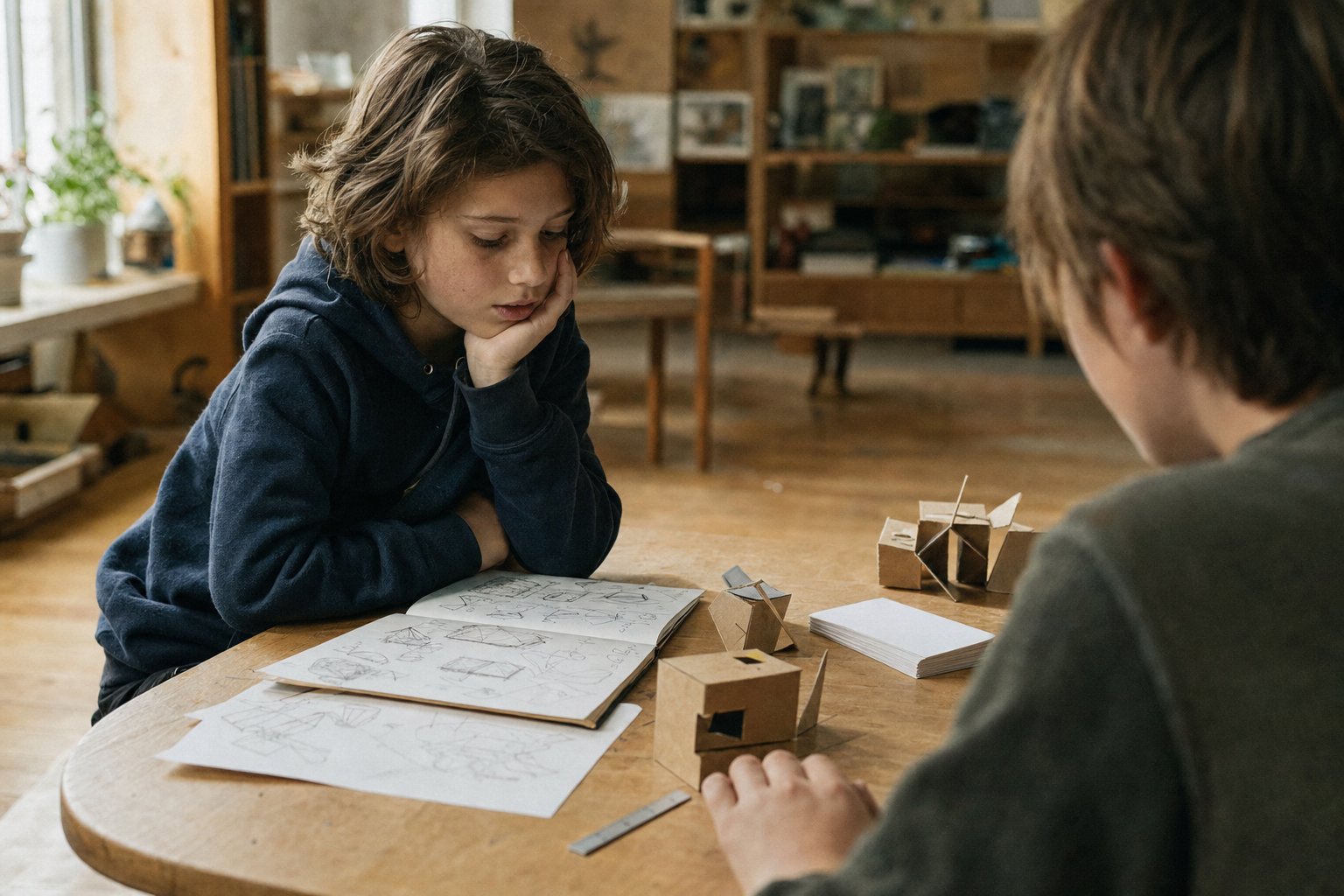
If a child spends 15,000 hours in an environment designed around deliberate practice. Where every hour is goal-directed, feedback-rich, and tied to a real capability being built. Those hours produce something qualitatively different from what conventional schooling produces. Not just more knowledge. A different kind of person.
The Architecture of Wasted Hours
Conventional schooling. Including the most selective and expensive private schools. Is built around a model that educational researchers sometimes call rote learning: the acquisition of information through repetition, without deep understanding of the underlying principles. You memorize facts, dates, and formulas until you can reproduce them on a standardized test. Then the test passes and most of it fades.
This is not a criticism invented by alternative educators. It is a structural feature of a system optimized for measurable, uniform outputs across large populations. Age-segregated classes, teacher-directed lectures, fixed curricula tied to state standards, and uniform pacing based on the calendar rather than individual readiness. These are the mechanics of a system that was designed for a different century and a different economy.
The practical consequence: a child who has spent 13 years in that system arrives at adulthood having accumulated an enormous number of hours and a surprisingly thin set of capabilities. They may have excellent grades. They may have a strong transcript. They are often, genuinely, still waiting to be told what to do next.
For families exploring alternative K-12 education in Laguna Hills and across South Orange County, this gap between hours spent and capability built is the central problem. Not the teachers. Not the individual schools. The architecture.
What 15,000 Hours Can Build Instead
Wonderstorm Academy is a private K-12 micro-school in Laguna Hills built on a single premise: that the 15,000 hours a child spends in school should function like 15,000 hours of deliberate practice toward mastery, not like 15,000 hours of passive seat time.
The three capabilities that Wonderstorm organizes every hour around are Leadership, Entrepreneurship, and Powerful Communication. These are not electives. They are not extracurricular add-ons offered after the real curriculum ends. They are the lenses through which every academic subject. Reading, writing, mathematics, science, history. Is taught and learned.
"These three things. How they communicate, how they lead themselves, how they create value. Are what will actually determine the shape of their life. Every intelligent parent knows this. No school, other than Wonderstorm Academy, is built around it."
A student does not just study history at Wonderstorm. They step into the shoes of the most consequential figures at the most critical decision points in history, research the competing pressures those figures faced, and defend a position in Socratic debate. A student does not just learn mathematics in the abstract. They launch a real business, price a real product, track their own margins, and watch a bad number eat their profit. The mathematics becomes impossible to forget because it was never abstract to begin with.
This is what the deliberate practice framework actually requires: work that is goal-directed, tied to a real outcome, and immediately connected to feedback. Not feedback from a grade weeks later. Feedback from the room, from the customer, from the result.
Families from Aliso Viejo, Rancho Santa Margarita, Lake Forest, San Juan Capistrano, Dana Point, San Clemente, Laguna Beach, Newport Coast, Coto de Caza, Las Flores, Trabuco Canyon, Ladera Ranch, and Portola Hills choose Wonderstorm not because they are opposed to academic rigor. They choose it because they want the rigor to produce something real.
The Three Lenses and Why They Compound
The reason the Leadership, Entrepreneurship, and Powerful Communication framework is so effective is that these three capabilities are genuinely self-reinforcing. A child who learns to communicate persuasively becomes a more effective leader. A child who builds a real business develops a concrete understanding of what leadership actually requires. A child who has led something with real stakes becomes a fundamentally more confident communicator.
In communication, Wonderstorm students master public speaking, persuasion, charisma, and social calibration through real-world in-field training, social calibration exercises, and Socratic debate. They learn to read a room and adjust in real time. They practice influencing outcomes rather than simply reporting information.
In leadership, they build the internal architecture that conventional schooling systematically neglects: self-awareness, goal-setting, follow-through, grit, adaptability, and decision-making under uncertainty. Leadership at Wonderstorm is developed through real responsibility with real stakes. Older students mentoring and leading younger ones. Not through simulated exercises.
In entrepreneurship, students learn to identify real problems that people will pay to have solved, build real products, launch real businesses, understand pricing and margin, write copy that actually sells, and chart a path toward financial self-sufficiency. A student who has priced a product, tracked their own margins, and watched a bad number eat their profit understands percentages in a way no worksheet can produce.
These are the meta-skills. The five academic subjects. Reading, writing, mathematics, science, history. Are the raw material. The lenses are the curriculum.
The Two Versions of Your Child at Nineteen
There is a version of your child at nineteen who walks into a room and owns it. Who has already built multiple businesses. Who doesn't wait to be told. Who can hold a room, change what people think, and solve an unscripted problem with the ease of someone who has done it hundreds of times.
And there is a version who has excellent grades and is still waiting for permission or instruction from someone to know what to do.
The difference is not potential. Both versions of that child are equally capable. The difference is what the last 13 years were actually organized around.
Wonderstorm is a student-led education environment that operates as a full-time, on-site private school. Not a homeschool program, not an online alternative, not a hybrid arrangement. It is a real campus, a real community, and a real daily environment where children from South Orange County ages 5 through 18 spend their school hours doing something that compounds into genuine capability.
For parents who have been searching for a learning center, a private school, a project-based elementary school, or a Montessori school in South Orange County that takes this question seriously. The question of what those 15,000 hours are actually building. Wonderstorm is the answer that was built for exactly that question.
Small class sizes mean every child is known, challenged, and coached as an individual. Mixed-age learning means older students lead and younger students watch what leadership actually looks like. A customized curriculum means the pace is set by mastery, not by the calendar.
The hours are going to pass either way. The only question is what they build.
Start the Conversation
If you are a parent in Laguna Hills, Mission Viejo, Laguna Niguel, Aliso Viejo, Rancho Santa Margarita, Lake Forest, San Juan Capistrano, Dana Point, San Clemente, Laguna Beach, Newport Coast, Coto de Caza, Las Flores, Trabuco Canyon, Ladera Ranch, or Portola Hills, and this question has been sitting with you. The question of what your child's school hours are actually producing. The next step is a conversation.
Not a brochure. Not a website. A real conversation about whether Wonderstorm is the right fit for your family.
Book a Call to See If Wonderstorm Is Right for Your Family
Research sources1
Live web research informed this article. These are the sources it drew on.
- Deliberate Practice and Proposed Limits on the Effects of ...frontiersin.org2019-10-25