15,000 Hours: What Did Your Child Actually Build?
By the time your child walks across a graduation stage, they will have spent roughly 15,000 hours inside a school building. That number is not a metaphor. It is a life. And if you cannot name a single thing they built, led, or solved during those years, it is worth asking what those hours were actually for.
The Hours Are Real. The Question Is Harder.
Fifteen thousand hours is more time than most adults have spent at any single job. It is more than enough time to become genuinely competent at almost anything. A language, an instrument, a craft, a business. Researchers who study expertise estimate that deep mastery of a complex skill requires somewhere between 1,000 and 10,000 hours of deliberate, engaged practice. Your child gets fifteen times the lower bound and still, in most cases, graduates without a portfolio, a project, or a single real-world problem they can point to and say: I solved that.
This is not a criticism of teachers, most of whom are doing something genuinely difficult inside a system that was not designed for the world your child is about to enter. It is a structural observation. The traditional K–12 model was built in the industrial era to produce reliable workers. People who could follow instructions, sit still, and perform on command. That model has not fundamentally changed in over a century. The world it was designed for has.
The traditional K–12 model was built to produce reliable workers. Your child is going to need to be something else entirely.
For intentional, values-driven parents in Orange County who are already asking hard questions about private school choices and alternative K–12 education in Laguna Hills, this structural gap is not news. You have felt it. You have watched a bright, curious child come home deflated, bored, or anxious. And sensed that the problem was not your child. This article is for you. It is a practical look at what those 15,000 hours could produce instead, and what a genuinely different model. One organized around Leadership, Entrepreneurship, and Powerful Communication. Actually looks like in practice.
What the Research Actually Says About Skill Development
The science of learning has advanced dramatically since the last major redesign of the K–12 curriculum. Cognitive scientists now have strong consensus on several principles that most traditional classrooms violate daily.
First, passive reception does not produce durable knowledge. When students sit and listen, they retain a fraction of what is delivered. When they apply, create, defend, and iterate. When they do something with information. Retention and genuine understanding compound. Project-based learning environments, where students tackle real problems with real stakes, consistently outperform lecture-based instruction on measures of both retention and transfer. The ability to apply knowledge in new contexts.
Second, intrinsic motivation is the most powerful driver of learning, and it is also the first casualty of a compliance-based school culture. Children arrive at school naturally curious. They ask relentless questions. They build things, test things, and repeat. A system that rewards sitting still and penalizes wrong answers trains that curiosity out of them, sometimes permanently.
Third, the skills that predict life outcomes. Communication, leadership, the ability to collaborate and adapt under uncertainty. Are not soft. They are the hardest skills to develop and the most durable once built. They also cannot be transmitted through a textbook. They require practice in real conditions, with real feedback, in front of real people.
This is the research foundation behind the learner-driven, project-based model that schools like Wonderstorm Academy in Laguna Hills have built their entire curriculum around. It is not an experiment. It is the application of what we already know works. Applied consistently, from age four through twelfth grade.
What Entrepreneurship Education for Kids Actually Looks Like
When most parents hear the phrase entrepreneurship education for kids, they picture a high school elective where teenagers write a business plan that no one reads. That is not what we are talking about.
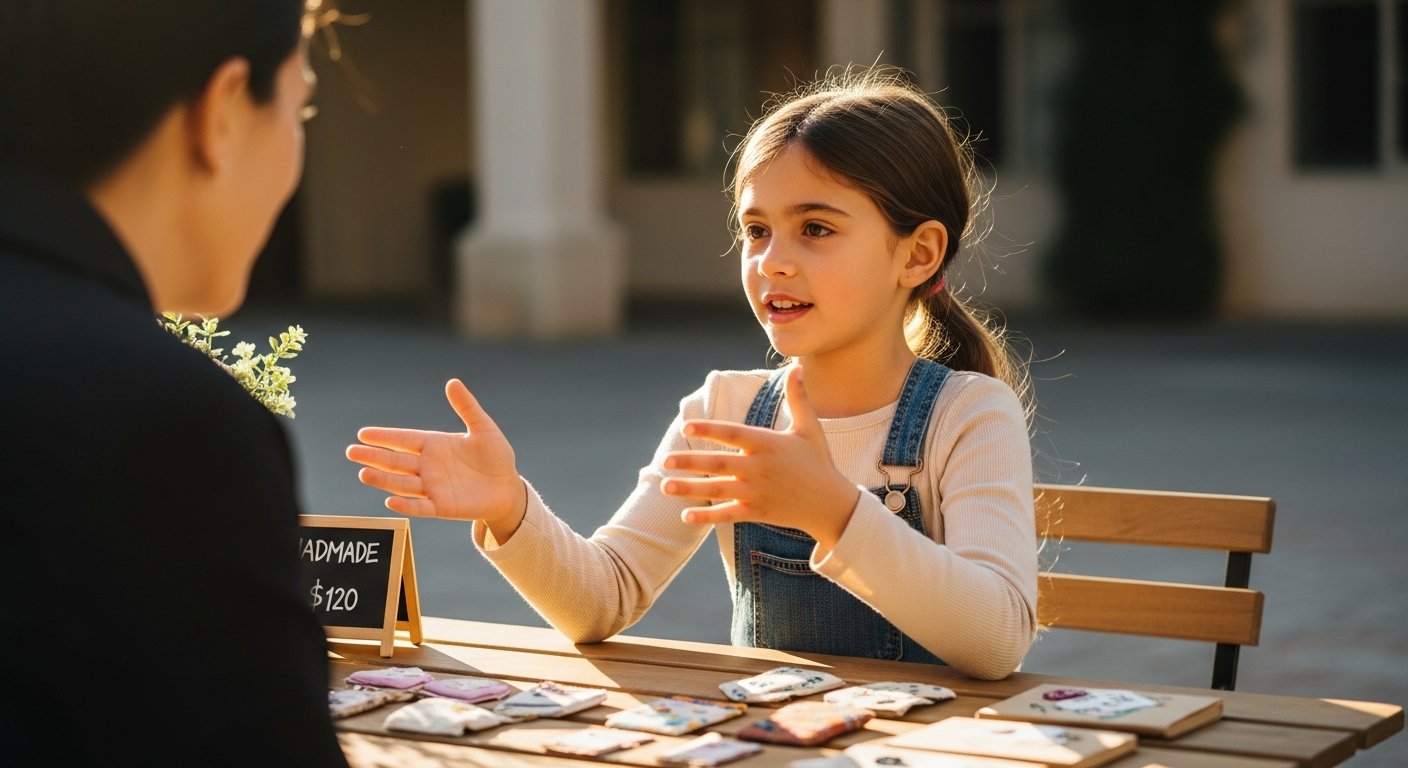
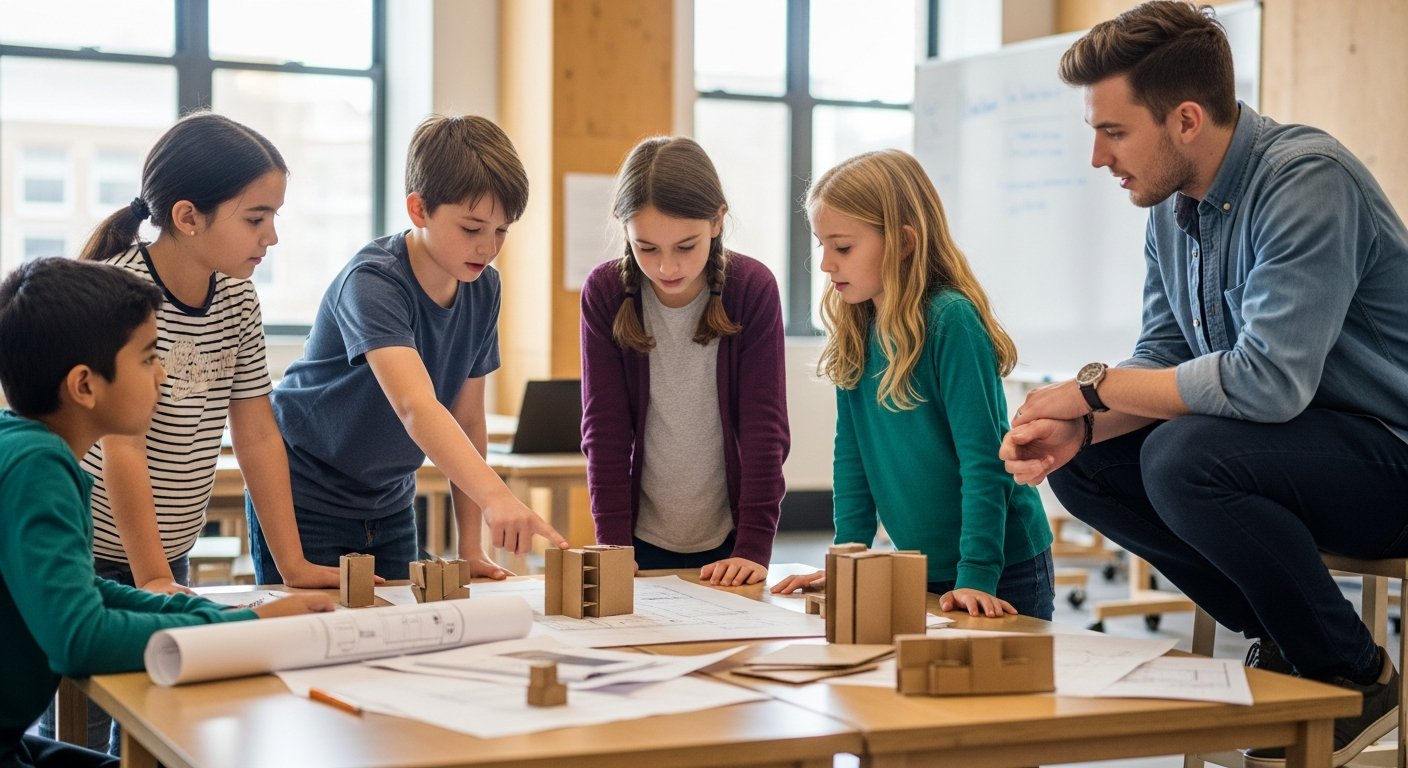
Real entrepreneurship education. The kind embedded as a daily lens from early childhood. Looks like a seven-year-old who has designed a product, set a price, made a sign, and is now standing behind a table at a community marketplace explaining to a stranger why they should buy it. It looks like a ten-year-old who has run a team meeting, hit a deadline, and iterated on a prototype after customer feedback told them the first version did not work. It looks like a fifteen-year-old who has completed a real-world apprenticeship with a local professional and can speak specifically about what they learned, what they got wrong, and what they would do differently.
This is not play. It is the same cognitive and character work that founders, executives, and leaders do every day. Scaled to age and delivered with the scaffolding that children need to succeed at it. The difference between a school that offers entrepreneurship as an elective and one that embeds Leadership, Entrepreneurship, and Powerful Communication as its three organizing lenses is the difference between a garnish and a meal.
Entrepreneurship embedded from age four is not a program. It is the architecture of how the entire school thinks about what children are capable of.
For families considering a microschool in Orange County or exploring alternative K–12 education in Laguna Hills, the question to ask any school is not whether they offer entrepreneurship. It is whether entrepreneurship is structural. Whether it shapes how every subject is taught, how every project is designed, and how every student is evaluated. At a learning center built around this model, a student's growth is measured not by their score on a standardized test but by what they have built, what they have led, and how clearly they can communicate both.
The Leadership Gap No One Talks About
Leadership is perhaps the most chronically undertaught skill in the K–12 system. Not because educators do not value it, but because the traditional classroom structure makes it structurally impossible to practice.
You cannot learn to lead from a desk. Leadership is relational, situational, and earned through repeated cycles of responsibility, failure, feedback, and growth. It requires being given real authority over real outcomes and then living with the consequences. A student government election is not leadership development. A class president who has no actual power over anything is not a leader in training. They are a title.
A private K–12 school that takes leadership seriously creates conditions where students run things. Where they design their own learning goals, hold each other accountable through peer governance, lead projects with external stakeholders, and develop the kind of phronesis. Practical wisdom, the capacity to make good decisions in complex, ambiguous situations. That no standardized test can measure but every employer, partner, and community desperately needs.
The school choice conversation in California, including growing interest in ESA California funding mechanisms, is increasingly being driven by parents who recognize this gap. They are not leaving traditional schooling because it is academically weak. Many are leaving because it is character-weak. Because it produces compliant students who are technically proficient and emotionally underprepared for the actual demands of adult life.
Why Communication Is the Third Pillar. And Why Most Schools Miss It
Powerful Communication is the third lens in Wonderstorm Academy's curriculum, and it is worth examining separately because it is the most consistently underestimated skill in education.
Communication is not grammar. It is not a five-paragraph essay. It is the ability to stand in front of a room, or a camera, or a difficult conversation, and articulate your thinking with clarity, confidence, and conviction. It is the ability to listen well enough to understand what someone actually needs before you respond. It is the ability to write in a way that moves people. Not just informs them.
These capacities are built through practice in high-stakes, real-audience conditions. A student who has pitched their business idea to actual community members, defended their project to a panel of adults who asked hard questions, and written proposals that real people read and responded to has developed communication competencies that four years of English class cannot replicate.
For the families in Orange County who are evaluating private school options and wondering whether a micro-school can match the academic rigor of a traditional institution, the answer is yes. And the communication development alone justifies the comparison. A student who can think clearly, speak confidently, and write persuasively is more prepared for college, career, and citizenship than one who has simply accumulated AP credits.
What a Different Model Produces
The proof of any educational model is not its curriculum document. It is what students can do when they leave.
Elizabeth Hoefer, a Wonderstorm family whose children and grandchildren have all attended the school, describes her middle daughter's journey this way: she entered after sixth grade carrying significant educational trauma from the public school system, and left as a tenth grader who had completed four college courses through a dual enrollment program at Saddleback College. An entire year ahead of her peers. Her youngest daughter is a year ahead going into seventh grade and is, in Elizabeth's words, a very thoughtful leader in her peer group.
Lindsey Jaleh, whose daughter has attended for a year, put it this way: nearly a year later, the transformation has been incredible. She is confident, engaged, joyful, and genuinely loves going to school. Watching her thrive has been emotional for my husband and me because she feels truly seen, respected, and valued for who she is. Not expected to fit into a predetermined mold.
These are not testimonials about test scores. They are descriptions of human transformation. The kind that happens when a school is organized around who a child is becoming, not what a child can memorize.
Wonderstorm Academy operates within the Apogee Strong network, recognized as a leading model of K–12 innovation in the United States, and is aligned with the nationally validated learner-driven framework that has produced documented results across dozens of campuses. This is not a local experiment. It is a proven architecture, delivered by a founder-led team that has their own children enrolled. Which tells you everything about how much they believe in what they have built.
The 15,000-Hour Decision Is Yours
Here is the honest framing: your child's 15,000 hours of schooling are going to be spent somewhere, building something. Or not. The question is not whether you can afford a private K–12 school in Laguna Hills or a microschool in Orange County. The question is what you believe those 15,000 hours are for.
If you believe they are for producing a transcript and a test score, the traditional system will serve you adequately. If you believe they are for producing a human being who can lead, communicate, build, and adapt in a world that none of us can fully predict. Then you already know the answer.
Wonderstorm Academy was built for the second belief. Their curriculum is not a supplement to real education. It is real education. Organized around Leadership, Entrepreneurship, and Powerful Communication, delivered through hands-on projects, Life Skills Labs, and real-world apprenticeships, inside a small and intentional community where every child is genuinely known.
If you are an intentional parent in Orange County who has been sensing that the default path is not right for your child. You are not wrong. The next step is simple. Come see it for yourself.
Book a campus tour at Wonderstorm Academy in Laguna Hills. Walk the campus, meet the guides, watch learners in action, and decide with your own eyes. Spots are limited, and fall 2026 enrollment is open now.
David Yarbrough
Co-Founder
Dave Yarbrough is the founder of Wonderstorm Academy, a devoted husband and father of six, and a lifelong student of human potential. For more than 25 years, he has explored how education can help children flourish intellectually, socially, and personally. His vision is to create a new model of learning that expands what is possible for children and for education as a whole. Dave holds a Bachelor of Arts in Philosophy from UC Santa Barbara.
More from David Yarbrough →