How 10-Year-Olds Run Real Businesses at School
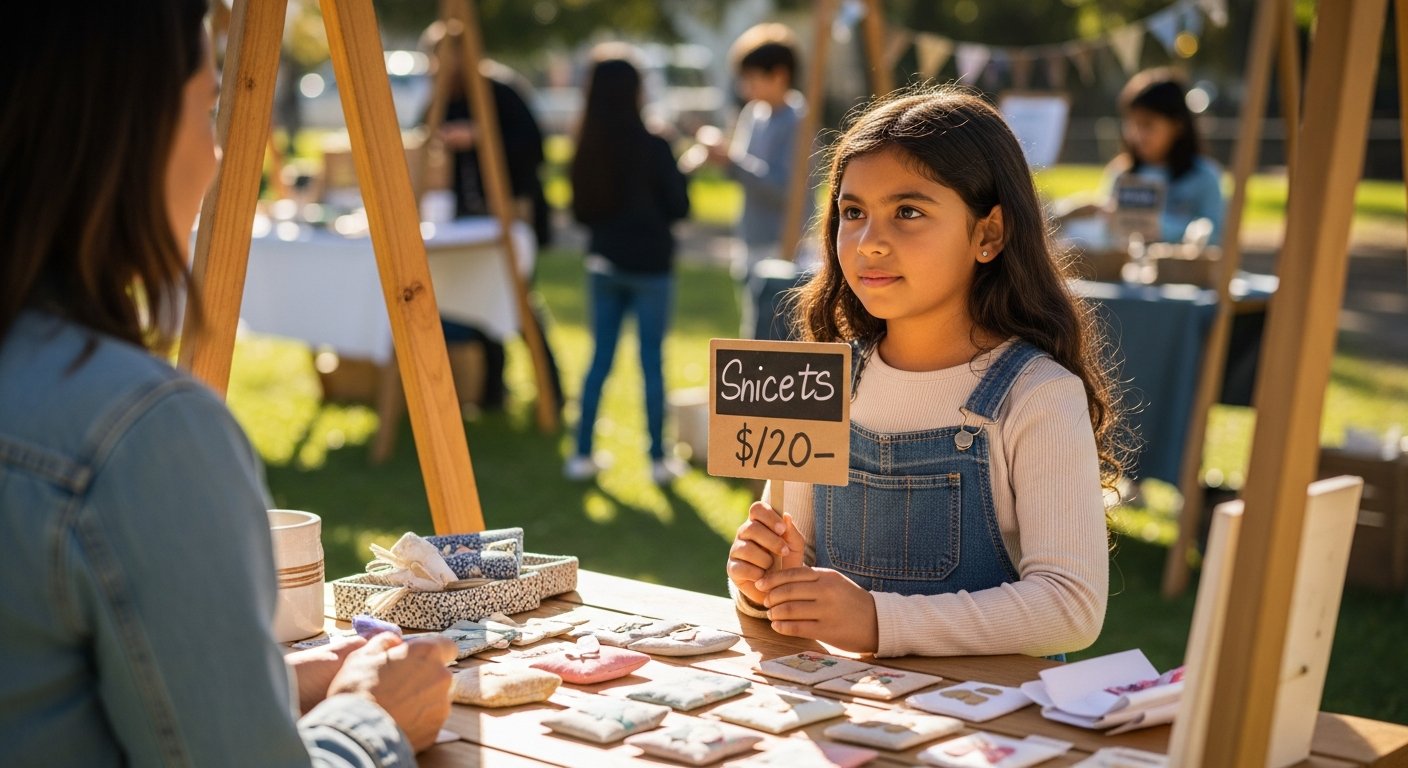
Somewhere in Laguna Hills, a fifth-grader is not doing a worksheet about supply and demand. She is living it. Pricing her product, handling objections from real customers, and counting her revenue at the end of the day. This is not a field trip. This is Tuesday.
The Homework That Actually Matters
Most conversations about entrepreneurship education for kids treat it as a future ambition. Something to aspire to after graduation, after college, after life has handed a young person enough experience to justify the attempt. At Wonderstorm Academy, that premise gets inverted completely.
The question the school's curriculum is built around is not "how do we prepare kids for entrepreneurship someday?" It is "what happens when we put a child in entrepreneurial conditions right now, at age ten, with real stakes and real feedback?"
The answer, repeated across every cohort of learners the school has run, is remarkable: children rise. Not all at once, not without friction, and not without the kind of productive failure that actually builds capability. But they rise.
"Entrepreneurship education for kids is not a program you add to a school. It is the operating system the whole school runs on."
This is the foundational insight behind Wonderstorm's three-lens model. Leadership, Entrepreneurship, and Powerful Communication are not electives layered onto a conventional academic schedule. They are the lenses through which every subject, every project, and every daily interaction is filtered. A 10-year-old learning to run a business is simultaneously practicing math, persuasion, planning, resilience, and self-knowledge. In a single afternoon.
What "Running a Business" Actually Looks Like at Age Ten
The word "entrepreneurship" can mean almost anything, so it is worth being precise about what students at this private K-12 school are actually doing.
The process begins well before any product hits a table. Learners identify a real need. Not a hypothetical one assigned by a teacher, but one they have observed or experienced themselves. They research it. They prototype a solution. They cost it out, set a price, and build a pitch. Then they take it to market.
The Kid's Market is the school's signature proof-of-concept event: a community-facing marketplace where Wonderstorm students operate actual booths, sell actual products, and handle actual transactions with members of the public. There are no participation trophies for showing up. If a product does not sell, the learner finds out why and iterates. If a pitch falls flat, the feedback is immediate and honest.
This is what separates a micro-school model from every conventional alternative K-12 education Laguna Hills families might otherwise consider. The learning is not simulated. The consequences are real, the feedback is real, and the confidence that accumulates from navigating both is permanent.

For parents evaluating private school options in Orange County, this distinction matters enormously. A school can teach a child what a profit margin is. Wonderstorm teaches a child how it feels to earn one, lose one, and engineer a better one next time.
The Three Lenses Working Together
It would be a mistake to treat the entrepreneurship component in isolation. What makes the model coherent. And what makes it produce the outcomes it does. Is the way Leadership, Entrepreneurship, and Powerful Communication operate as an interlocking system rather than three separate programs.
Consider a typical project arc. A learner identifies a product idea and has to pitch it to their studio group before it advances. That pitch requires Powerful Communication: clarity, structure, the ability to anticipate questions and answer them confidently. Once the project is approved, the learner has to organize their own timeline, manage materials, and coordinate with peers. That requires Leadership: self-direction, accountability, the capacity to make decisions without being told what to decide. Then comes the market itself, where Entrepreneurship is the operating framework: pricing, customer interaction, real-time problem-solving, and financial reckoning.
None of these three lenses functions without the other two. And none of them can be taught by lecture. They have to be practiced, repeatedly, in conditions that are just challenging enough to require genuine effort.
This is precisely why families seeking school choice in California. Including those exploring ESA California options to fund non-traditional education. Are drawn to this model. It is not an experiment. It is a structured, rigorous system with a national track record, delivered locally in a community that knows every child by name.
Why This Works for Young Children Specifically
A common objection from parents first encountering this model is that entrepreneurship education for kids sounds compelling for teenagers but seems premature for a nine or ten-year-old. The developmental research, and the lived experience of every family at Wonderstorm, points in the opposite direction.
"The window between ages four and twelve is not too early for entrepreneurial thinking. It is the exact right time, because the habits of agency and initiative form before the habits of compliance and passivity have a chance to calcify."
Children at this age are naturally oriented toward making things, testing ideas, and seeking feedback from the world around them. They are not yet self-conscious about failure in the way older students often are. They pitch ideas with unselfconscious confidence. They iterate without ego. They negotiate with peers and customers with a directness that most adults have to relearn.
What the school does is channel that natural energy into a structured framework that builds real competence. The Life Skills Labs embedded in the curriculum give learners hands-on practice in areas that traditional schooling has never touched: financial literacy, communication under pressure, project management, and the practical mechanics of bringing an idea from conception to execution.
This is not soft-skills programming layered on top of academics. The academics are rigorous. The standards are high. What Wonderstorm adds is the context that makes academic skills meaningful. The reason a child would want to be good at math, writing, and research, because those tools are the instruments of real work they are already doing.
What Parents Notice First
Families who tour the campus. And the campus tour is where the model stops being abstract and becomes undeniable. Consistently report the same first impression: the children are not waiting to be told what to do next.
In a conventional learning center or private school setting, the default posture of a student is receptive. The teacher holds the agenda. The child responds to it. At Wonderstorm, the default posture is initiative. Learners are working on something they chose, toward a deadline they understand, with a standard they helped set.
For parents who have watched their child disengage in a traditional classroom. Who have seen a naturally curious, energetic kid slowly learn to perform compliance instead of actually learning. This sight is genuinely emotional. It is the version of their child they have always known was in there, finally in an environment designed for them.
One parent, Lindsey Jaleh, described it this way after her daughter's first year: "She is confident, engaged, joyful, and genuinely loves going to school. Watching her thrive has been emotional for my husband and me because she feels truly seen, respected, and valued for who she is. Not expected to fit into a predetermined mold."
That transformation is not accidental. It is the designed outcome of a model built around learner sovereignty. The conviction that children who own their education become adults who own their lives.
The Broader Picture: Why OC Families Are Choosing This Path
Orange County's private K-12 market is dense with options, and most of them are competing on the same metrics: test scores, college placement rates, and campus facilities. Wonderstorm is not competing on those terms because it is not playing the same game.
The families who find their way to this school are not looking for a better version of what they already have. They are looking for a fundamentally different answer to the question of what school is for. They are the parents who have already noticed that their child's 15,000 hours of schooling are producing compliance and credential-chasing rather than capability and conviction. They are the parents who want their child to graduate not just academically prepared, but as a self-directed young leader who knows how to build something, lead a team, and communicate with clarity and confidence.
In the current environment. Where AI is reshaping every career path that does not require genuine creativity, leadership, and communication. That is not a niche aspiration. It is a survival skill. And it is exactly what the Apogee Strong network and the model behind Wonderstorm were built to deliver.
For families exploring what alternative K-12 education in Laguna Hills can actually look like, for parents researching school choice ESA California pathways, or for anyone who has typed "microschool Orange County" into a search bar and wondered whether something genuinely different exists in their community. The answer is yes. It exists. And it is already working for the children who are in it.
Come See It For Yourself
No article captures what you will see when you walk onto the Wonderstorm campus and watch a 10-year-old explain their pricing strategy to a customer, or listen to a group of learners run their own project debrief without an adult in the room.
The enrollment process at Wonderstorm begins with a conversation and a campus tour. Not a test, not a waitlist form, not a brochure. It begins with a real look at whether this community is the right fit for your family and your child.
If you have been sensing that the traditional system is not built for the child you are raising, trust that instinct. Book your campus tour today and see what school looks like when children are treated as the leaders they already are.
David Yarbrough
Co-Founder
Dave Yarbrough is the founder of Wonderstorm Academy, a devoted husband and father of six, and a lifelong student of human potential. For more than 25 years, he has explored how education can help children flourish intellectually, socially, and personally. His vision is to create a new model of learning that expands what is possible for children and for education as a whole. Dave holds a Bachelor of Arts in Philosophy from UC Santa Barbara.
More from David Yarbrough →