How to Find a School Where Kids Learn by Doing
Somewhere between the school tour and the enrollment packet, most parents ask the same quiet question: does any of this actually stick? If your child spends 13 years in a classroom and graduates without knowing how to lead a conversation, pitch an idea, or solve a real problem, the hours spent getting there are very hard to recover.
What 'Project-Based Learning' Actually Means
The phrase gets used loosely. A science fair, a group poster presentation, a coding club that meets on Fridays. These are all called project-based learning at various schools, and technically none of them are wrong. But there is a meaningful difference between a school that assigns projects and a school whose entire model is built around them.
Real project-based learning means students are doing work that matters to them, for an audience beyond the teacher, with stakes that feel genuine. It means a child is not just answering a question the curriculum already knows the answer to. They are asking their own questions, running into real obstacles, and figuring out how to move anyway.
"The difference between a school that assigns projects and a school built around them is the difference between a field trip and a field education."
When you are evaluating schools, the most useful question is not whether they offer projects. It is whether the project is the education or the decoration.
What to Actually Look For When You Visit
Most school tours are designed to impress, not to reveal. You will see clean hallways, enthusiastic staff, and a highlight reel of student work. That is fine. But if you want to understand whether a school genuinely delivers on project-based learning, you need to look past the display case.
Ask to see a student's day, not a teacher's lesson plan. What did a specific child choose to work on this morning? Who decided? What happens when they get stuck. Do they raise their hand and wait, or do they navigate it themselves?
Look at how teachers move through the room. In a genuine project-based environment, the adult is not the center of gravity. Students are moving, building, debating, presenting, revising. The teacher is present and purposeful, but they are not the source of all knowledge and direction.
Listen for the word "agency." Schools that truly believe in student-led education use it constantly, because it is the thing they are actually trying to protect. A child's right to make real choices about their own learning is not a feature of the curriculum. It is the curriculum.
The Three Things a Real Project-Based School Builds
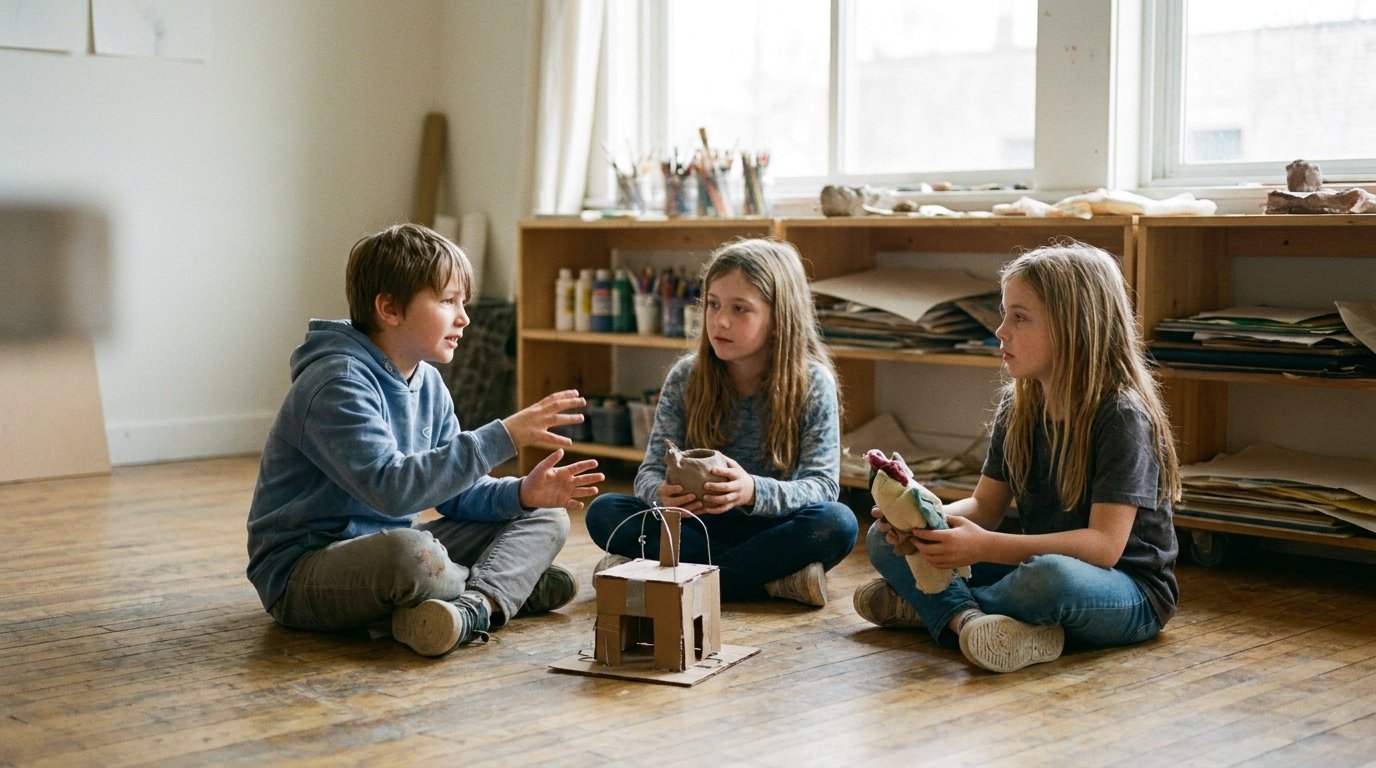
A school built around doing rather than listening develops three things that a traditional classroom model rarely reaches, at least not intentionally.
The first is leadership. Not the kind that gets assigned to a class president, but the everyday kind: the ability to move a group toward a goal, to make a decision under uncertainty, to take responsibility for an outcome. When students run real projects with real consequences, they practice leadership in every session, not once a year at student council.
The second is powerful communication. Presenting work to an actual audience. Not just a teacher who already knows the answer. Teaches children to read a room, to adjust their message, to handle questions they did not anticipate. This is a fundamentally different skill than writing an essay for a grade, and it is one of the most important skills an adult can have.
The third is entrepreneurial thinking. The ability to see a problem, imagine a solution, test it, fail, adjust, and try again. This is not a personality trait. It is a learned capability. And it can only be learned through practice, which means a school has to give students real problems to solve, not simulated ones with predetermined answers.
A school that builds leaders, communicators, and entrepreneurs does not add those things to a curriculum. It makes them the curriculum.
What to Ask Before You Enroll
Once you have found a school that seems genuinely project-based, there are a few questions worth asking directly before you commit.
First: how is academic rigor maintained within a project-based model? A school worth enrolling in will have a clear, confident answer. The best student-led schools do not sacrifice math, reading, or writing. They embed them inside work that gives students a reason to care about getting them right.
Second: what does a student's progression look like over time? Can you see examples of work from a student who has been enrolled for three years versus one who just started? Growth should be visible, specific, and documented.
Third: how are students prepared for life after this school? If the program runs through middle or high school, ask how graduates have fared. Not just college acceptance rates. Though those matter. But what former students are doing, what they are building, who they are becoming.
Fourth: what is the community like? A small school's culture is its most important asset and its hardest thing to fake. The families enrolled, the conversations at pickup, the way the school handles conflict. These things shape your child's experience as much as any curriculum.
Why South Orange County Families Are Finding Wonderstorm Academy
Families in Laguna Hills, Mission Viejo, Aliso Viejo, Dana Point, San Clemente, Rancho Santa Margarita, Laguna Niguel, Lake Forest, San Juan Capistrano, Laguna Beach, Newport Coast, Coto de Caza, Ladera Ranch, Trabuco Canyon, Las Flores, and Portola Hills are increasingly asking the same question this article opens with. And a growing number of them are finding the answer at Wonderstorm Academy.
Wonderstorm is a private K through 12 micro-school on a full, on-site campus at 25332 McIntyre St in Laguna Hills. It is not a hybrid program. It is not a homeschool co-op. It is a full-time, in-person school built entirely around three core lenses: Leadership, Entrepreneurship, and Powerful Communication. These are not electives or enrichment add-ons. They are the organizing framework through which every subject, every project, and every student's growth is understood.
Students at Wonderstorm do not wait to be assigned a project. They pursue work that is genuinely theirs. Guided by a student-led model that has been refined inside a nationally recognized network of schools with a track record of results. From kindergarten through 12th grade, the school serves children across four programs: Sparks for ages 5 to 6, Discovery for ages 7 to 9, Adventure for ages 10 to 12, and Launchpad for ages 13 to 18. The same philosophy runs through all of them: children learn most powerfully when they are trusted to lead their own education, challenged with real problems, and held to genuine standards.
The entrepreneurship curriculum at Wonderstorm is not a once-a-semester simulation. It is woven into the daily experience of being a student there. Children as young as five are building the habits of mind. Curiosity, persistence, resourcefulness, honest self-assessment. That entrepreneurship requires. By the time a Wonderstorm student reaches middle school, they have years of real-world project experience behind them. That is not something a traditional school can replicate by adding a business elective in 10th grade.
The school's enrollment process reflects its community-first philosophy. It begins with a conversation. A call to understand whether the fit is right for your family. Followed by a campus tour that lets you see the model in action rather than just read about it. Families from across South Orange County who have made that visit consistently describe it as the moment the abstract became real.
How to Make the Move If You Are Ready
If you have read this far, you already know something is missing. The question is not whether project-based learning is better for your child. The evidence on that is clear, and your instincts have been telling you the same thing. The question is whether you are willing to act on it.
The families who thrive at schools like Wonderstorm are not the ones who waited for the perfect moment. They are the ones who made a call, took the tour, and trusted what they saw with their own eyes.
January is historically the most common month families switch schools. The fall semester is behind you. You have a clear picture of what this year looks like. If it is not what you wanted for your child, this is the window.
Wonderstorm Academy serves families across South Orange County, from Laguna Hills and Mission Viejo to Dana Point, San Clemente, Aliso Viejo, Rancho Santa Margarita, and beyond. The campus is real, the community is intentional, and the model is built for exactly the child you are trying to raise.
Schedule your campus tour and see project-based learning in action
Frequently Asked Questions
Does project-based learning cover the same academic content as a traditional school? Yes. At a rigorous project-based school, foundational academics. Math, reading, writing, science, history. Are embedded inside real work rather than delivered through passive instruction. The difference is that students engage with academic content because it serves something they are genuinely trying to accomplish, which deepens retention and application. Wonderstorm Academy maintains academic rigor as a non-negotiable alongside its Leadership, Entrepreneurship, and Powerful Communication framework.
How do I know if a school is genuinely project-based or just using the language? Ask to observe a regular school day, not a curated showcase. In a real project-based environment, students are directing their own work, the teacher is facilitating rather than lecturing, and the outcomes of a project are not predetermined. If the school can show you student work that surprised even the teacher, that is a strong signal the model is real.
Is a project-based micro-school socially isolating because of its smaller size? Small schools often produce stronger social outcomes than large ones, because every child is known as an individual rather than managed as a number. At Wonderstorm Academy, the intentional community of enrolled families is a core feature of the model. Students build deep, genuine relationships within a values-aligned peer group, and the school's real-world projects create natural collaboration and communication practice every day.
Will my child be prepared for college and standardized academic benchmarks? This is the most common concern families bring to their first conversation with Wonderstorm, and it deserves a direct answer: yes. A student-led education that builds critical thinking, communication, and self-direction produces students who are better prepared for the demands of higher education, not less. The skills that college and career require. Independent thinking, written and verbal communication, problem-solving under pressure. Are exactly what a project-based model develops intentionally and daily.
How do I take the first step toward enrolling at Wonderstorm Academy? The enrollment journey begins with a call. A genuine conversation to understand your family's situation and whether Wonderstorm is the right fit. From there, you are invited for an in-person campus tour at 25332 McIntyre St in Laguna Hills. There is no pressure and no obligation. The school's process is designed to serve families who are making a serious, values-aligned decision, and that conversation is the best place to start.
Research sources8
Live web research informed this article. These are the sources it drew on.
- FAQs — Wonderstorewonderstore.assortedbitsofwisdom.com
- Rambursare si returwonderstore.ro2023-10-17
- Soluções Inteligentes de Marketing Orgânico & E-commercewonderstores.pt2025-01-01
- Wondershare Help Centersupport.wondershare.com
- Wonder Help Center home pagesupport.wonder.com
- Autodesk Flow Studio Help & Documentation - Getting Started, Tips ...help.wonderdynamics.com2025-07-31
- Securitate si confidentialitatewonderstore.ro2023-10-17
- WONDERSTORE | LinkedInlinkedin.com2024-07-02