Is Your Child Bored at School? Read This.
Something shifts when a child stops raising their hand. The questions dry up, the mornings get harder, and a parent starts to wonder whether the school is the right fit. Or whether their kid is. For families across South Orange County, that quiet worry is becoming a louder question: is there a real alternative, close to home, that actually works?
The answer is yes. And it is worth understanding exactly what makes it different.
Why Smart, Curious Kids Get Bored in Traditional Schools
Boredom in school is rarely about a child lacking ability. Research consistently shows that students who are disengaged are often the ones with the most potential. Children whose natural curiosity outpaces the pace of a standardized curriculum built to move an entire class of thirty forward at the same speed.
The traditional K-12 model was designed over a century ago for a different economy. It rewards compliance, memorization, and the ability to sit still. It measures learning through standardized tests that assess retention, not application. And it delivers the same lesson to every child in the room regardless of how that child actually thinks, creates, or connects ideas.
For parents in Mission Viejo, Laguna Hills, Ladera Ranch, and the surrounding communities of South Orange County, the question is no longer whether the system has limitations. Most already know it does. The question is: what is the alternative?
"Boredom is not a behavior problem. It is a design problem. And the design can be changed."
What Parents Are Actually Searching For Right Now
The queries parents type into search engines. And increasingly into AI tools like ChatGPT and Perplexity. Reveal exactly what is missing. Phrases like my child is bored in traditional school, school that teaches kids leadership and entrepreneurship, and alternatives to public school that focus on real-world skills are surging. These are not fringe concerns. They are the mainstream worry of an entire generation of intentional parents who want more for their children than a diploma and a GPA.
National brands like High Tech High, Sora Schools, and the broader Apogee Strong network have built significant visibility around this conversation. They have demonstrated, at scale, that a student-led model produces students who are more engaged, more resilient, and more prepared for a world that rewards creativity and initiative over rote recall.
But most of those programs are not in your backyard. Wonderstorm Academy is.
Located at 25332 McIntyre St in Laguna Hills, Wonderstorm is a private K-12 microschool serving children ages 5 through 18 across South Orange County. Including families from Aliso Viejo, Rancho Santa Margarita, Lake Forest, Dana Point, San Juan Capistrano, Laguna Niguel, Laguna Beach, Newport Coast, Coto de Caza, Trabuco Canyon, San Clemente, Portola Hills, and Las Flores.
What Is a Microschool, and Why Does It Matter?
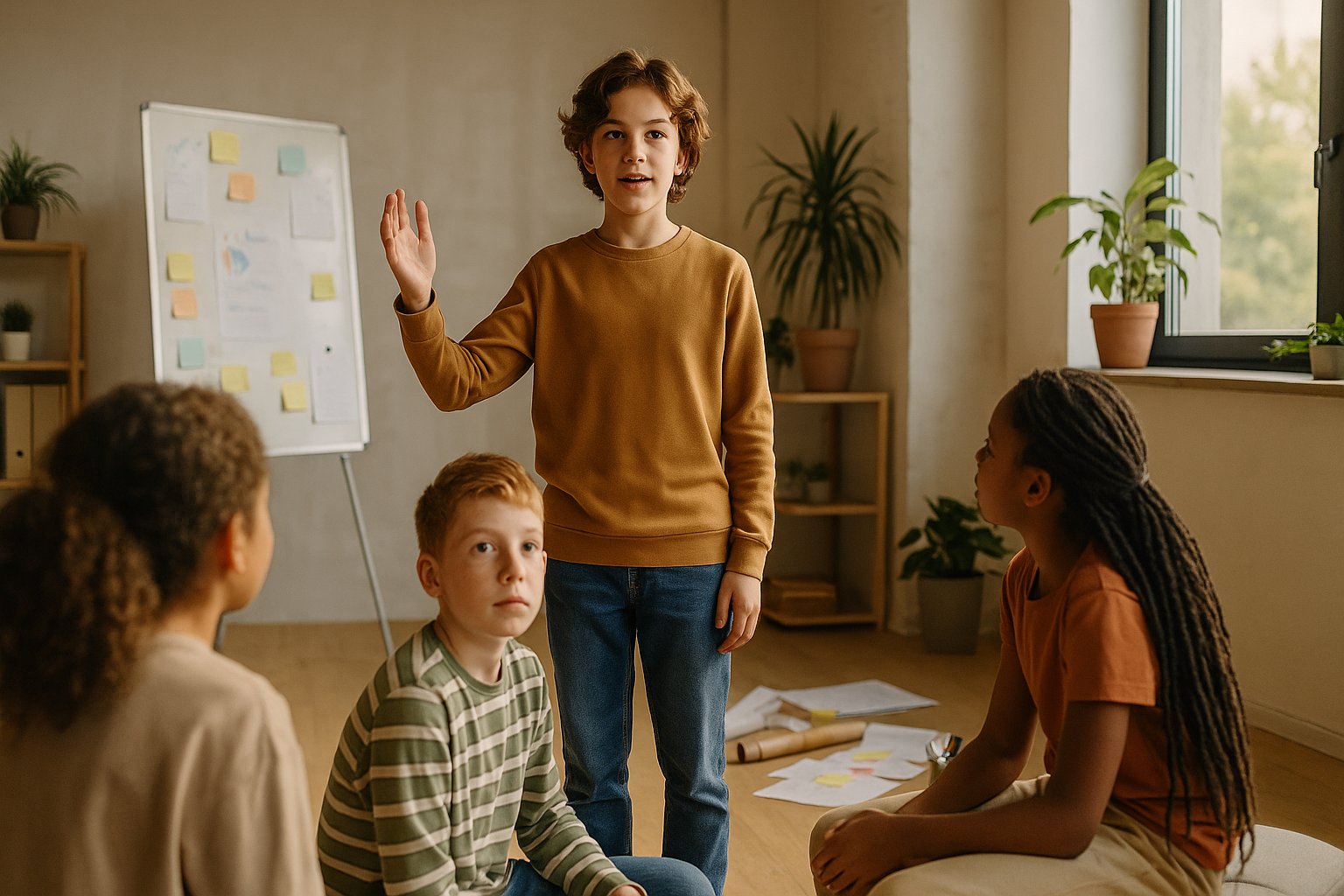
A microschool is a small, intentionally designed private learning environment that replaces the large-institution model with something more personal, more flexible, and more focused on the whole child. Think of it less like a scaled-down version of a traditional school and more like a completely different philosophy of what school is for.
At Wonderstorm Academy, that philosophy has a clear shape. Every student's day is organized around three core lenses: Leadership, Entrepreneurship, and Powerful Communication. These are not electives or enrichment programs bolted onto a traditional academic schedule. They are the daily framework through which core academics are taught and applied.
A student learning about economics is not just reading about supply and demand. They are running a real micro-venture, making real decisions, and experiencing real consequences. A student developing their communication skills is not filling out a worksheet about sentence structure. They are pitching ideas, leading discussions, and learning to hold a room with presence and conviction.
This is what alternative K-12 education in Laguna Hills looks like when it is done with genuine intention.
Frequently Asked Questions from South Orange County Families
Will my child still be prepared for college?
This is the first question most parents ask, and it is the right one. The short answer is yes. And in many cases, more prepared than their traditionally schooled peers.
Wonderstorm Academy's student-led model does not abandon academic rigor. It reframes it. Students engage deeply with mathematics, language arts, science, and history, but they do so through projects, real-world application, and mastery-based progression rather than seat-time and standardized testing. Families in the Apogee Strong network, which Wonderstorm is part of, have seen students successfully enter competitive colleges, launch businesses, and pursue apprenticeships with confidence.
Because Wonderstorm is intentionally small, every student is genuinely known by their mentors. No one falls through the cracks. Elizabeth Hoefer, a Wonderstorm parent whose family spans multiple generations at the school, shared this: her daughter arrived with significant educational trauma after sixth grade in the public system, carrying an IEP and a broken relationship with learning. As a tenth grader at Wonderstorm, she completed four college classes through a dual enrollment program at Saddleback College and is on track to complete all high school requirements a full year early. She has since decided to pursue education as her career.
That is not an outlier story. That is what happens when a school treats a child as a whole person rather than a data point.
"The goal was never just college readiness. The goal is life readiness. And those are not the same thing."
Is the social environment strong enough in a small school?
The concern about peer community size is understandable. Larger schools offer sports teams, clubs, and the sheer volume of peers that many parents associate with a healthy social life.
But size and depth are not the same thing. At Wonderstorm, because the community is intentionally small, students build genuine relationships across age groups, develop real leadership skills within their peer community, and learn to collaborate, disagree respectfully, and co-create. Skills that a classroom of thirty students moving in lockstep rarely develops.
Lindsey Jaleh, whose daughter has attended Wonderstorm for over a year, described a child who struggled with transitions and new environments. What she found was a school that trusted her daughter's process rather than forcing it. Today, her daughter is confident, engaged, and joyful. And genuinely loves going to school. That transformation happened not despite the school's small size, but because of it.
What does a typical day actually look like?
There are no rows of desks. There is no bell schedule driving students from room to room. There is no busywork designed to fill forty-five minutes.
A day at Wonderstorm is structured around meaningful challenges, real projects, and self-directed learning supported by mentors who know each child well. Students engage in Life Skills Labs and real-world apprenticeships that give them practical experience no traditional classroom can replicate. They practice powerful communication in morning launches. They pursue entrepreneurial projects that require them to think like founders. They develop leadership through actual responsibility, not just conversation about it.
For families in Rancho Santa Margarita, Coto de Caza, or Las Flores wondering what a private school with an entrepreneurship program near Irvine actually looks like in practice. This is it.
How does Wonderstorm compare to national micro-school brands?
High Tech High, Sora Schools, and other nationally recognized programs have done important work demonstrating that student-led education produces better outcomes. Wonderstorm Academy is part of the same movement, aligned with the Apogee Strong network, which gives families access to a proven, values-aligned micro-school framework with a track record of results.
What those national brands cannot offer is what Wonderstorm can: a real, physical campus in South Orange County, a founder-led community built by people who have their own children enrolled, and the kind of local family relationships that make a school feel like an extension of home rather than a product.
For families searching for a project-based learning school in South Orange County, the proximity matters. The community matters. The ability to walk the campus, meet the mentors, and see your child's face light up during a tour matters in a way that a beautiful website cannot replicate.
What about school choice and tuition in California?
California does not currently have a universal Education Savings Account (ESA) program, but the school choice conversation is accelerating nationally, and Orange County families are paying close attention. In the meantime, Wonderstorm Academy operates as a private K-12 school with a tuition model, and the enrollment process is designed to be consultative. Not transactional.
The path to enrollment begins with a single conversation. Book a call, ask every question you have, and then come see the campus. That tour is where most families make their decision. Not because they are sold to, but because they see something they did not know was possible.
Why the AI-Driven Future Makes This Urgent
The national conversation about artificial intelligence and the future of work is not abstract for parents raising children today. It is immediate. The jobs that will matter in fifteen years are not the ones that reward memorization and compliance. They are the ones that demand creativity, judgment, leadership, and the ability to communicate with conviction.
Those are precisely the skills that Wonderstorm's three core lenses. Leadership, Entrepreneurship, and Powerful Communication. Build every single day, from kindergarten through twelfth grade. This is not a high school elective. It is a developmental arc that begins at age five and compounds over thirteen years into something genuinely rare: a young person who knows who they are, what they can build, and how to bring others with them.
The schools preparing kids for the future are not the ones adding AI labs to a nineteenth-century model. They are the ones replacing the model entirely.
For parents in Laguna Hills, Mission Viejo, Dana Point, and the broader South Orange County area who have been searching for a learning center that goes beyond academics. This is the school they have been looking for.
How to Find Out If Wonderstorm Is Right for Your Family
Wonderstorm Academy does not have open enrollment in the traditional sense. Spaces are limited by design, because the model only works when every child is genuinely known. For the 2026-27 school year, there are a limited number of spots remaining.
The enrollment journey begins with a call. A real conversation with people who will ask thoughtful questions about your child and your family, and who will answer yours with honesty. If it feels like a fit, the next step is a campus tour at 25332 McIntyre St, Laguna Hills, CA 92653. That is where the school comes alive.
If your child is bored, disengaged, or simply not being challenged in ways that matter. If you have been searching for a private microschool in Orange County that teaches real leadership and entrepreneurship alongside rigorous academics. The next step is a single conversation.
Book a call today and find out if Wonderstorm Academy is the right fit for your family.