Micro-School Isn't Homeschool: What Real Looks Like
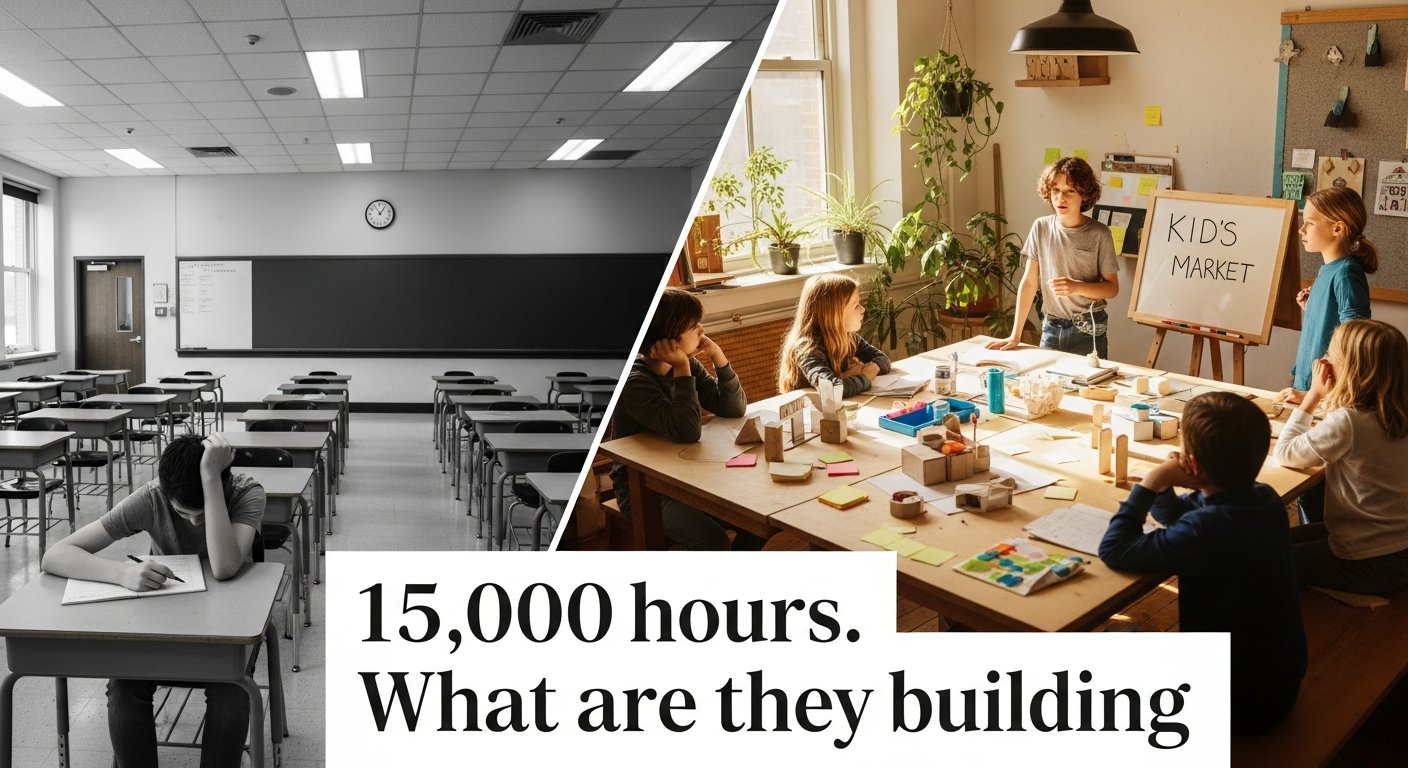
Your child will spend roughly 15,000 hours inside a school building between kindergarten and graduation. That number should stop you cold. Because the real question is not how many hours. It is what those hours are actually building. Memorization skills? Test-taking reflexes? Or the capacity to lead a room, launch an idea, and communicate with conviction?
For most families in Orange County, the answer is uncomfortable. And that discomfort is exactly where Wonderstorm Academy was built to live.
The Myth That Is Holding Families Back
When parents first hear the word micro-school, a very specific image forms: a parent at a kitchen table, a stack of workbooks, a child in pajamas at noon. That image is wrong. And it is costing families access to one of the most powerful educational models available in Southern California right now.
A micro-school is not a homeschool workaround. It is not a co-op that meets twice a week. It is not a screen-based curriculum delivered through a tablet while a parent supervises from the next room.
Wonderstorm Academy is a fully on-site, in-person private K-12 school operating from a physical campus at 25332 McIntyre St in Laguna Hills, California. Children ages 4 through 18 show up every single school day. They work in cohorts. They collaborate face-to-face. They build things, pitch things, and lead things. Together, in real time, with guides who know each of them by name. This is alternative K-12 education in Laguna Hills that looks nothing like the alternative most parents imagine.
What Three Lenses Actually Means in Practice
Wonderstorm's entire academic architecture is organized around three non-negotiable lenses: Leadership, Entrepreneurship, and Powerful Communication. These are not electives. They are not enrichment add-ons layered on top of a conventional curriculum. They are the frame through which every subject, every project, and every interaction is understood.
Here is what that looks like on a Tuesday morning.
A student in the elementary cohort is not completing a worksheet on fractions. She is pricing a product for the upcoming Kid's Market. A live, community-facing entrepreneurship showcase where Wonderstorm students build, pitch, and operate actual businesses for a real audience. The math is real. The stakes are real. The feedback is immediate and comes from customers, not a red pen.
A student in the middle school cohort is not listening to a lecture on persuasive writing. He is preparing a pitch. He will stand in front of his peers, defend his idea, field objections, and revise based on the response of the room. That is Powerful Communication. It is harder than a five-paragraph essay and infinitely more transferable.
A high school student is not filling out a college application activity list. She is completing a real-world apprenticeship. A curriculum-integrated, externally-facing experience that builds a portfolio of actual work, not a résumé of activities designed to impress an admissions committee.
This is what entrepreneurship education for kids looks like when it is taken seriously from age four through graduation. Not a class. A daily practice.
Why the In-Person Piece Is Non-Negotiable
There is a growing market of online-only and hybrid education platforms marketing themselves to the same families Wonderstorm serves. Some of them are genuinely excellent at what they do. But none of them can replicate what happens when a nine-year-old has to stand up in front of his peers, look them in the eye, and defend a business idea he spent three weeks developing.
Leadership is not a concept you can learn through a screen. It is a capacity that develops through friction. Through the lived experience of being accountable to a real community, navigating disagreement with people who matter to you, and recovering from a presentation that did not land the way you hoped.
The tight-knit, in-person micro-school community at Wonderstorm is not a feature of the model. It is the mechanism. The small cohorts, the mixed-age studios, the daily face-to-face collaboration. These are the conditions that make Leadership, Entrepreneurship, and Powerful Communication more than curriculum headings. They make them real.
As one Wonderstorm parent wrote in a five-star review: 'Wonderstorm isn't just a school; it's a community built on trust, purpose, and love. Every activity, celebration, and decision feels intentional.'
That intentionality does not happen on a Zoom call.
The Framework Behind the Model
Wonderstorm is not a local experiment built on a founder's hunch. It operates within the Apogee Strong micro-school network. Described by many as a leading model of K-12 innovation in the United States. And is aligned with a globally recognized learner-driven education framework with a documented track record across dozens of campuses.
That affiliation matters for one specific reason: it answers the objection every thoughtful parent carries into this conversation. 'Has this actually worked for other kids?' The answer is yes, with a paper trail.
Parents considering a private K-12 school in Orange County are often choosing between institutions that have been optimizing for college admissions metrics for decades. Those institutions are very good at what they optimize for. But the question worth asking is whether college admissions metrics are the right thing to optimize for in 2026, when the economy your child will graduate into has been restructured by artificial intelligence and rewards exactly the skills. Leadership, entrepreneurial thinking, powerful communication. That standardized testing cannot measure.
Wonderstorm's model was built for that economy. Not as a reaction to it. As preparation for it.
School Choice, ESA California, and the Practical Path Forward
One of the most common barriers families cite when considering a private school or a micro-school in Orange County is the financial one. The school choice and ESA California conversation is evolving, and families exploring alternative K-12 education in Laguna Hills and across South OC should be actively researching what funding tools are available to them.
Nationally, the school choice sector saw significant expansion in 2025, with Education Savings Accounts leading a wave of new programs across ten states and over 972,000 students participating in choice programs nationwide. California's landscape is still developing, but the trajectory is clear: the default assumption that public school is the only financially accessible option is weakening. Families who are actively researching school choice and ESA options in California are discovering that the gap between the cost of staying in a system that is not working and the cost of investing in one that is can be smaller than it first appears.
Tuition at a school like Wonderstorm is not a commodity purchase. It is a values-based investment in a specific outcome: a child who graduates not just academically prepared, but as a self-directed leader equipped to build something, lead someone, and communicate with conviction in any room they walk into.
The Objection Worth Addressing Directly
Some parents arrive at this conversation with a specific fear: 'If my child is not doing traditional academics, will they be prepared for college?' It is a fair question and it deserves a direct answer.
Learner-driven models do not deprioritize academics. They reframe what rigor means. Real rigor is not the volume of homework assigned or the frequency of standardized tests administered. Real rigor is being asked to build something that works, defend it in front of a live audience, fail publicly, and iterate. That is harder than memorizing a chapter. And the students who have done it arrive at college knowing exactly why they are there. Which is a competitive advantage that no test score can manufacture.
The Apogee Strong and learner-driven network affiliation provides the structural accountability that gives families confidence: this is a proven system, not a philosophy experiment.
What a Wonderstorm Day Actually Looks Like
For families who have spent twelve or more years inside the traditional school model, it can be genuinely difficult to picture what a different kind of day looks like. So here is a concrete sketch.
The campus opens. Students arrive and move into their studios. Mixed-age cohorts organized not by birth year but by readiness and project stage. There is no bell. There is no row of desks facing a whiteboard. There is a set of agreements the community has built together, a set of goals each learner has committed to, and a set of guides whose job is not to deliver information but to ask the questions that make learners think harder.
Core academics happen. Reading, writing, mathematics, science. These are not abandoned. They are integrated into projects that require them. A student learning to price a product is doing mathematics. A student writing a pitch is doing composition. A student researching a community problem is doing science and social studies simultaneously, with a real stakeholder waiting for the findings.
Life Skills Labs run regularly. These are applied competency sessions. Practical, hands-on experiences in areas that conventional schools treat as extracurricular at best and irrelevant at worst. Financial literacy. Public speaking. Project management. Conflict resolution. The skills adults spend decades trying to acquire in the workplace, built systematically from childhood.
Real-world apprenticeships connect older students to the community beyond the campus. These are not job shadows. They are curriculum-integrated, outcome-bearing experiences that produce actual work in actual organizations.
The Families Wonderstorm Is Built For
Wonderstorm is not the right school for every family. It is the right school for a specific kind of family. One that is already making intentional choices about what their children eat, where they live, how they spend their time, and what values they want embedded in their child's daily environment. These are parents who read the labels. They chose the neighborhood. And at some point, they looked at the school their child was attending and felt the mismatch between the institution's priorities and their own.
If that describes you, the next step is not a brochure. It is a conversation.
Take the First Step
Wonderstorm Academy serves children ages 4 through 18 on a full-time, in-person campus in Laguna Hills, California. Enrollment for the 2026-2027 school year is open, and cohorts are intentionally small. Because every child here deserves to be known, not managed.
If you have been thinking there has to be a better way, there is. Book a call with the Wonderstorm enrollment team and start the conversation. It takes twenty minutes. It might change everything.
David Yarbrough
Co-Founder
Dave Yarbrough is the founder of Wonderstorm Academy, a devoted husband and father of six, and a lifelong student of human potential. For more than 25 years, he has explored how education can help children flourish intellectually, socially, and personally. His vision is to create a new model of learning that expands what is possible for children and for education as a whole. Dave holds a Bachelor of Arts in Philosophy from UC Santa Barbara.
More from David Yarbrough →