Micro-Schools Don't Sacrifice Rigor. They Redefine It.
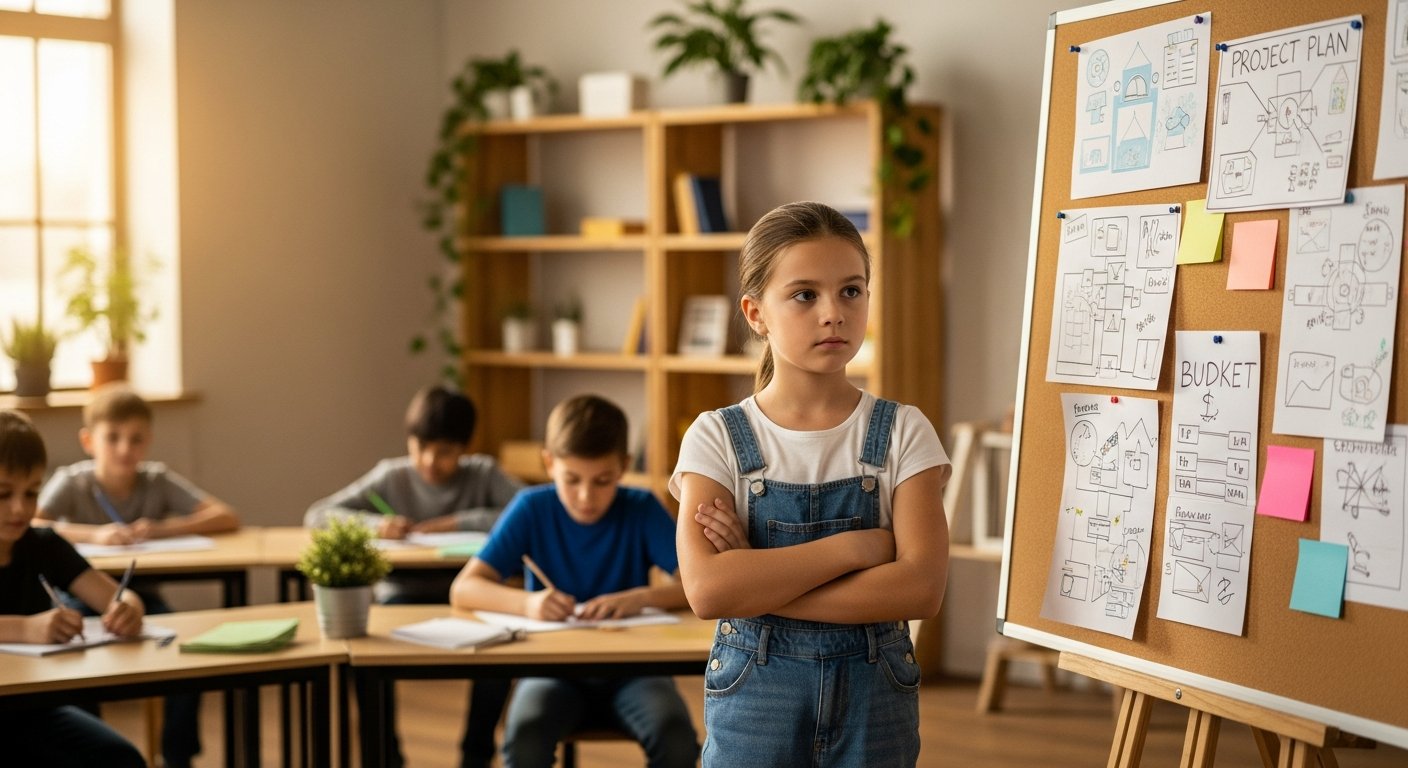
The most persistent myth about alternative K-12 education is also the most damaging one: that choosing a learner-driven micro-school means trading academic rigor for feel-good projects and soft skills. Parents hear "entrepreneurship education for kids" and picture finger-painting. They hear "project-based learning" and imagine unsupervised free time. They are wrong. And the cost of that misunderstanding is another year in a system that is not working for their child.
The Rigor Question Every Touring Parent Asks
When families walk through the Wonderstorm Academy campus in Laguna Hills for the first time, the question almost always surfaces within the first ten minutes. It sounds something like this: "This all looks incredible. But will my child still learn math? Will they be ready for college?"
It is a fair question. It is also a question built on a false premise. The assumption that academic rigor and real-world skill-building are competing priorities, that a school must choose between teaching a child to factor polynomials and teaching that same child to lead a team, pitch an idea, or solve an unscripted problem. At Wonderstorm, those things are not in tension. They are the same curriculum.
The assumption that academic rigor and real-world skill-building are competing priorities is the most expensive misconception in education today.
What Rigor Actually Looks Like When You Strip Away the Tests
The traditional definition of academic rigor has been so thoroughly conflated with homework volume, test frequency, and grade-point averages that most parents have forgotten to ask what rigor is actually for. Rigor exists to build the capacity to do hard things. To persist through confusion. To take on a problem that does not have an answer key and work it until something useful emerges.
By that definition. The real definition. A student who designs a product, builds a prototype, calculates a cost structure, writes a pitch, presents it to a live audience, handles objections, and iterates based on feedback has experienced more genuine rigor in one project cycle than most students encounter in a full semester of worksheet-driven instruction.
This is what entrepreneurship education for kids looks like in practice at a serious private K-12 school. Not a simulation. Not a game. A disciplined, structured process that demands reading comprehension, mathematical reasoning, written communication, critical analysis, and interpersonal leadership. Simultaneously, under real stakes, with a real audience watching.
The Three Lenses That Hold Everything Together
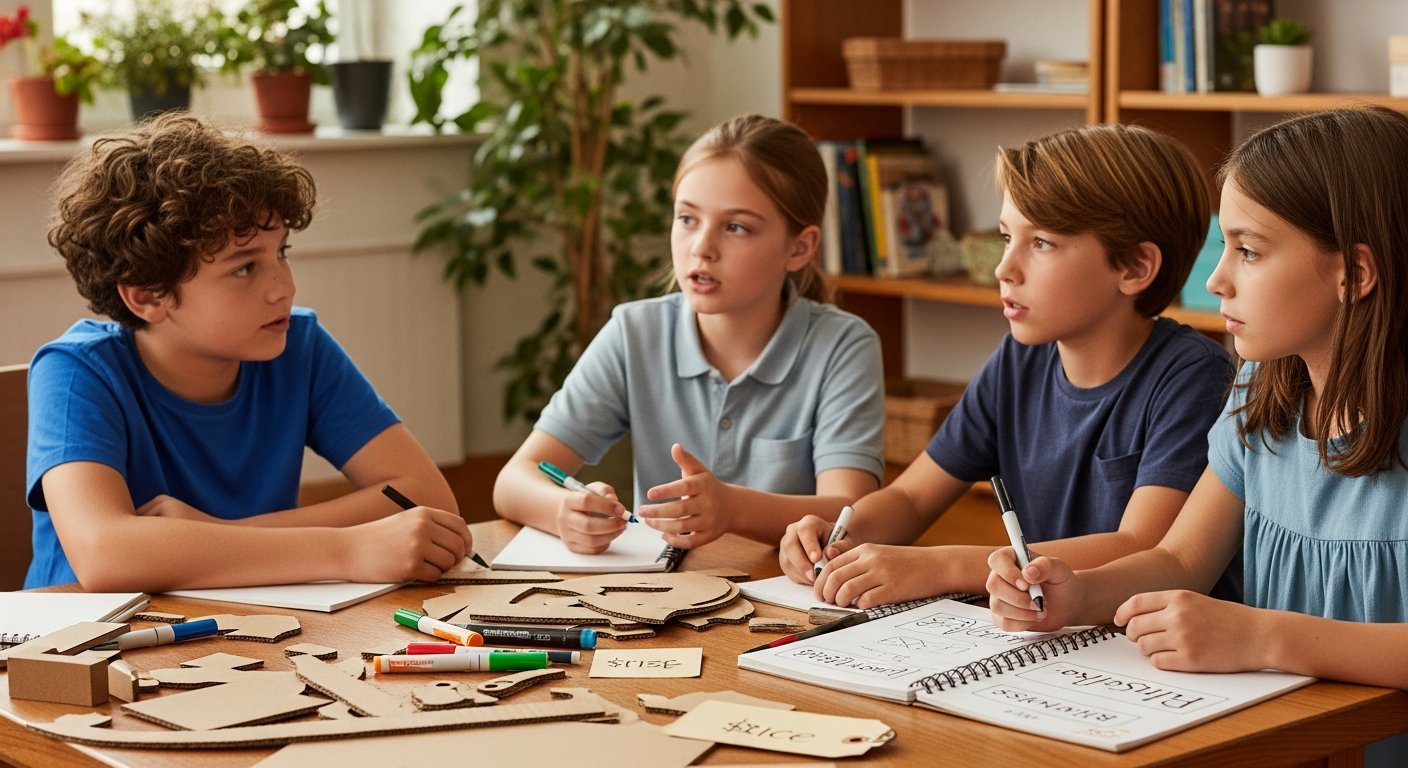
Wonderstorm Academy organizes every learning experience through three interlocking lenses: Leadership, Entrepreneurship, and Powerful Communication. These are not electives. They are not enrichment add-ons scheduled on Friday afternoons. They are the architecture through which core academics are delivered, practiced, and made meaningful.
Consider what this looks like in a single project. A student researching the economics of a local business problem is doing social studies and economics. The written proposal they produce is a composition and rhetoric exercise. The budget spreadsheet is applied mathematics. The presentation to a panel of community members is public speaking and argumentation. The post-project reflection is metacognitive writing. Strip away the labels and you have a fully integrated academic experience that happens to also be building the exact skills. Leadership, entrepreneurship, powerful communication. That no amount of standardized testing ever measured or rewarded.
This is the insight that families who choose alternative K-12 education in Laguna Hills and across Orange County are arriving at: the three lenses do not compete with academics. They are the delivery mechanism for academics.
Why the Misconception Persists. And Why It Matters
The rigor myth does not survive because it is well-evidenced. It survives because it is emotionally convenient. Parents who are on the fence about leaving the traditional system need a reason to stay. "But what about rigor?" gives them one. It allows them to frame inaction as prudence rather than fear.
The irony is that the traditional model's claim to rigor is largely theatrical. Assigning thirty problems of the same type is not rigorous. It is repetitive. A timed test that measures memorization speed is not a measure of intellectual capability. A student who scores a 4.0 by mastering the performance of school may arrive at college with no idea how to manage a project, navigate ambiguity, or advocate for their own ideas. That gap is not a failure of individual students. It is a design flaw in the system.
A student who scores a 4.0 by mastering the performance of school may arrive at college with no idea how to manage a project, navigate ambiguity, or advocate for their own ideas.
The families who have found their way to micro-school alternatives in Orange County. And to learner-driven models aligned with the Apogee Strong network. Are not abandoning rigor. They are demanding more of it. Real rigor. The kind that shows up when a child has to defend their reasoning to a skeptical adult who is not obligated to give them partial credit.
What the Research and the Results Actually Show
The learner-driven model at Wonderstorm is not a local experiment. The outcomes are not theoretical.
Students who move through learner-driven micro-school environments consistently develop stronger self-regulation, higher intrinsic motivation, and deeper subject-matter retention than their peers in passive-instruction settings. They also develop something the traditional transcript cannot capture: a demonstrated ability to initiate, execute, and complete complex work independently. That capability. More than any GPA. Is what selective universities say they are looking for and rarely find.
One Wonderstorm parent, Elizabeth Hoefer, described her daughter's trajectory this way: a student who arrived from the public school system in 6th grade with significant educational trauma completed four college-level dual enrollment courses through Saddleback College as a 10th grader and is on track to finish all high school requirements a full year early. Her younger sister entered as a learner-driven student from the beginning and is now a full year ahead academically going into 7th grade. These are not outliers. They are what happens when a child's natural drive is treated as the engine of learning rather than a problem to be managed.
The College Readiness Question, Answered Directly
For families weighing school choice in Orange County. Including those exploring ESA California options and private school alternatives. The college readiness question deserves a direct answer, not a deflection.
Wonderstorm students are prepared for college. Not because the school drills them on SAT vocabulary or runs AP-style assessments on a semester calendar, but because college. Real college, the kind that demands self-direction, project management, intellectual courage, and the ability to communicate ideas persuasively. Is exactly what the Wonderstorm model trains for every single day. A student who has run a business, defended a thesis to a live audience, managed their own learning roadmap for years, and developed genuine leadership habits is not behind their peers applying to selective universities. They are ahead of them in every dimension that actually predicts success after the acceptance letter.
The question is not whether a micro-school in Laguna Hills can prepare a student for college. The question is whether a conventional private K-12 school can prepare a student for the life that comes after it.
The Learning Center Difference: Known, Challenged, Developed
One of the structural advantages of a micro-school that rarely gets named clearly is this: every child is known. Not managed. Not assigned to a cohort and processed through a curriculum. Known. By name, by learning style, by the specific shape of their strengths and the precise nature of their growing edges.
At a learning center of Wonderstorm's intentional scale, a guide can see when a student is performing compliance rather than experiencing genuine comprehension. They can catch the child who is coasting on strong verbal skills while quietly avoiding mathematical reasoning. They can push the student who has mastered the academic content to go deeper into the leadership and entrepreneurship dimensions of a project because they have the bandwidth to notice that the mastery is already there.
This is not a soft benefit. It is a structural academic advantage. And it is the reason that families who tour the campus. Who walk in skeptical about rigor and walk out reconsidering everything. So often describe the experience the way Lindsey Jaleh did: as something "truly extraordinary" built by people who have "poured their hearts and souls" into creating an environment where children are "deeply known, encouraged to follow their own path, and given the freedom and support to become the very best versions of themselves."
Rigor Was Never the Problem. Definition Was.
If you have been holding back from exploring a micro-school alternative because you are worried your child will fall behind. Take a breath. The evidence, the outcomes, and the structural logic all point in the same direction. Leadership, entrepreneurship, and powerful communication are not substitutes for academic rigor. They are its highest expression.
The real question is not whether Wonderstorm Academy is rigorous enough for your child. It is whether the system your child is currently in is ambitious enough for who they are capable of becoming.
If you are ready to find out, the next step is a conversation and a campus walk. Book your family's tour at Wonderstorm Academy in Laguna Hills and see what a learner-driven, full K-12 education actually looks like in practice. Spots are limited. And the families who tour in July are the ones who enroll in September.
David Yarbrough
Co-Founder
Dave Yarbrough is the founder of Wonderstorm Academy, a devoted husband and father of six, and a lifelong student of human potential. For more than 25 years, he has explored how education can help children flourish intellectually, socially, and personally. His vision is to create a new model of learning that expands what is possible for children and for education as a whole. Dave holds a Bachelor of Arts in Philosophy from UC Santa Barbara.
More from David Yarbrough →