My Child Is Bored at School. Now What?
Something shifts in a parent the moment they realize their child's boredom is not a phase. It is a signal. And for families across South Orange County. From Laguna Hills to Mission Viejo to Ladera Ranch. That signal is getting harder to ignore.
The Boredom Nobody Talks About Honestly
There is a version of school boredom that gets dismissed quickly. Teachers call it restlessness. Report cards call it "needs to apply himself more." Well-meaning advisors say it will get better next year, with a harder class, a different teacher, a new grade level.
But the parents reading this know the difference. There is a particular look a curious, capable child gets when they have stopped expecting school to surprise them. It is not defiance. It is not laziness. It is resignation. And it tends to arrive earlier than anyone expects.
"Boredom in a genuinely curious child is not a personality trait. It is a system failure. And the longer it goes unnamed, the more it costs."
The data behind this feeling is not subtle. Research consistently shows that students spend the majority of their school hours in passive reception: listening to instruction, completing repetitive tasks, preparing for assessments that measure recall rather than reasoning. For children who are wired to build, question, create, and lead, this is not just boring. It is a slow erosion of the instincts that will matter most in their adult lives.
And the stakes are not abstract. A child who spends ages 5 through 18 learning to sit still and comply is not just bored. They are being trained out of the very qualities. Initiative, curiosity, resilience, creative problem-solving. That an AI-driven world will demand of them.
Why Traditional Schooling Was Not Designed for This Child
The traditional classroom model was designed for a different century and a different economy. It was built to produce reliable, consistent workers who could follow instructions, retain information, and perform predictably under standardized conditions. That is not a conspiracy. It is history. And for a long time, it worked reasonably well for what the world needed.
But that world is gone.
The children sitting in South Orange County classrooms today will graduate into an economy where the most valuable skills are the ones least likely to appear on a standardized test: the ability to identify a real problem and design a solution for it, to communicate a vision clearly enough that others will follow, to take initiative without being told, to recover from failure and try again with better information.
These are not soft skills. They are the hard skills of the 21st century. And they are almost impossible to build through passive instruction.
For the child who is bored in traditional school right now, the problem is not that they are difficult. It is that the system was not built around them. It was built around averages, compliance, and uniformity. A child who needs to move, to question, to make things, to argue ideas, to lead. That child is not a problem to be managed. They are exactly the kind of person the future needs. They just need a different kind of school.
What "Student-Led" Actually Means in Practice
The phrase gets used a lot in alternative education circles. But what does it actually look like on a Tuesday morning?
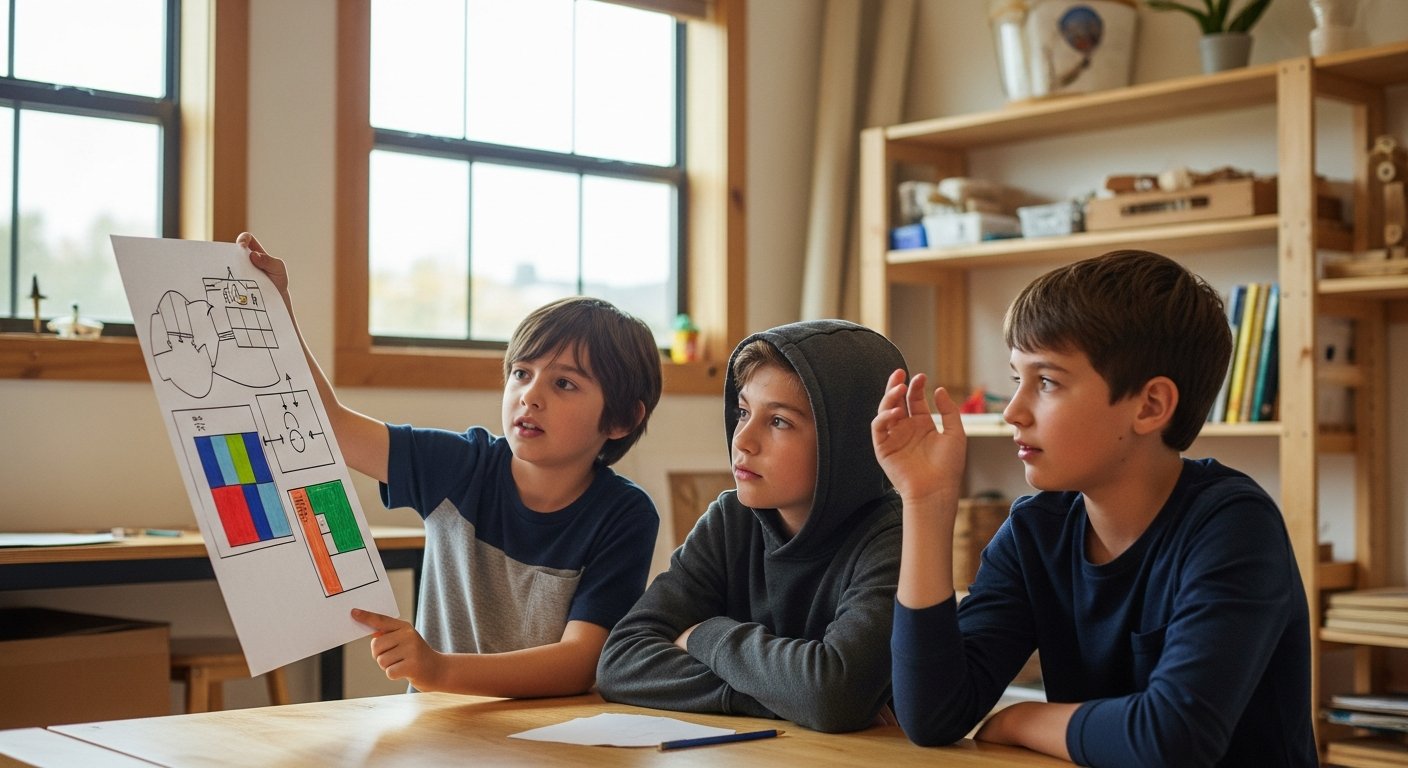
At Wonderstorm Academy, a private K-12 micro-school on McIntyre Street in Laguna Hills, student-led is not a philosophy statement on a wall. It is the structure of the day.
Students do not sit in rows waiting to be filled with information. They work on real projects with real stakes. Ventures, presentations, community challenges, and collaborative problems that require them to think, communicate, negotiate, and build. They set goals and are held accountable for them. They lead teams. They pitch ideas. They fail, reflect, and try again.
The three lenses that organize everything at Wonderstorm are Leadership, Entrepreneurship, and Powerful Communication. These are not electives or after-school enrichment. They are the framework through which core academics are taught. The context that makes math, writing, history, and science feel like tools rather than obligations.
A child learning to pitch a business idea to a panel of adults is also learning to write with precision, to think quantitatively, to understand how persuasion works, and to manage the emotional experience of being evaluated publicly. That is not a substitute for academics. That is academics, made real.
The school that ends boredom is not the one that moves faster. It is the one that makes the work matter.
The Micro-School Difference: Why Size Is a Feature
One of the most common concerns parents bring to Wonderstorm is the social question. Will my child have enough peers? Will they be prepared for the larger world?
It is a fair question. But it rests on an assumption worth examining: that a larger school automatically produces better social development. In practice, the opposite is often true for the kind of child who is bored and disengaged in a traditional setting.
In a large school, a child who does not fit the mold. Who is too curious, too energetic, too creative, or simply too different. Can spend years in the social margins. In a small, intentional community like Wonderstorm, that same child is seen. Named. Known. Challenged in ways that are specific to who they actually are.
The micro-school model also enables something that large institutions simply cannot offer: genuine relationships between students of different ages. Mixed-age learning is not a logistical compromise. It is one of the most powerful developmental environments available to a young person. Older students develop leadership and mentorship instincts. Younger students develop aspiration and confidence. Everyone develops the social fluency that comes from navigating real, multi-dimensional human relationships. Not just peer cohorts sorted by birthday.
For families throughout South Orange County. In Aliso Viejo, Rancho Santa Margarita, Lake Forest, Dana Point, San Juan Capistrano, and beyond. Wonderstorm's Laguna Hills campus is close enough to be genuinely local, and small enough to be genuinely personal.
Entrepreneurship Is Not an Add-On. It Is the Point.
Parents sometimes arrive at Wonderstorm wondering whether entrepreneurship programming comes at the expense of rigorous academics. The question makes sense if you have only ever seen entrepreneurship treated as a club, a competition, or a weekend workshop.
At Wonderstorm, entrepreneurship is the lens through which academic rigor is delivered. Not a replacement for it. A student designing and launching a micro-venture is learning to write business plans (writing), model revenue and costs (mathematics), research their market (research and critical thinking), and present findings to an audience (public speaking and persuasion). The academic content is not diminished. It is contextualized in a way that makes it stick.
This matters especially for the child who is bored in traditional school right now. Boredom is rarely about the content itself. It is about the absence of purpose. When a child cannot answer the question "why does this matter?". They disengage. When the answer is visible, tangible, and connected to something they are actually building, engagement is not something you have to engineer. It arrives naturally.
Wonderstorm is a K-12 school in Orange County offering a sustained, full-spectrum entrepreneurship and leadership curriculum embedded from kindergarten through 12th grade. This is not a program that begins in high school when it is almost too late. It begins at age five, in age-appropriate ways that build the habits of mind that compound over years.
For families in Newport Coast, Coto de Caza, Las Flores, Trabuco Canyon, Portola Hills, and across the South OC corridor, this is a genuinely different option. Not a better version of the same thing.
What Parents Who Have Made This Shift Say
The families who find Wonderstorm are rarely impulsive decision-makers. They have usually been sitting with the problem for months, sometimes years. They have tried enrichment programs, tutors, gifted testing, and conversations with teachers and administrators. They have been told to be patient, to trust the system, to wait for the right class or the right year.
At some point, they stop waiting.
What they describe after making the transition is not just academic improvement. Though that comes. What they describe first is a change in their child's relationship to learning itself. The child who used to complain about school starts talking about their projects at dinner. The child who said "I hate reading" starts reading for research because they need the information for something they are building. The child who was labeled distracted starts demonstrating focus. Because the work now demands it in a way that feels worth responding to.
That shift is the real outcome Wonderstorm is designed to produce. Not just college readiness. Not just test scores. A child who knows who they are, what they are capable of, and how to make things happen in the world.
Frequently Asked Questions
Will my child be prepared for college admissions from a micro-school? Yes. Wonderstorm Academy is a full K-12 private school with rigorous academic standards embedded within its project-based framework. Students build portfolios of real work, develop strong communication skills, and graduate with the critical thinking abilities that selective colleges increasingly value alongside traditional metrics. The Apogee Strong network, which Wonderstorm is part of, has a track record of outcomes that go well beyond conventional test prep.
Is the student community large enough for healthy social development? The micro-school model at Wonderstorm is intentionally small. And that is a feature, not a limitation. Mixed-age learning environments build genuine leadership and mentorship instincts that age-sorted classrooms rarely produce. Every student is known individually, challenged specifically, and embedded in a tight-knit community of families who share a common philosophy. Many parents find the depth of relationship in a small community far exceeds what their children experienced in larger schools.
How does Wonderstorm handle foundational academics alongside entrepreneurship and leadership? Leadership, Entrepreneurship, and Powerful Communication are the three lenses through which academics are taught. Not replacements for them. Core subjects including mathematics, writing, science, and history are embedded in real-world projects and challenges, making the academic content contextually meaningful rather than abstract. Students do not sacrifice rigor for relevance. They get both.
What ages does Wonderstorm Academy serve? Wonderstorm Academy serves children ages 5 through 18 across a full K-12 range at its on-site campus at 25332 McIntyre St in Laguna Hills, CA. The school's single coherent philosophy spans the entire formative journey, meaning the habits and skills built in early childhood compound continuously through graduation.
How do I find out if Wonderstorm is the right fit for my family? Wonderstorm's enrollment process begins with a conversation, not a form. The first step is booking a call to explore whether the school's philosophy, structure, and community align with your family's values and your child's needs. From there, families are invited to schedule a campus tour and experience the environment in person before making any decisions.
The Only Question That Actually Matters
Your child is going to spend thousands of hours inside a school between now and graduation. The question is not whether they are bored today. The question is what those hours are building. And whether, at the end of them, your child will emerge as someone who knows how to lead, how to create, how to communicate, and how to make their life mean something.
If the answer you are getting from their current school does not satisfy you, you are not being unreasonable. You are being a parent.
Wonderstorm Academy exists for exactly this moment. For the family in Laguna Hills, Mission Viejo, San Clemente, Laguna Beach, or anywhere across South Orange County who has been waiting for a real alternative, not just a shinier version of the same thing.
Book a call today and find out if Wonderstorm is the right fit for your family. Schedule your campus tour and see what school looks like when it is built around who your child is becoming. Not just who they are expected to be.