Personalized Learning Is Dead. Leadership Is the New Edge.
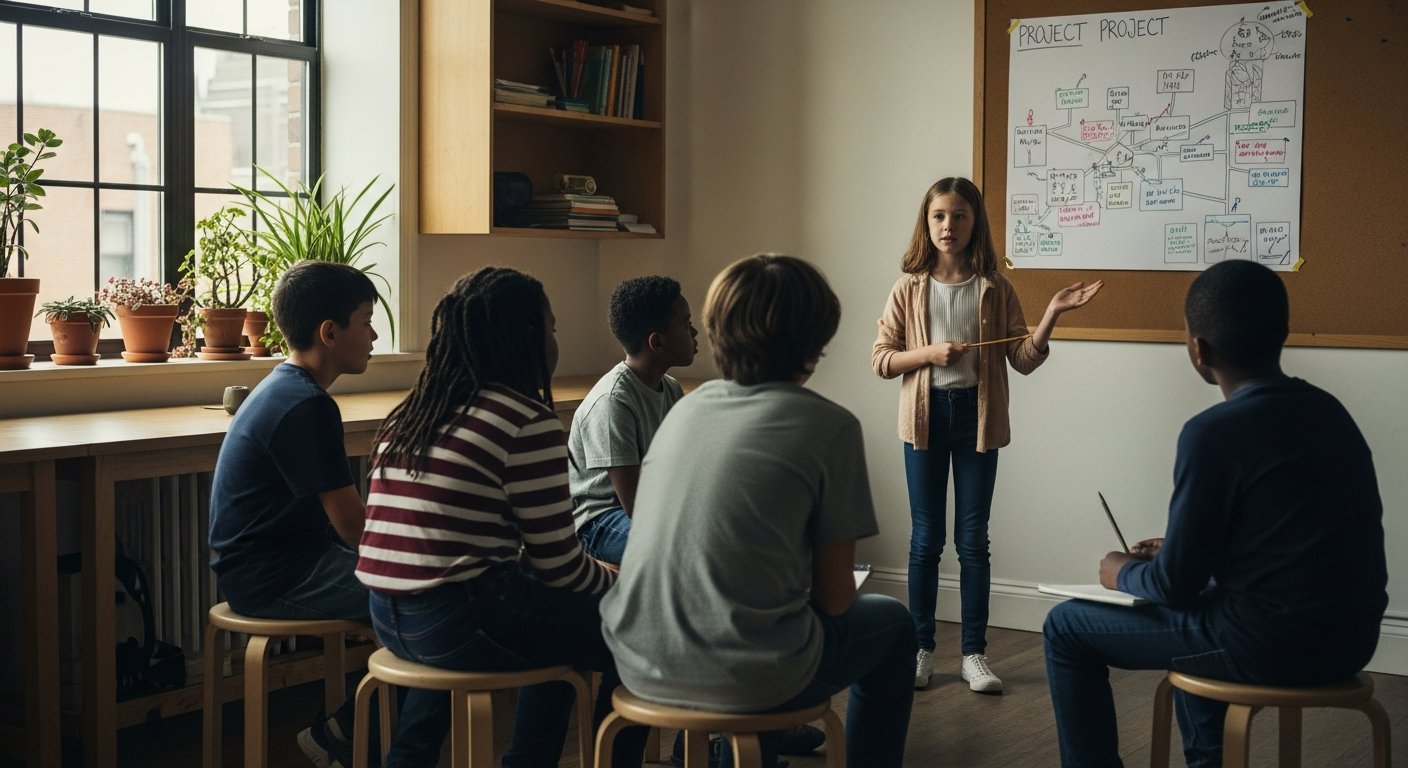
Every school opening its doors in Orange County right now is promising personalized learning. Most of them are telling the truth. And almost none of them are teaching your child what actually matters in the world they are about to enter.
The Personalization Trap
Personalized learning became the dominant promise of alternative K-12 education over the last decade for a good reason. The traditional classroom model. One teacher, thirty students, one pace, one test. Visibly fails too many children. The child who processes slowly gets left behind. The child who processes quickly gets bored into disengagement. Personalization was the obvious corrective, and it was a genuine improvement.
But improvement is not transformation. And the market caught up fast.
Today, virtually every private school, every micro-school, every learning center, and every online platform from here to the other side of the country leads with some version of the same claim: we meet your child where they are. AI-powered adaptive curricula, self-paced mastery modules, individualized learning plans. These are now table stakes, not differentiators. When every alternative K-12 education option in Laguna Hills and across South Orange County is making the same promise, the promise stops meaning anything.
Personalization tells you how fast your child moves through content. Leadership determines whether your child can move other people.
The sharper question. The one most schools are not equipped to answer. Is this: after your child has mastered the content at their own pace, what do they do with it? Who do they become? Can they walk into a room of people who disagree with them and change the outcome? Can they build something from nothing, pitch it to a skeptical audience, and iterate when it fails? Can they communicate with enough precision and conviction that other people follow their lead?
Personalization is about the individual. Leadership is about the individual in relation to the world. And the world does not care how quickly your child completed a module.
Why Leadership Cannot Be an Elective
The conventional private school response to this gap is to offer leadership as a program. A student council. A speech and debate team. A capstone project in senior year. These are fine additions. They are not a curriculum.
The difference matters enormously. A program is something you opt into, usually in high school, after a decade of conditioning toward passivity. A curriculum is the operating system of the entire school day from the first year of enrollment. You cannot bolt leadership onto a passive model and call it transformation. You have to build the school around it from the ground up.
This is exactly what separates a genuinely learner-driven micro-school from one that has simply replaced rows of desks with flexible seating and called it innovation. The question to ask any school you are evaluating. Whether it describes itself as a private school, a learning center, a micro-school in Orange County, or an alternative K-12 education program in Laguna Hills. Is not whether students move at their own pace. It is whether students are regularly placed in situations where they must lead other people, fail in front of an audience, recover, and try again.
If the answer is yes, you are looking at a genuine alternative. If the answer is a program name and a schedule, you are looking at a traditional school with better marketing.
The Three Skills That Actually Compound Over a Lifetime
There is a useful framework for thinking about what education should actually produce. Not test scores, not college admissions outcomes, not even academic mastery in isolation. But the three capabilities that compound in value across every decade of a person's life.
The first is leadership: the ability to understand what a group of people needs, articulate a direction, and move them toward it. This is not a personality trait. It is a practiced skill, and it can be developed in a four-year-old just as surely as in a forty-year-old. The contexts are different. The underlying competency is the same.
The second is entrepreneurial thinking: the ability to identify a problem, generate a solution, build something real, test it against reality, and adapt. This is not about starting companies, though some students will. It is about the cognitive habit of treating the world as a set of problems worth solving rather than a set of facts worth memorizing. Entrepreneurship education for kids is not a business class. It is a way of moving through the world.
The third is powerful communication: the ability to translate what you know and believe into language that lands precisely on the person in front of you. Not presentation skills. Not public speaking as performance. The deep, practical ability to make another person understand something they did not understand before, and to do it under pressure, in real time, with real stakes.
These three skills interact. A child who can lead, think entrepreneurially, and communicate powerfully is not just prepared for one career path. They are prepared for every career path, including the ones that do not exist yet. In an economy where AI is compressing the value of information recall and routine execution toward zero, these are the only capabilities that remain durably, irreplaceably human.
A school that teaches your child to lead, build, and communicate is not preparing them for college. It is preparing them for every version of the future that college might lead to.
What School Choice Actually Means in 2026
The school choice and ESA California conversation has matured significantly. A few years ago, the debate was largely about access. Whether families should have the legal and financial ability to choose something other than their assigned public school. That battle is still being fought in many states, but the more interesting conversation happening among intentional parents in Orange County right now is not about access. It is about what to choose, and why.
Orange County public school enrollment fell 1.7 percent in 2025-26, continuing a multi-year decline. Families are leaving. The question is where they are going and whether the alternatives they are choosing actually solve the underlying problem or simply relocate it to a smaller campus with a friendlier aesthetic.
A micro-school that centers personalization without centering leadership is a more comfortable version of the same fundamental model. The child still sits, still receives, still performs for an external evaluator. The class size is smaller and the teacher is warmer, but the posture of the learner has not changed. That is not school choice in any meaningful sense. That is school preference.
Real school choice means choosing a fundamentally different theory of what a child is and what education is for. It means choosing a school that treats your child as an active agent in their own development rather than a passive recipient of a curriculum designed by someone who has never met them. It means choosing a model where leadership, entrepreneurship, and communication are not electives or enrichment programs. They are the core.
The Apogee Strong Framework and Why Network Matters
One of the most common concerns parents raise when they first encounter the micro-school model is whether a small, alternative school has the institutional infrastructure to deliver on its promises over the long arc of a K-12 education. It is a fair question. The landscape is full of earnest experiments that ran well for three years and then lost their footing.
The answer, for families evaluating Wonderstorm Academy, lies in the network. Wonderstorm operates within the Apogee Strong micro-school network. Described by its peers as a leading model of K-12 innovation in the United States. And is aligned with the globally recognized learner-driven education framework that has produced documented results across dozens of campuses. This is not a homegrown experiment. It is a locally rooted delivery of a proven system, with the intimacy of a founder-led campus and the structural confidence of a validated national network.
The curriculum architecture at Wonderstorm is built around three non-negotiable lenses: Leadership, Entrepreneurship, and Powerful Communication. These are not themes layered over a conventional academic program. They are the organizing logic of every project, every Life Skills Lab, every real-world apprenticeship, every student-run enterprise. A child who enters at age four and graduates at eighteen has spent fourteen years inside a system explicitly designed to develop these three capabilities alongside rigorous academics. That is not a supplement to their education. That is their education.
For families in South Orange County comparing options. Private school, micro-school, alternative K-12 education in Laguna Hills, or some hybrid of homeschool and enrichment. The Apogee Strong affiliation is the clearest signal of structural seriousness available in this market.
The Proof Is in the Projects
Arguments about pedagogy only go so far. At some point, the evidence has to be observable. And at Wonderstorm, it is.
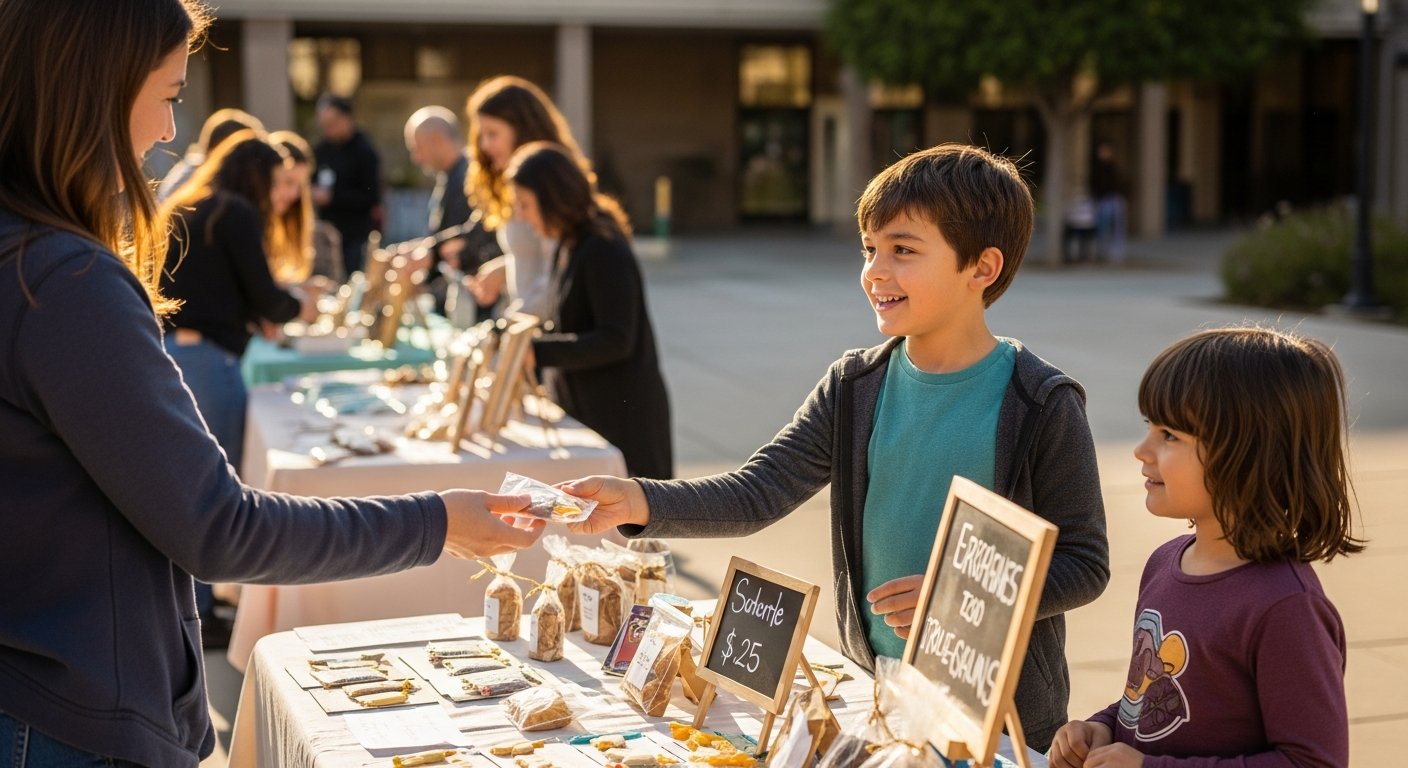
The Kid's Market events, where students build products, set prices, manage inventory, handle customers, and count their own revenue in front of a live community audience, are not a school fair. They are a public demonstration of what the three-lens model produces in practice. An eight-year-old who has just closed two hundred dollars in sales before noon has not been taught about entrepreneurship. She has done it. The distinction is the entire argument.
Lindsey Jaleh, a Wonderstorm parent, put it this way in her review of the school: her daughter, a creative and deeply feeling child for whom transitions and new environments were genuinely difficult, arrived at Wonderstorm cautiously. Nearly a year later, she was confident, engaged, joyful, and genuinely excited about school. Not because the curriculum was easier. Because she was finally seen as a whole person. Her pace respected, her gifts developed, her uniqueness treated as an asset rather than a deviation from the norm.
Elizabeth Hoefer, whose family spans three generations at Wonderstorm, described a middle daughter who arrived in 7th grade with significant educational trauma from the public school system. At Wonderstorm, her love of learning was restored. She completed four college classes through a dual enrollment program at Saddleback College, finished her high school requirements a full year early, and decided to pursue education as her career. Not despite what school did to her, but because of what Wonderstorm gave back.
These are not marketing stories. They are the natural output of a model that takes the three lenses seriously at every level of the school, from the earliest childhood years through graduation.
Conclusion: Stop Asking If Your Child Is Being Personalized. Start Asking If They Are Being Developed.
The private K-12 school landscape in Orange County is more crowded and more sophisticated than it has ever been. There are more options, more claims, and more beautifully designed campuses competing for your family's attention and trust. Most of them are offering some version of personalized learning. A few of them are offering something genuinely different.
The question that cuts through all of it is simple: does this school produce leaders? Not students who were given the freedom to move at their own pace. Students who learned to lead other people, build real things, and communicate with conviction. Students who graduate not just academically prepared but personally equipped for every version of the future they might face.
If that is the education you are looking for. A full K-12 private school experience built around Leadership, Entrepreneurship, and Powerful Communication, grounded in a proven national network, and delivered in a tight-knit micro-school community in Laguna Hills. Wonderstorm Academy was built for your family.
Book a campus tour. Walk the space. Watch the learners. The difference between personalization and development is visible the moment you step through the door.
Visit wonderstormacademy.com or call to schedule your family's private tour. Spots are limited by design. Because every child here deserves to be known, not managed.
David Yarbrough
Co-Founder
Dave Yarbrough is the founder of Wonderstorm Academy, a devoted husband and father of six, and a lifelong student of human potential. For more than 25 years, he has explored how education can help children flourish intellectually, socially, and personally. His vision is to create a new model of learning that expands what is possible for children and for education as a whole. Dave holds a Bachelor of Arts in Philosophy from UC Santa Barbara.
More from David Yarbrough →