Private Schools Where Kids Actually Direct Their Own Education
Your child is not disengaged because they are lazy or difficult. They are disengaged because no one has ever handed them the wheel. For families across South Orange County who have been quietly researching Sudbury schools, democratic education models, and student-led alternatives, the question is no longer whether this kind of school exists. It is whether one exists here.
What "Student-Led Education" Actually Means
The phrase gets used loosely. Every school brochure in Orange County mentions student voice, personalized pathways, and child-centered learning. Most of them mean something narrow: students choose between two essay topics, or vote on a class pet.
True student-led education is structurally different. In the Sudbury model, which originated at Sudbury Valley School in Massachusetts in 1968, students govern their own time, choose what they work on, and participate in school governance through a democratic assembly. There are no required classes, no grades, and no fixed curriculum. The premise is that children are capable of directing their own intellectual development when given genuine freedom.
Democratic schools operate on similar principles. Students have real votes on school rules and daily structure. Learning emerges from interest rather than being delivered by schedule.
These models attract serious parents for serious reasons. The research on self-determination theory, going back to the work of Deci and Ryan at the University of Rochester, consistently shows that intrinsic motivation produces deeper learning, greater retention, and stronger long-term outcomes than compliance-driven instruction. When children choose what they pursue, they pursue it further.
But for many families in South Orange County. In Laguna Hills, Mission Viejo, Laguna Niguel, Rancho Santa Margarita, Aliso Viejo, and the surrounding communities. The Sudbury and democratic school models raise a genuine concern: what about academic rigor? What about college? What about the structure a child still needs to build real capability?
That tension is exactly where Wonderstorm Academy enters the conversation.
A school where children have genuine agency over their education does not have to choose between freedom and rigor. The two are not opposites. They are, at the right school, the same thing.
The South Orange County Option Most Families Have Not Found Yet
Wonderstorm Academy is a private K-12 micro-school located at 25332 McIntyre St in Laguna Hills, California. It serves children ages 5 through 18 across a full-time, on-site campus. Not a hybrid program, not a homeschool co-op alternative, not an online learning center. A real school, in a real building, with a real community of families who made a deliberate choice.
What makes it relevant to this search is the model. Wonderstorm is built around a fundamentally different question than most private schools ask. Not: how do we deliver the curriculum? But: what would it take to help this child become the kind of person who can confidently create the life they want?
That question changes everything about how the school is structured.
Students at Wonderstorm actively participate in designing their own learning journey. They set personal goals. They track their own progress. They choose and pursue project-based work connected to real interests and real problems. They progress when they are genuinely ready, not because a bell rings or a calendar page turns.
All five core academic subjects. Reading, writing, mathematics, science, and history. Are taught rigorously. But they are not the finish line. They are the raw material. Every subject is taught through three foundational lenses: Leadership, Entrepreneurship, and Powerful Communication. Those three capabilities are not offered as electives or extracurricular add-ons. They are the actual curriculum through which all learning happens.
A student does not just study history. They research and debate pivotal historical decisions, stepping into the shoes of the people who made them. A student does not just learn mathematics. They launch and operate real businesses, where pricing a product wrong costs them real margin and understanding percentages stops being abstract.
This is what separates Wonderstorm from both conventional private schools and from the more loosely structured democratic models. The child has genuine agency. And the child is also building specific, documented capability every single day.
One parent, Lindsey Jaleh, described her daughter's experience this way: "There is no expectation that everyone should learn the same thing at the same pace simply because they're the same age. Each hero is encouraged to discover and develop their individual gifts, pursue subjects that excite them, and progress when they're truly ready."
Another parent, Evan Jaleh, put it plainly: "Once I learned a model like this existed. One that focuses on self-directed education and real-world critical thinking. I honestly couldn't imagine sending my daughter to a traditional school."
Why the Sudbury Model Alone Does Not Satisfy Every Family
The Sudbury and democratic school movements deserve genuine credit. They took seriously what most institutions refused to acknowledge: that children are not empty vessels waiting to be filled, and that the structure of conventional schooling produces compliance more reliably than it produces capability.
But the Sudbury model, taken in its pure form, makes a bet that not every family is willing to make. The bet is that total freedom, over enough time, will produce a self-directed adult. For some children, in some environments, it does. The documented outcomes for Sudbury graduates are genuinely interesting, and the alumni tend to be resourceful, self-sufficient, and entrepreneurially inclined.
The concern many intentional South Orange County parents bring to this research is not ideological. It is practical. They want their child to have genuine agency. They also want their child to graduate with the ability to write persuasively, think mathematically, communicate with confidence in front of a room, and build something real from an idea. They want both.
The customized curriculum at Wonderstorm is designed precisely for that combination. It is not a Sudbury school. It does not pretend to be. But it shares the foundational conviction that a child who owns their education learns it more deeply, retains it more fully, and builds from it more powerfully than a child who receives it passively.
The difference is that Wonderstorm pairs that conviction with a structured framework. The three lenses of Leadership, Entrepreneurship, and Powerful Communication. That ensures the child's agency is building toward something specific. Not just freedom. Capability.
The child who has spent thirteen years being asked to comply will graduate knowing how to follow instructions. The child who has spent thirteen years being asked to lead, create, and communicate will graduate knowing how to build a life.
What Student Agency Looks Like in Practice at Wonderstorm
It is worth being concrete, because abstract language about student-led education and self-directed learning fills a lot of school websites without meaning very much.
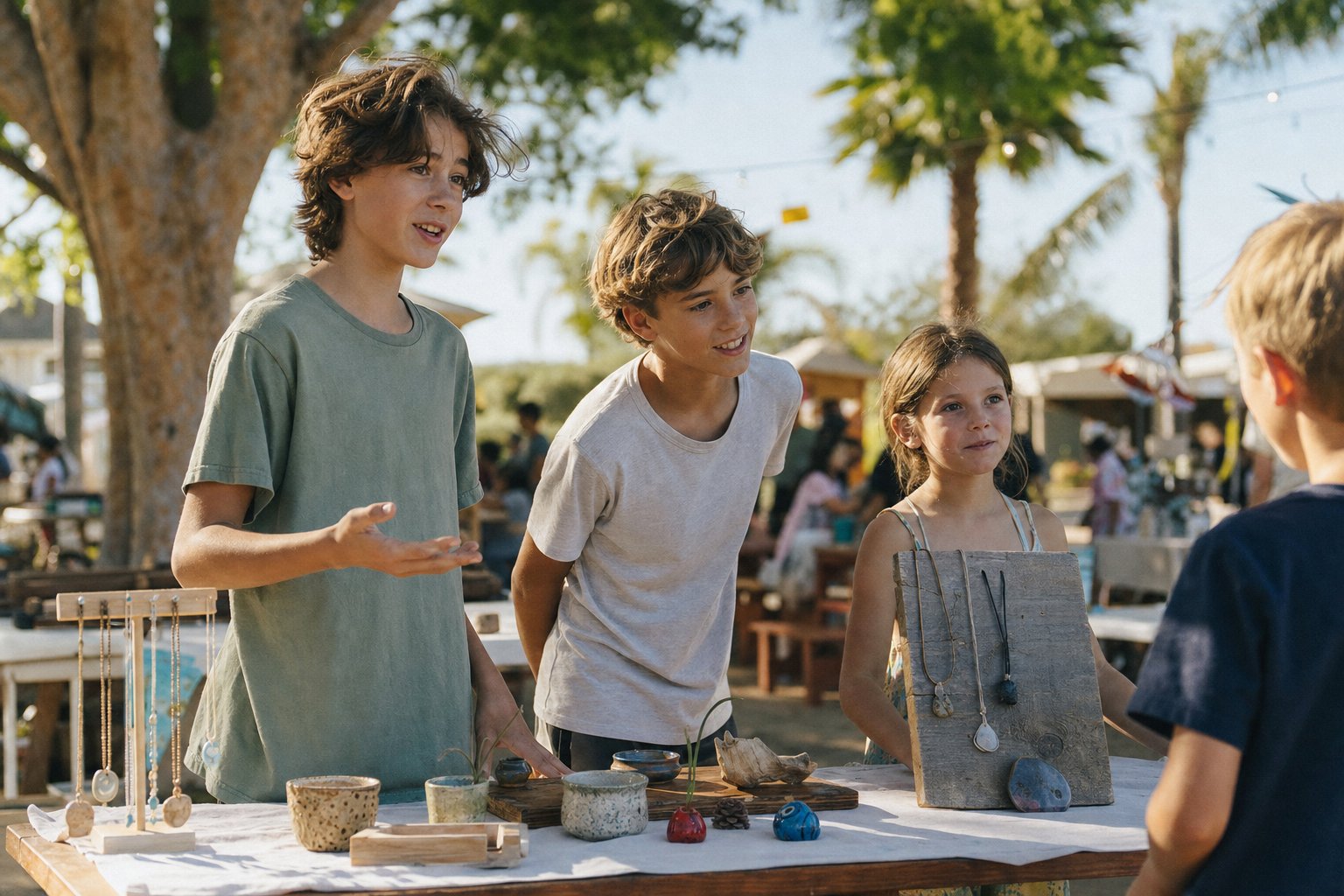
At Wonderstorm, a younger student might spend part of their day working through a mathematics challenge by designing the pricing structure for a small product they want to sell at the school's Kid's Market event. A real community market where students build, pitch, and operate actual businesses for a live audience. The math is not a worksheet exercise. It is a real decision with real consequences, and the child made the choice to pursue it.
An older student might be developing a persuasive argument about a historical turning point through Socratic discussion. A structured dialogue where students question each other's reasoning, defend their positions, and learn to disagree with both conviction and grace. This is not a debate club that meets on Thursdays. It is how history is taught.
The school's mixed-age learning environment means a twelve-year-old and a nine-year-old might be working on related problems in the same space, with the older student taking on a mentorship role that builds the leadership capability the curriculum names explicitly. Small class sizes mean every child is known by name, challenged as an individual, and coached rather than managed.
The Communication pillar includes public speaking, persuasion, social skills mastery, and what the school calls social calibration. The ability to read a room and adjust in real time. This is taught through live exercises and real interactions with real audiences, not through instruction about social skills delivered to rows of seated students.
The Entrepreneurship pillar ensures that financial self-sufficiency is a felt experience before graduation, not a lesson delivered in a semester. Students learn to identify problems people will pay to have solved, build real products, understand pricing and margin, write copy that sells, and pitch to real buyers. By the time a Wonderstorm student is seventeen, they have built multiple businesses. Not simulated ones.
The College Question, Answered Directly
For families in South Orange County weighing a non-traditional private school, the college question is almost always the first objection. It deserves a direct answer.
Wonderstorm offers a specific college pathway that reframes the entire conversation. Rather than competing with 40,000 other high school seniors for a 9 percent acceptance rate at a University of California campus, a Wonderstorm student can complete an associate degree and all transfer coursework by age 18. They then apply through the transfer admission door, where roughly one in four applicants is admitted. Same university. Same diploma. Approximately 2.5 times the odds of admission, and somewhere between $70,000 and $90,000 in tuition they never have to spend.
For families whose children are not planning a traditional four-year university path, the question is different but the answer is equally direct. A young adult who can walk into any room and connect with people effortlessly, who has already built real businesses, who leads rather than waits to be told. That person has an advantage in every setting: trade school, entrepreneurship, career, friendship, and life. The three lenses of Leadership, Entrepreneurship, and Powerful Communication are not preparation for college. They are preparation for everything.
The school also draws families from across the region. Mission Viejo, San Clemente, Dana Point, Aliso Viejo, Rancho Santa Margarita, Laguna Niguel, Lake Forest, San Juan Capistrano, Laguna Beach, Newport Coast, Coto de Caza, Las Flores, Trabuco Canyon, Ladera Ranch, and Portola Hills. Which speaks to something real. Families do not drive past dozens of closer schools because of marketing. They do it because what they found at Wonderstorm is not available anywhere else in South Orange County.
One parent, Elizabeth Hoefer, whose family has multiple children at the school, described her middle daughter's trajectory: the student left the public school system after sixth grade with significant educational trauma, enrolled at Wonderstorm, and as a tenth grader completed four college classes through a dual enrollment program at Saddleback College. Finishing all high school requirements an entire year early. Her daughter has since decided to pursue education as a career, specifically because of the experience.
What to Do If This Resonates
If you have been searching for a private school where your child has a genuine say in their own education. And you have been finding results dominated by Sudbury schools, democratic education collectives, and models that require a cross-country move. Wonderstorm Academy is worth a direct conversation.
The enrollment process is intentionally consultative. It begins with a call, moves to a campus tour, and ends with a decision made by families who have seen the school in person and met the community. That is not a sales funnel. It is a filter for families who are genuinely ready to choose something different.
Alternative K-12 education in Laguna Hills does not have to mean choosing between academic rigor and a child who owns their learning. It does not have to mean an online program, a franchise model, or an informal collective with no structure. It means Wonderstorm: a full-time, on-site private school in South Orange County where every subject is taught through the three lenses of Leadership, Entrepreneurship, and Powerful Communication, and where every child is known, challenged, and trusted to grow into the highest version of who they are meant to be.
The version of your child who graduates from a school like this is not waiting for permission. They have already been building for years.
Schedule your campus tour and see Wonderstorm in person