Real-World Skills Your Kid's School Isn't Teaching
Something is off. Your child is bright, curious, full of questions at home. And somewhere between the bell and the worksheet, that spark goes quiet. You are not imagining it. The system was not designed to fan it.
The 15,000-Hour Question
A child who starts kindergarten and graduates from high school will spend approximately 15,000 hours inside a classroom. That is a staggering investment of the most formative years of a human life. The question worth asking. The one most school tours never raise. Is not whether those hours are being filled. It is what they are building.
"The question is not whether those hours are being filled. It is what they are building."
Across South Orange County, from Laguna Hills to Mission Viejo to Ladera Ranch, parents who describe themselves as intentional. Parents who think carefully about nutrition, screen time, values, and community. Are increasingly asking a harder version of that question. They are not asking whether their child's school is safe or staffed by caring teachers. Most are. They are asking whether the model itself, the one-size-fits-all, seat-time-and-test-prep architecture that has defined American K-12 for over a century, was designed to produce what their child actually needs to thrive in the world that is coming.
The honest answer is no. And understanding why is the first step toward finding something better.
What Traditional Schooling Was Actually Built to Do
The modern public school model was largely designed in the late 19th and early 20th centuries to prepare a population for industrial-era work. Compliance, consistency, and the ability to follow sequential instructions were not incidental outcomes. They were the point. Sit in rows. Wait for the bell. Do what the teacher says. Move to the next station.
That model produced exactly what the economy of 1920 needed. It is not what the economy of 2026. Or 2040. Needs from your child.
The World Economic Forum, McKinsey, and dozens of employer surveys over the past decade have identified the same cluster of skills as most critical for the coming workforce: critical thinking, communication, initiative, adaptability, and entrepreneurial problem-solving. These are not electives. They are not personality traits. They are learnable capacities. And they are systematically underbuilt by a model that rewards memorization and penalizes deviation.
This is not a critique of individual teachers, many of whom are extraordinary. It is a structural observation. A system optimized for standardized outcomes cannot simultaneously optimize for individual agency. It has to choose.
What Real-World Skills Actually Look Like for Kids Ages 5 to 18
Before a parent can evaluate whether a school builds real-world skills, it helps to name what those skills concretely are across different developmental stages.
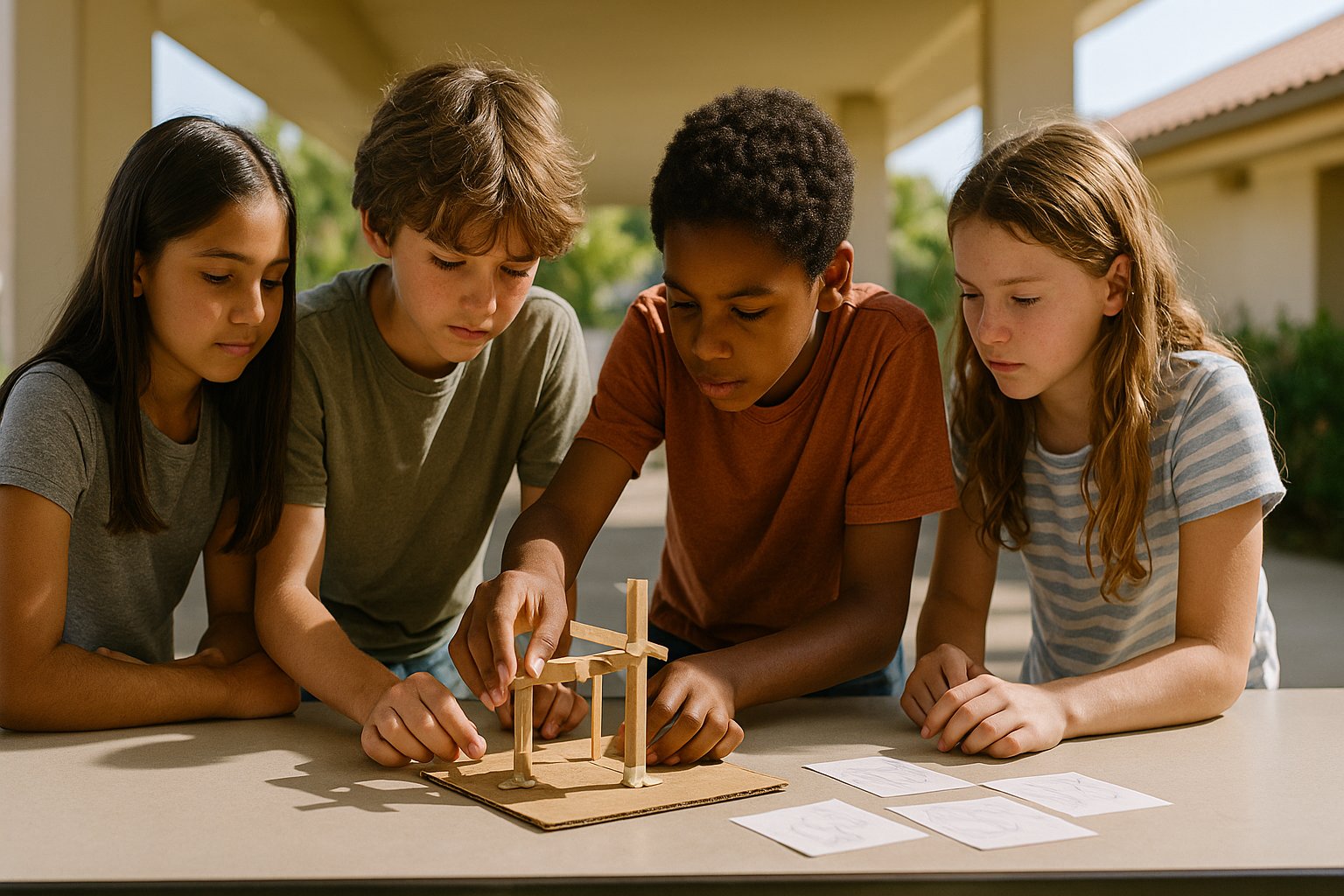
For younger children, ages 5 through 10, real-world readiness looks like: learning to articulate an idea to a room, making decisions and living with the consequences, collaborating on a project that has no single right answer, and developing the internal discipline to pursue a goal across multiple days or weeks without external reward.
For older children and teens, ages 11 through 18, it looks like: identifying a real problem in a community and designing a response, building and pitching a business concept, leading a team through disagreement, communicating with clarity under pressure, and developing a portfolio of actual work. Not a transcript of grades, but evidence of things built and lessons earned.
None of these are soft. They are among the hardest things a human being learns to do. And they are almost entirely absent from a curriculum calendar built around AP test preparation and standardized benchmarks.
"A portfolio of actual work. Not a transcript of grades, but evidence of things built and lessons earned."
Parents in communities like Aliso Viejo, Rancho Santa Margarita, Dana Point, and San Clemente are not anti-academic. They want rigorous math and genuine literacy. What they are increasingly unwilling to accept is the false choice between academic rigor and real-world preparation. As though a child cannot learn to write compellingly while also learning to pitch an idea, or cannot master mathematics while also learning to manage a budget.
Why Micro-Schools Are the Fastest-Growing Alternative in Orange County
The growth of micro-schools. Small, intentional, often privately operated learning communities with 20 to 100 students. Is one of the most significant structural shifts in American education since the charter school movement of the 1990s. Independent research and education observers estimate that the number of formal micro-school programs in the United States grew from a few hundred before 2020 to several thousand by 2024.
The reason is not novelty. It is fit.
A micro-school can do things a large institution structurally cannot. It can know every student by name and learning style. It can redesign the day around projects and mastery rather than seat time and coverage. It can build genuine relationships between students across age groups, the kind that produce real mentorship and leadership practice. And it can move. Adapting curriculum, pace, and focus in response to what students actually need, rather than what a district calendar prescribes.
For families in Laguna Hills, Lake Forest, Newport Coast, Laguna Niguel, and surrounding South Orange County communities, the micro-school question has shifted from "is this a real option?" to "which one is actually built on something proven?"
That distinction matters enormously. Not every small school is a good school. The size is not the differentiator. The philosophy is.
What Wonderstorm Academy Is Actually Built Around
Wonderstorm Academy is a private K-12 micro-school located at 25332 McIntyre St in Laguna Hills, serving children ages 5 through 18 across a full, on-site campus. It is not a hybrid program. It is not a homeschool co-op. It is a fully operational, five-day-a-week learning community built around three specific lenses that replace the compliance-and-coverage model with something fundamentally different.
Those three lenses are Leadership, Entrepreneurship, and Powerful Communication.
They are not electives. They are not a club that meets on Thursdays. They are the organizing framework through which core academics are taught and through which students spend their days. A student at Wonderstorm is not learning about leadership in the abstract. They are practicing it. Through project teams, through real-world challenges, through the daily experience of making decisions that have actual consequences inside a community that holds them accountable.
Entrepreneurship at Wonderstorm is not a unit on how businesses work. It is the repeated experience of identifying a problem, designing a response, testing it, failing, iterating, and building something real. Students graduate not just with a transcript but with a portfolio of ventures, projects, and leadership experiences that demonstrate what they can actually do.
Powerful Communication is taught as a discipline, not a personality trait. Students learn to articulate ideas with clarity, to advocate for a position under pressure, to listen and respond rather than simply wait for their turn to speak. These are skills that most adults wish they had been taught earlier. At Wonderstorm, they are built from age five.
The school operates within the Apogee Strong network. A nationally recognized student-led education framework. Giving families access to a proven, values-aligned model with a documented track record, not an untested local experiment.
The real question isn't whether your child's school is good. It's whether it's built for the life your child is actually going to live.
Families from Coto de Caza, Las Flores, Trabuco Canyon, Portola Hills, San Juan Capistrano, Laguna Beach, and across South Orange County have found in Wonderstorm a school that finally matches what they already believe about how children learn and who they are capable of becoming.
The Objection Every Thoughtful Parent Raises
When parents first encounter a school like Wonderstorm, the most common question is not "does this sound good?" It almost always sounds good. The question is: "But will my child be prepared for college?"
It is a fair question and it deserves a direct answer.
Student-led, project-based education does not sacrifice academic rigor. It recontextualizes it. Mathematics taught inside a real financial problem is not less rigorous than mathematics taught as an abstract sequence of procedures. It is more demanding, because the student must understand it well enough to apply it. Writing developed through real persuasion and real pitches is not less rigorous than five-paragraph essay drills. It is more rigorous, because it must actually work on a real audience.
The Apogee Strong framework, within which Wonderstorm operates, has produced graduates who have gone on to colleges and universities, launched businesses, and built careers. The model is not anti-academic. It is anti-passive. There is a meaningful difference.
Parents who are concerned about standardized benchmarks, college readiness, and academic accountability should bring those questions directly to Wonderstorm's team. The enrollment process is designed exactly for that conversation. A personal call, a campus tour, and a genuine dialogue about whether the fit is right. Not every family is the right fit. That honesty is itself a signal of integrity.
The Transparency Parents Now Demand
In 2026, the most informed parents are approaching school selection the way investigative journalists approach a story. Examining governance, safety policies, curriculum philosophy, and real outcomes before committing. This is healthy. It is exactly the scrutiny that good schools should welcome.
Wonderstorm's model is built to withstand that scrutiny. A fixed, on-site campus in Laguna Hills. A clear, named educational philosophy. A defined enrollment process. An affiliation with a nationally recognized network. These are not marketing claims. They are verifiable facts that families can examine before they ever set foot on campus.
For parents in South Orange County who are done waiting for a large institution to change, and who are ready to choose an environment built around who their child is and who they are becoming, the question is not whether an alternative exists. It does. The question is whether this is the right one for your family.
Frequently Asked Questions
Does Wonderstorm Academy follow a standard academic curriculum, or is it entirely project-based? Wonderstorm integrates core academics. Mathematics, language arts, science, and more. Within its project-based, student-led model. The goal is not to replace academic rigor but to teach it through real-world application, so students develop genuine mastery rather than test-preparation fluency. Families with specific questions about academic scope and sequence are encouraged to ask during the enrollment call.
What ages does Wonderstorm Academy serve, and where is it located? Wonderstorm Academy serves children ages 5 through 18 across a full K-12 range. The school is located at 25332 McIntyre St in Laguna Hills, California. A fully on-site, five-day-a-week campus serving families throughout South Orange County, including Mission Viejo, Aliso Viejo, Rancho Santa Margarita, Laguna Niguel, Lake Forest, Dana Point, San Clemente, San Juan Capistrano, Newport Coast, Laguna Beach, Coto de Caza, Ladera Ranch, and surrounding communities.
What does "student-led" actually mean in practice at Wonderstorm? Student-led means students have meaningful agency over their learning goals, the pace at which they pursue mastery, and the projects they undertake. Within a structured, accountable community. It does not mean unstructured or unsupervised. Students are held to high expectations by peers, mentors, and the real-world standards of the projects they pursue. The difference is that the motivation is internal and purposeful, not compliance-based.
How does Wonderstorm Academy prepare students for college admissions? Wonderstorm's student-led model builds the skills. Critical thinking, communication, self-direction, and a demonstrated portfolio of real-world work. That selective colleges and universities increasingly value alongside GPA and test scores. The school operates within the Apogee Strong network, a nationally recognized framework with a track record of graduate outcomes. Specific questions about college preparation are best addressed in the enrollment conversation with the school's team.
What is the enrollment process, and how do I find out if Wonderstorm is right for my family? The enrollment process begins with a personal call to explore whether Wonderstorm is the right fit for your child and family. That conversation is followed by a campus tour in Laguna Hills, where you can see the environment, meet the team, and ask every question on your list. Wonderstorm is intentionally selective. Not because of exclusivity, but because the model works best when the community shares a genuine alignment of values and vision. Book your call or schedule a campus tour today to begin that conversation.
Research sources8
Live web research informed this article. These are the sources it drew on.
- Soluções Inteligentes de Marketing Orgânico & E-commercewonderstores.pt2025-01-01
- Răspunsuri rapidewonderstore.ro2023-10-17
- Wondershare Help Centersupport.wondershare.com
- Securitate si confidentialitatewonderstore.ro2023-10-17
- Log into Facebookfacebook.com
- Wonder Support - Wonder Apphelp.wonder.app
- Download and Install Help for ...support.wondershare.com
- Wonderstores is rated "Great" with 4 / 5 on Trustpilottrustpilot.com2025-07-01