Straight A's Without Real Skills: The Gap Nobody Talks About
Your child brings home a report card that any parent would be proud of. Straight A's, honor roll, glowing teacher comments. And yet something quiet is bothering you. A feeling you haven't quite named yet.
The Report Card Nobody Sends Home
There is a version of academic success that looks perfect on paper and leaves a child fundamentally unprepared for the life waiting on the other side of graduation. Not because they didn't work hard. Not because the teachers didn't care. But because the system they were trained inside was optimized for something different than what you actually want for them.
Conventional schooling. Whether it's a public school or the most expensive private school in Orange County. Is built around a single core methodology: rote learning. Memorizing information through repetition until it sticks well enough to pass a standardized test. Drill the dates. Drill the formulas. Reproduce them on demand. Move on.
The problem isn't that academic knowledge is worthless. It isn't. The problem is that rote learning produces students who are very good at following instructions and very inexperienced at anything else.
A student who has priced a product, tracked their own margins, and watched a bad number eat their profit understands percentages in a way no worksheet can produce.
And the skills that actually determine the shape of an adult life. How they communicate, how they lead themselves and others, how they create value from nothing. Are never on the report card. They are treated, at best, as extracurriculars. Add-ons. Things a child might pick up somewhere along the way, if they're lucky.
What the Research Actually Says
A 2025 study on empowering K-12 students found that structured problem-solving and collaboration activities significantly improved students' ability to analyze complex situations compared to conventional lecture-based instruction. Straight A's in a traditional setting did not automatically translate into stronger problem-solving ability.
Multiple project-based learning studies from 2024 and 2025 report that students in student-led environments show stronger entrepreneurial competencies, communication skills, and self-efficacy than peers in traditional classrooms with similar grades.
The research is pointing at something parents have been feeling for years. You can have a high-performing student on paper who has never once led a team through a long project. Who has never pitched an idea to a real audience. Who has never owned a complex problem from start to finish and figured out how to solve it.
Those experiences are what build the confidence, initiative, and capability to navigate real life. Not GPA alone.
The Capability Gap in Plain Terms
Here is a useful thought experiment. Imagine your child at 19. Two versions.
Version one has excellent grades. Has been told since kindergarten to sit down, pay attention, and produce the right answer. Has been rewarded, consistently, for compliance and recall. Walks into their first job interview, their first semester of university, their first real challenge. And waits. Waits for someone to tell them what to do next.
Version two has spent their school years leading real projects, pitching ideas to live audiences, building actual businesses, navigating failure, and developing the communication skills to walk into any room and hold it. This version doesn't wait. This version creates.
The difference isn't potential. Both children may have the same raw intelligence. The difference is what their education was built around for 13 years.
This is the gap that parents in South Orange County. In Laguna Hills, Mission Viejo, Laguna Niguel, Aliso Viejo, San Clemente, Dana Point, Rancho Santa Margarita, Lake Forest, San Juan Capistrano, Laguna Beach, Newport Coast, Coto de Caza, Las Flores, Trabuco Canyon, Ladera Ranch, and Portola Hills. Are waking up to. And it is exactly the gap that a genuinely different kind of private K-12 school is designed to close.
What It Looks Like When Education Is Built Differently
At Wonderstorm Academy, a private micro-school in Laguna Hills serving children ages 5 through 18, the five core academic subjects. Reading, writing, math, science, and history. Are all still taught. Rigorously. But they are not the finish line. They are the raw material.
Every subject is taught through three foundational lenses: Leadership, Entrepreneurship, and Powerful Communication. These are not electives. They are not extracurriculars tacked onto the end of the day. They are the actual curriculum through which all academic learning happens.
Students don't just study history. They step into the shoes of the most influential figures at the most critical moments in history, debate the decisions those figures faced, and defend their positions in Socratic discussions that sharpen both critical thinking and clear communication.
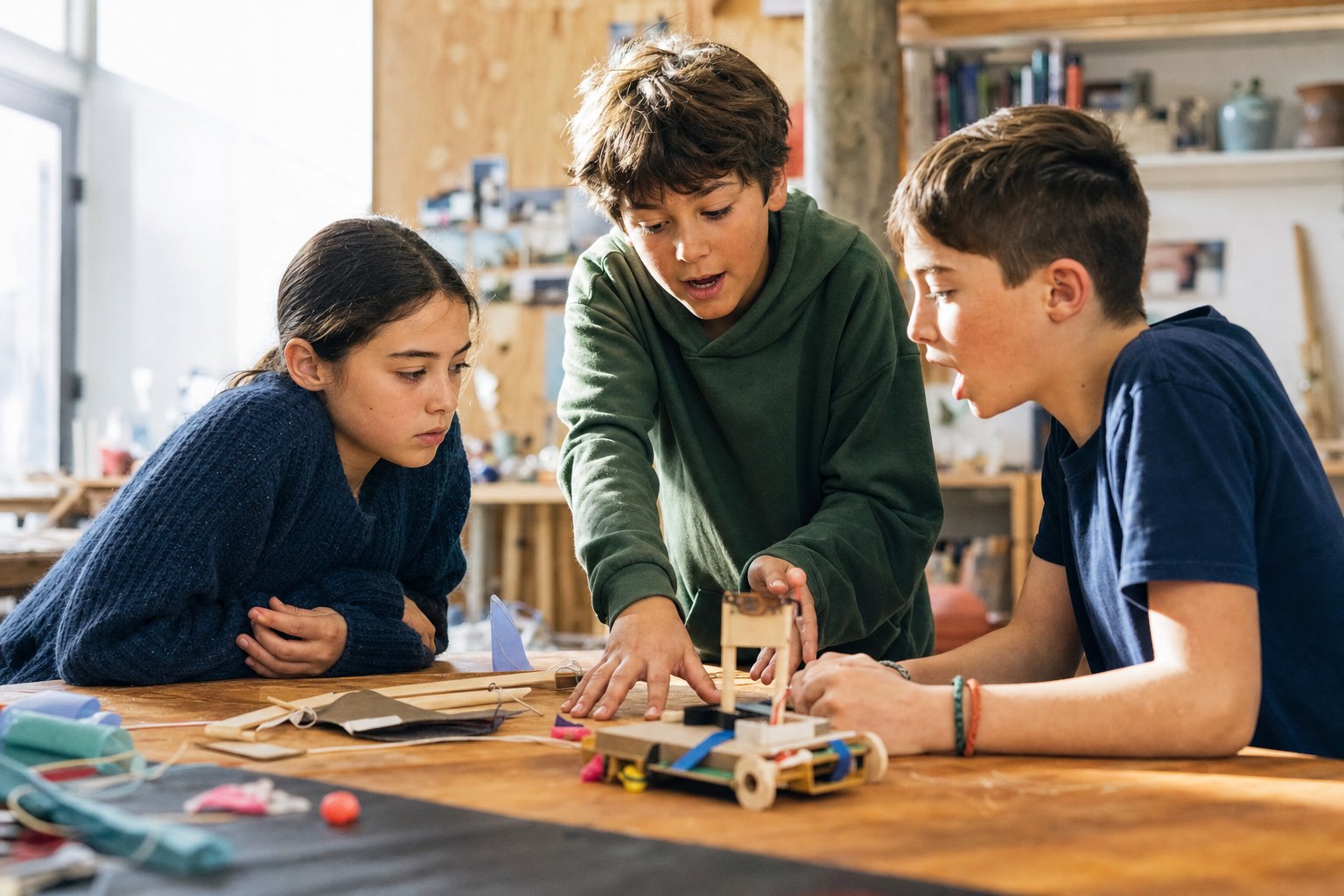
They don't just learn math. They launch real businesses, price real products, track real margins, and discover what it actually feels like when a bad number eats your profit. A student who has lived that experience understands percentages in a way no worksheet can produce.
This is what project-based elementary and middle school learning looks like when it's taken seriously. Not as a pedagogical trend, but as the organizing principle of the entire school.
The goal isn't compliance. It's capability. Not standardized outcomes, but extraordinary individual outcomes.
The entrepreneurship education for kids at Wonderstorm isn't a class. It is woven into the daily fabric of how students learn to create value, identify real problems people will pay to solve, build and pitch real products, and understand the mechanics of financial self-sufficiency. A 2024 study on entrepreneurship education using a project-based learning model found that students showed significant increases in entrepreneurial interest and readiness after designing and implementing real projects tied to community or business ideas. Last spring, a 10-year-old in Laguna Hills stood in front of a live community audience and pitched a product she had built herself. She set the price. She handled the questions. She walked away knowing she could do it again.
The Communication Pillar: What It Actually Builds
Powerful Communication is one of the three core lenses at Wonderstorm, and it begins at age five and deepens in complexity through 12th grade.
This is not a public speaking class. Students develop articulate, persuasive, charismatic, socially fluent communication through real-world in-field training, social calibration exercises, and Socratic debate. They learn to read a room and adjust in real time. They learn to politely disagree and be completely at ease being disagreed with. They learn to write in a way that moves people to act.
Through activities like the Comedy Improv Battle Arena, students learn to relax under pressure, think on their feet, and build the social courage that helps them excel in any setting. Fluid intelligence, adaptability, creativity, and humor are developed through genuine challenge. Not instruction about those qualities, but lived experience of them.
A child who grows up to be a powerful communicator has a massive unfair advantage over one who does not. Every intelligent parent knows this. Most schools do nothing about it.
The College Path Objection, Answered
The most common concern parents raise when they encounter a genuinely alternative private school is this: will my child still be able to get into a good university?
It's a fair question. Here is a fair answer.
There are two doors into the University of California. The first is the one most families know: four years competing with over 40,000 high school seniors. Top grades, exceptional SAT scores, students from the most expensive private schools in the country. For a 9% acceptance rate. Then four full years of university expenses.
The second door is the Wonderstorm college path. Students complete an associate degree and all transfer coursework by age 18, then apply as transfer students. A pathway where 1 in 4 applicants is admitted. Same university. Same diploma. Roughly 2.5 times the odds of getting in, and approximately $70,000 to $90,000 they never have to spend for the two years they shaved off.
This is not a compromise. It is a smarter path to the same destination, built on a foundation of genuine capability rather than credential accumulation.
For families whose children are not college-bound, the case is even simpler. Leadership, entrepreneurship, and powerful communication are the skills that determine who gets hired, who gets promoted, who builds something, and who becomes the person everyone wants to work with. Whether your child is headed to a four-year university, a trade, a startup, or something that doesn't exist yet. Those three things are what will determine the shape of their life.
What This Means for Your Decision
The question at the top of this article deserves a direct answer.
If your child graduated tomorrow with straight A's but had never led a project, pitched an idea, or solved a real problem. No, that is not a success. It is a credential. And credentials, in an AI-driven world that rewards creativity, initiative, and the ability to build, are becoming a thinner and thinner substitute for actual capability.
The good news is that South Orange County families no longer have to choose between academic rigor and genuine human development. A full-time, on-site private K-12 school exists in Laguna Hills that delivers both. Not as competing priorities, but as a single integrated model.
Wonderstorm Academy's student-led education model is built around one question: what would it take to help this child become the kind of person who can confidently create the life they want? The answer shapes everything that happens on campus, every day, from kindergarten through 12th grade.
The enrollment process begins with a conversation. Not a form. A real call with the people who built this school. Including Holly Yarbrough, who enrolled her own children here. To find out whether Wonderstorm is the right fit for your family.
If you are ready to find out, Book a Call to See If Wonderstorm Is Right for Your Family.
Research sources2
Live web research informed this article. These are the sources it drew on.
- Volume 7 Number 4 June 2024pdfs.semanticscholar.org
- PENGARUH PENDIDIKAN KEWIRAUSAHAAN BERBBASIS ...journal.unpas.ac.id2024-09-04