The 10-Year-Old Who Pitched a Real Product at School
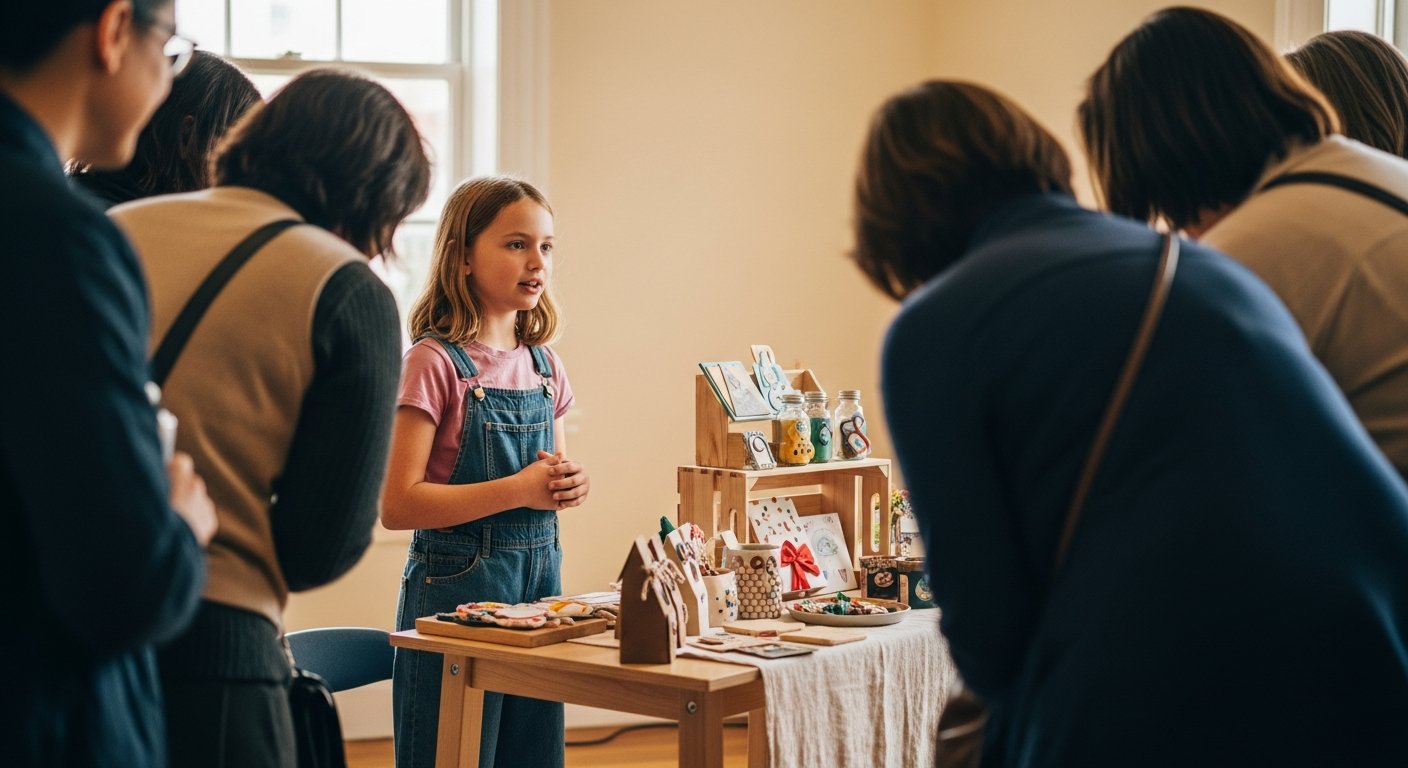
Last spring, a 10-year-old in Laguna Hills stood in front of a live community audience and pitched a product she had built herself. She set the price. She handled the questions. She counted the revenue. This was not a club activity, an after-school program, or a science fair. It was a Tuesday.
What Actually Happened That Day
The family had enrolled their daughter at Wonderstorm Academy, a private K–12 micro-school in Laguna Hills, after a year of watching her disengage from a traditional classroom that had no room for the way her mind worked. She was not struggling academically. She was bored in a way that was starting to harden into something worse. A belief that school was a place where you waited, not a place where you built.
One semester into her time at Wonderstorm, she stood at a table at the school's Kid's Market event and pitched a real product to a real audience. Her parents watched from a few feet away, trying to stay composed.
The moment a child discovers she can build something, price it, defend it, and sell it. That is not a school activity. That is the beginning of a life orientation.
This is what entrepreneurship education for kids looks like when it is taken seriously. Not as an elective, not as enrichment, but as the architecture of the entire school day.
Why Most Schools Cannot Do This
The traditional K–12 model was designed for a different century and a different economy. It optimizes for compliance and recall: sit in a seat, absorb the material, reproduce it on a test, advance to the next grade. For a certain kind of student, this works tolerably well. For a growing number of students. Particularly those with entrepreneurial instincts, creative energy, and a need to build rather than receive. It is a slow-motion mismatch.
The problem is structural, not personal. A classroom of 28 students, a fixed curriculum, and a bell schedule that moves every 50 minutes cannot, by design, create the conditions for a child to develop a product concept, refine it through feedback, build a prototype, price it, and present it to a live audience. There is simply no room in the architecture.
Alternative K-12 education in Laguna Hills and across Orange County has grown precisely because this structural mismatch has become impossible for intentional parents to ignore. The data point that tends to stop a room: the average K–12 student spends roughly 15,000 hours in school. At the end of those 15,000 hours, most graduates cannot run a meeting, pitch an idea, or navigate an unscripted problem. They can, however, identify the themes in a novel they did not choose to read and solve for x on a worksheet they will never see again.
The Three Lenses That Change Everything
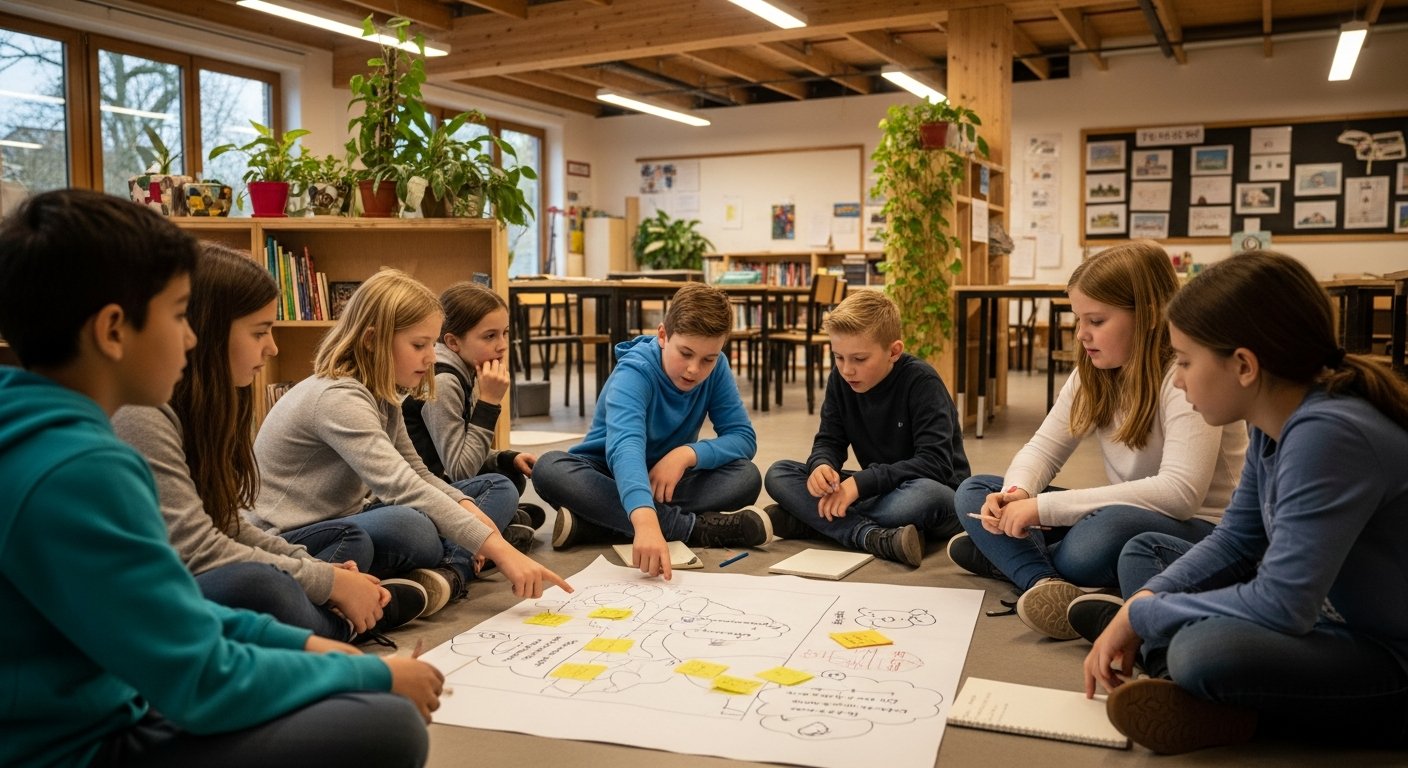
Wonderstorm Academy is a private school in Laguna Hills operating within the Apogee Strong micro-school network. A framework recognized as one of the leading models of K–12 innovation in the United States. The curriculum is organized around three interlocking lenses that run through every subject, every project, and every school day: Leadership, Entrepreneurship, and Powerful Communication.
These are not courses. They are not clubs. They are the organizing logic of the entire learning environment. A student working on a math concept is also working on how to explain her reasoning to a peer group. A student building a product for the Kid's Market is also studying cost structure, customer feedback, and the mechanics of a persuasive pitch. A student leading a team project is learning to navigate disagreement, delegate tasks, and own outcomes.
This is the mechanism that made it possible for a 10-year-old to stand in front of a live audience after one semester and perform like someone who had been doing this for years. She had been. Every single school day was practice.
What the Apogee Strong Framework Actually Delivers
Parents exploring microschool Orange County options often encounter a crowded and confusing landscape: online-only programs, loosely structured co-ops, and franchise models that promise innovation but deliver a slightly smaller version of the same system. The question worth asking is whether the alternative has a proven framework behind it or whether it is, as one parent put it, someone's well-intentioned experiment.
Wonderstorm's alignment with the Apogee Strong network and its connection to the learner-driven model used by innovative micro-schools globally answers that question directly. This is not a local experiment. It is the local delivery of a nationally validated system. One that has produced self-directed, entrepreneurially capable graduates across dozens of campuses. The campus at 25332 McIntyre St in Laguna Hills is where that framework becomes real for Orange County families.
For families navigating school choice ESA California conversations, this distinction matters enormously. The question is not just whether an alternative school exists, but whether it has the institutional depth, the pedagogical rigor, and the track record to justify the decision to leave the conventional path. Wonderstorm's network affiliation is the honest answer to that concern.
A learning center that builds entrepreneurs from age four is not making a promise about the future. It is describing what happens every morning when the doors open.
The College Question Every Parent Asks
The most common objection from parents considering a private K-12 school outside the conventional track is the college question. Will my child be prepared for college admissions? Will they have the transcripts, the test scores, the academic benchmarks that selective universities want?
It is a fair question, and it deserves a direct answer rather than a pivot. The honest answer is this: self-directed learners who know why they are pursuing higher education, who can articulate a clear vision for their life and work, who have a portfolio of real projects and real leadership experiences. These students are precisely what college admissions offices say they are looking for. The student who can describe the product she built at age ten, the team she led at fourteen, and the apprenticeship she completed at sixteen is telling a story that a transcript alone cannot tell.
Rigor and entrepreneurship are not in tension at Wonderstorm. Core academics are embedded in the model. The difference is that the academics serve the learner's development rather than the other way around. A student who is genuinely curious, genuinely engaged, and genuinely accountable for her own learning trajectory covers more ground. And retains more of it. Than a student who is performing compliance for a grade.
This is the reframe that changes everything for parents who have been watching a bright, capable child go through the motions of school for years.
The Enrollment Window Is Narrow. And Intentional
Wonderstorm keeps its cohorts small by design. This is not a limitation of the model. It is the model. Every child in a micro-school of this kind is genuinely known by the adults in the room. There is no version of the three-lens framework. Leadership, Entrepreneurship, and Powerful Communication. That works at scale the way a traditional school operates at scale. The intimacy is the mechanism.
As one Wonderstorm parent, Elizabeth Hoefer, described it after watching multiple generations of her family move through the school: her daughter arrived with significant educational trauma after leaving the public system in sixth grade, and left as a tenth grader who had completed four college courses through dual enrollment and decided to make education her career. Her younger daughter entered a full year ahead of grade level. Her granddaughter is thriving. This is what the learning center environment produces when the model is working. Not just academic recovery, but a complete reorientation of a child's relationship to learning.
Not a sales call. A tour. Come and watch what a learner-driven school day looks like in practice. Watch the 10-year-olds run their own projects. Watch the teenagers lead their own discussions. Watch what happens when a school is built around what a child can become rather than what a child can memorize.
The 10-year-old who pitched her product last spring did not do something unusual for a Wonderstorm student. She did something that is entirely usual here. And entirely rare everywhere else.
Book your campus tour at Wonderstorm Academy and see if this is the right fit for your family. Spots for the 2026–2027 school year are limited by design.
David Yarbrough
Co-Founder
Dave Yarbrough is the founder of Wonderstorm Academy, a devoted husband and father of six, and a lifelong student of human potential. For more than 25 years, he has explored how education can help children flourish intellectually, socially, and personally. His vision is to create a new model of learning that expands what is possible for children and for education as a whole. Dave holds a Bachelor of Arts in Philosophy from UC Santa Barbara.
More from David Yarbrough →