The Homework Debate Orange County Parents Are Finally Winning

Something shifted in Orange County this year. At dinner tables in Laguna Hills, in the comment threads of local Facebook groups, on the sidelines of Saturday soccer games, parents who spent years quietly tolerating the nightly homework grind are finally saying it plainly: this is not working for our kids. The question they're asking is not how to manage homework better. The question is whether homework. And the model that produces it. Was ever designed for the children they're raising.
The Real Homework Debate Is Not About Homework
The surface argument about homework is familiar. Too much of it causes stress. Too little of it signals low expectations. The research is genuinely mixed, and school administrators have been navigating parent pressure on both sides for decades. But the parents driving the most urgent conversations in Orange County right now are not arguing about quantity. They have moved past that. They are asking a more fundamental question: what is all of this schooling actually building in my child?
The average K–12 student spends roughly 15,000 hours inside a school system. That figure is not disputed. What is increasingly disputed. By researchers, by employers, by the parents watching their children come home depleted every evening. Is what those hours are producing. Homework that rehearses passive recall. Tests that measure compliance with a curriculum rather than genuine understanding. A daily structure optimized for institutional management rather than individual development.
The parents driving the most urgent conversations in Orange County are not arguing about homework quantity. They are asking what 15,000 hours of schooling is actually building in their child.
This is the real homework debate. And it is arriving at a cultural moment when the stakes feel unusually high. Artificial intelligence is reshaping the economy faster than any school district's curriculum committee can respond. The jobs that will define the next twenty years will reward leadership, communication, and entrepreneurial problem-solving. Precisely the capacities that standardized schooling is least equipped to develop. Orange County parents who work in technology, business, and creative industries are not abstractly worried about this. They are watching it happen in real time and looking at their children's homework folders with a new and unsettling clarity.
What Parents Are Actually Saying
The language parents use when they talk honestly about this is not the language of education policy. It is personal and specific. One parent describes watching her son. A genuinely curious, inventive kid. Spend forty-five minutes filling in blanks on a worksheet about a chapter he had already understood in ten minutes of reading. Another describes her daughter, who could hold a room of adults at a dinner party, shutting down completely during oral presentations at school because the format felt punishing rather than empowering. A third describes the moment he realized his child had no idea how to manage a project from start to finish, despite straight A's, because every task at school came pre-scoped, pre-timed, and pre-graded.
These are not complaints about bad teachers. Most of these parents have deep respect for the educators their children work with. The frustration is structural. It is directed at a system that asks teachers to deliver a standardized curriculum to thirty students simultaneously, measure outcomes through a narrow testing framework, and somehow also develop the whole child. That is an impossible brief, and the homework that arrives in backpacks every evening is the most visible symptom of a system straining under its own design.
What these parents are searching for. And increasingly finding. Is an alternative that does not ask them to choose between academic rigor and real-world preparation. They want both. They believe both are possible. And in the growing micro-school movement taking root across Southern California, some of them are discovering that the either-or framing was a false choice all along.
The Rise of Alternative K-12 Education in Laguna Hills
The phrase school choice used to belong almost exclusively to policy debates about vouchers and charter school funding. In Orange County today, it has become a dinner-table concept for a specific kind of parent: one who has done the research, weighed the options, and concluded that the default path is not the right path for their family. The rise of alternative K-12 education in Laguna Hills and the broader South OC corridor is not a fringe phenomenon. It is a measurable response to a measurable problem.
Orange County public school enrollment fell approximately 1.7 percent in 2025 to 2026, continuing a multi-year decline that reflects both demographic shifts and something harder to quantify: a growing number of families who have decided the system as designed is not serving their children. Some are exploring homeschool arrangements. Others are investigating hybrid models. A significant and growing cohort is turning to the micro-school model. Small, in-person, campus-based learning communities that replace the industrial-era classroom with something built for the actual demands of the twenty-first century.
The micro-school model that has gained the most traction among intentional OC families is not an experiment. The Apogee Strong network, which includes schools aligned with the learner-driven framework pioneered by Apogee and recognized nationally as a leading model of K-12 innovation, offers families something that neither public schooling nor conventional private school can fully deliver: a coherent, proven alternative built around the development of the whole child across the full K-12 arc.
What a Learner-Driven School Actually Looks Like
For parents who have spent their entire educational life inside the traditional model, the phrase learner-driven can sound either utopian or vague. It is neither. At a school like Wonderstorm Academy. A private K-12 micro-school in Laguna Hills operating within the Apogee Strong network. Learner-driven means something concrete and daily.
At Wonderstorm Academy, the curriculum is not delivered to students. It is built with them, through hands-on projects, Life Skills Labs, and real-world apprenticeships that make leadership, entrepreneurship, and powerful communication the fabric of every school day.
The curriculum is organized around three interlocking lenses: Leadership, Entrepreneurship, and Powerful Communication. These are not elective enrichment programs bolted onto a conventional academic schedule. They are the organizing framework through which core academics are delivered. A student working on a project that requires them to research, design, pitch, and execute a real-world solution is doing mathematics, language arts, critical thinking, and entrepreneurial practice simultaneously. The learning is not fragmented into forty-five-minute subject blocks. It is integrated, purposeful, and alive.
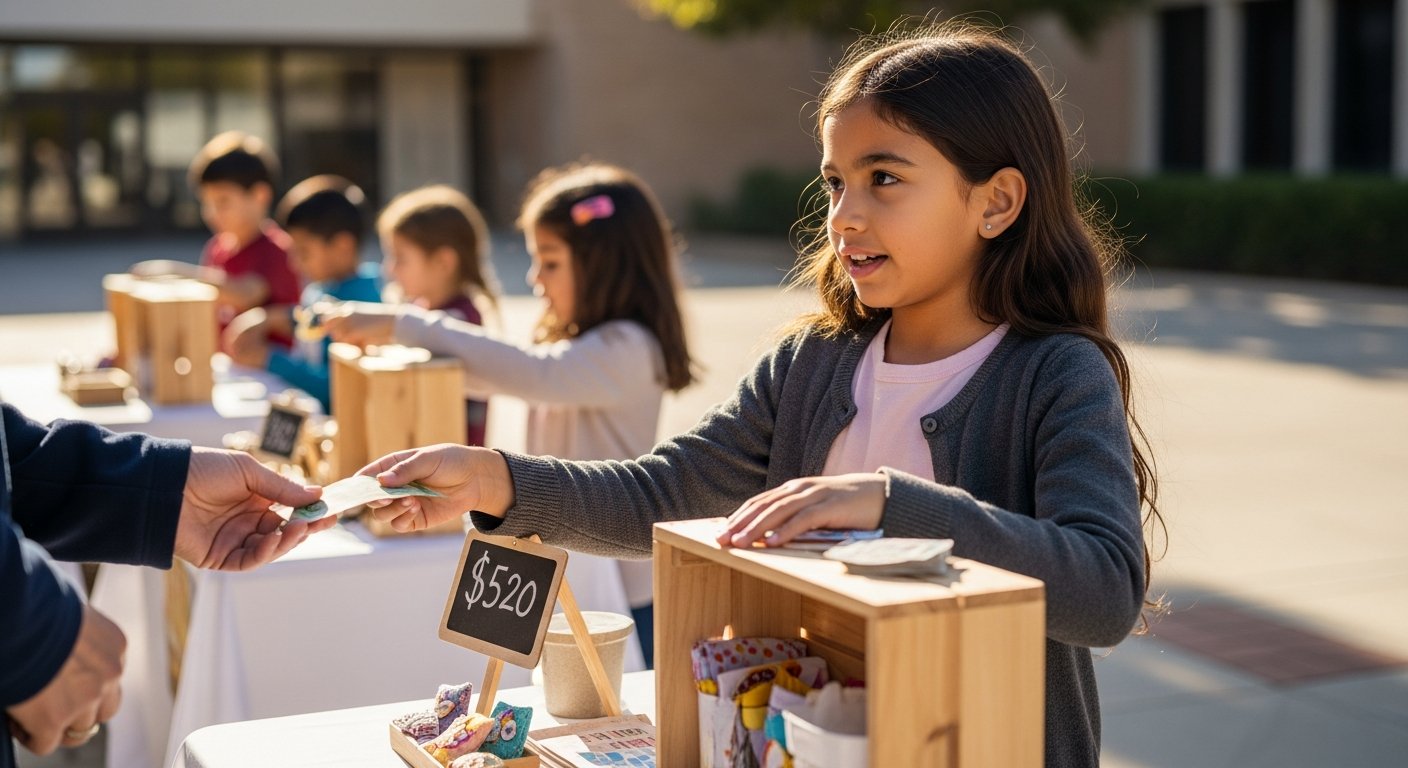
Life Skills Labs give students practical competencies that conventional schooling treats as someone else's job. Financial literacy, project management, interpersonal negotiation, public speaking under pressure. Real-world apprenticeships place students in actual community contexts where they must perform, adapt, and deliver. A third-grade student at a Kid's Market event is not playing at entrepreneurship. She is building a product, setting a price, managing customer interactions, and counting her own revenue. That experience, repeated and deepened across fourteen years of schooling, produces something that no amount of homework can replicate.
This is what entrepreneurship education for kids looks like when it is taken seriously as a developmental framework rather than a one-semester elective. And it is precisely what Orange County parents who have grown frustrated with the homework-and-test cycle are finding when they take a campus tour.
The College Question Every Parent Asks
The objection that surfaces most reliably in conversations about micro-school and alternative K-12 education is the college question. Parents who are drawn to the learner-driven model but educated inside the traditional one carry a deep, legitimate anxiety: will my child be prepared for college admissions? Will the absence of AP courses, standardized test prep, and conventional transcript structures close doors?
This is a fair question and it deserves a direct answer. Students who develop genuine self-direction, strong communication skills, and the demonstrated ability to manage complex projects from conception to completion are not disadvantaged in the college process. They are differentiated in ways that matter. Selective universities have been explicit for years about their appetite for students who have built things, led things, and shown the capacity to pursue meaningful work independently. A student who can walk into an admissions interview and describe the business she built at age twelve, the apprenticeship she completed at fourteen, and the community problem she solved at sixteen is not behind her peers. She is carrying a portfolio that most of her peers cannot match.
The school choice ESA California conversation is evolving, and families exploring alternative K-12 education in Laguna Hills and across Orange County are increasingly aware that the path through a micro-school is not a detour from a rigorous future. It is a more direct route to the capabilities that future actually requires.
What Intentional Families Are Choosing
The parents who ultimately choose a private K-12 micro-school like Wonderstorm Academy over a conventional learning center, a large traditional private school, or a public school placement are not making a decision based on dissatisfaction alone. Dissatisfaction is the starting point. The decision itself is based on something more affirmative: a clear picture of who they want their child to become and a conviction that the model they are choosing is genuinely built to get them there.
Lindsey Jaleh, a Wonderstorm parent, put it this way in a recent review: her daughter, a creative and deeply feeling child for whom transitions had always been difficult, arrived at Wonderstorm and was met with patience, compassion, and a process the guides trusted her to move through at her own pace. Nearly a year later, the transformation was, in Jaleh's words, incredible. Confident. Engaged. Joyful. Genuinely loving school. That is not a marketing claim. That is a parent describing what happens when a child is finally in an environment built for who she actually is.
Elizabeth Hoefer, whose family has spanned multiple generations at Wonderstorm, describes a daughter who arrived in middle school carrying what Hoefer calls a tremendous amount of educational trauma from the public school system, and who left with her love of learning restored, a dual-enrollment college course load completed in 10th grade, and a career direction rooted in giving back to education. The school did not fix her daughter by lowering expectations. It restored her by raising them in a way she could actually meet.
The Decision That Cannot Wait
The homework debate in Orange County is not going to be resolved by school districts adjusting their homework policies. It is going to be resolved, family by family, by parents who decide they are done waiting for a system to change that was not designed to change and who choose instead to find the alternative that was built for the children they actually have.
If you have been reading this and recognizing your own family in it. If you have watched your child come home depleted, if you have sat with the quiet anxiety that 15,000 hours are being spent on something that is not building what matters most. The next step is not a decision. It is a conversation. Wonderstorm Academy's enrollment process begins with a single call and a campus tour designed to show you, concretely and in person, what a school built around Leadership, Entrepreneurship, and Powerful Communication actually looks and feels like for children ages 4 through 18.
The fall 2026 enrollment window is open. Cohorts are intentionally small. Come see what your child's school day could look like when the homework debate is finally over because the model that created it has been replaced by something built to last.
Book your campus tour at Wonderstorm Academy in Laguna Hills and take the first step toward educational sovereignty for your family.
David Yarbrough
Co-Founder
Dave Yarbrough is the founder of Wonderstorm Academy, a devoted husband and father of six, and a lifelong student of human potential. For more than 25 years, he has explored how education can help children flourish intellectually, socially, and personally. His vision is to create a new model of learning that expands what is possible for children and for education as a whole. Dave holds a Bachelor of Arts in Philosophy from UC Santa Barbara.
More from David Yarbrough →