The School That Teaches Leadership and Entrepreneurship Daily
Somewhere in South Orange County right now, a child is sitting through another lecture on content they will forget by Friday. Down the road in Laguna Hills, a different child is standing in front of a live audience, pitching a product they built themselves. The gap between those two kids is not talent. It is what their school was built around.
What It Actually Means to Teach Leadership and Entrepreneurship
Most schools treat leadership and entrepreneurship the way they treat physical education: something that happens in a separate room, on a separate day, for a fixed number of minutes, and then stops. A club. A unit. A semester elective for juniors who already have everything else figured out.
At Wonderstorm Academy, a private K-12 micro-school in Laguna Hills serving families across South Orange County including Mission Viejo, Aliso Viejo, Laguna Niguel, Dana Point, San Clemente, Rancho Santa Margarita, Ladera Ranch, Lake Forest, San Juan Capistrano, Laguna Beach, Newport Coast, Coto de Caza, Las Flores, Trabuco Canyon, Portola Hills, and beyond, that model is reversed entirely.
Leadership, Entrepreneurship, and Powerful Communication are not electives here. They are the architecture of every project, every challenge, and every real-world experience a student undertakes from kindergarten through 12th grade.
The three lenses are exactly that: lenses. Every academic subject, reading, writing, mathematics, science, and history, is taught through them. A student does not study history and then separately study leadership. They study history by inhabiting the decision-making of people who shaped it. They do not learn mathematics and then later learn entrepreneurship. They learn mathematics by launching and operating real businesses, pricing real products, tracking real margins, and watching a bad number eat their profit in real time.
That is what learning through doing produces that no worksheet can: the felt experience of consequence.
The Three Lenses, In Practice
It is worth being specific about what each pillar actually looks like on the ground, because the words leadership and entrepreneurship are used so loosely in education that they have nearly lost their meaning.
Leadership at Wonderstorm is a daily practice, not a theoretical unit. Students make decisions and own outcomes. They lead projects, serve their teams, and help mediate conflicts among peers. They hold themselves and each other to standards they helped create. The character habits that make a young person someone others want to follow, integrity, initiative, accountability, are not discussed in the abstract. They are exercised, repeatedly, with real stakes.
Older students mentor younger ones. That relationship is not optional enrichment. It is built into the structure of the school, because leading someone younger and less experienced than you is one of the fastest ways to develop genuine self-awareness.
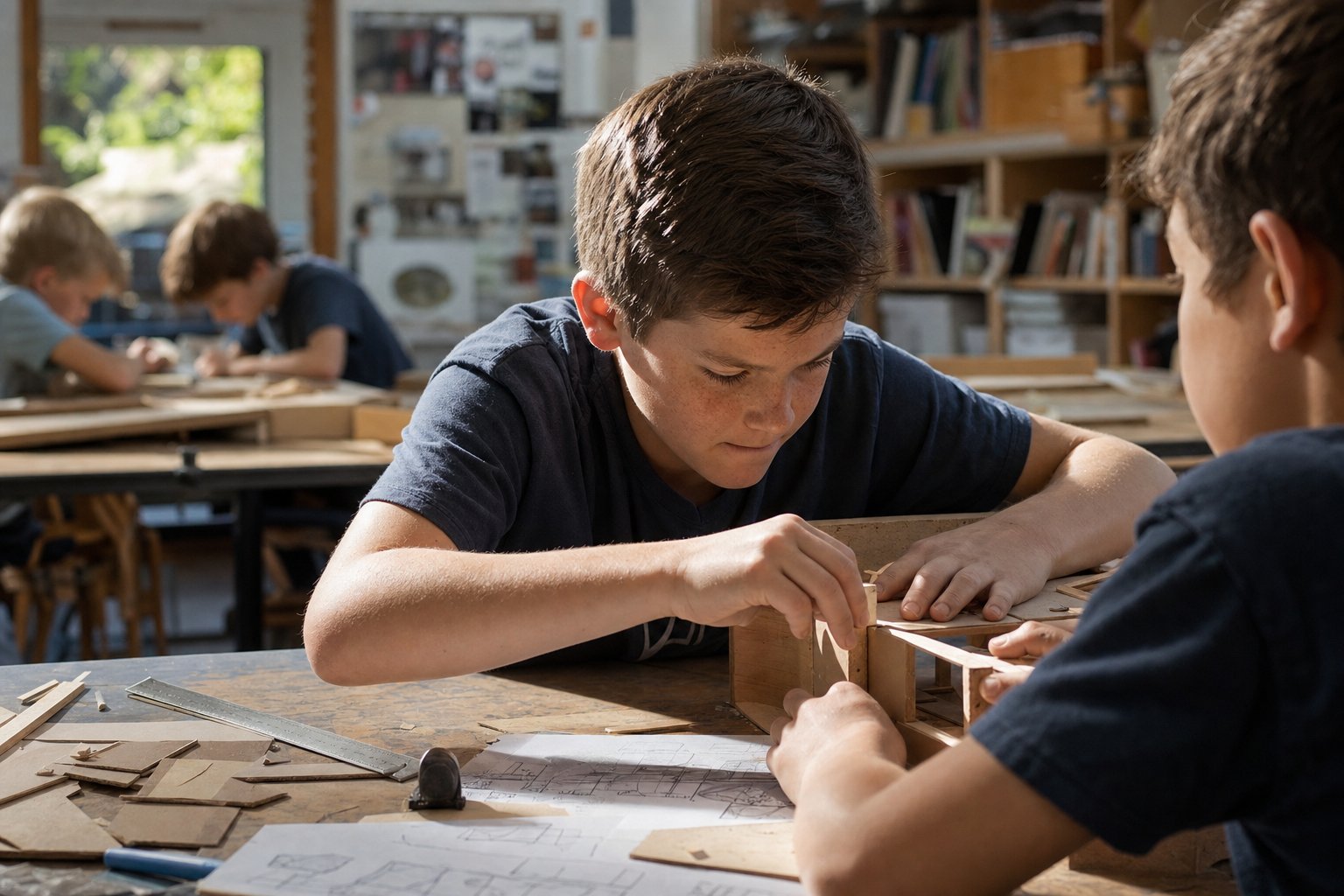
Entrepreneurship is not a unit on business concepts. Students identify real problems, design real solutions, build real things, and test them in front of an audience that has not been told to be kind. They learn to price a product, track their margins, write copy that sells, conduct customer discovery, and iterate based on honest feedback. The governing principle behind all of it is simple and powerful: financial abundance is earned by making other people's lives measurably better. That is not a slogan. It is the operating framework through which students experience mathematics, communication, and problem-solving as one integrated act rather than three separate subjects.
The school's Kid's Market events are the public face of this work. Students build, pitch, and operate actual businesses for a live community audience. A 10-year-old standing in front of strangers, explaining the product she designed and the price she set, is not performing a school exercise. She is doing the real thing.
Powerful Communication is where the other two pillars become visible. A student who can lead and create value but cannot articulate their thinking clearly, persuasively, and with genuine presence is operating at a fraction of their potential. At Wonderstorm, communication is taught through live social calibration exercises, public speaking, Socratic discussion, persuasion, debate, storytelling, and what the school calls in-field training: real interactions with real audiences generating real feedback.
Students learn to read a room and adjust in real time. They learn to disagree politely and to be completely at ease being disagreed with. They learn to write in a way that moves people to act. That training begins at age five and deepens in complexity through 12th grade.
Why Academics Do Not Suffer. They Deepen.
The most common concern parents raise when they first encounter Wonderstorm is a reasonable one: if the school is organized around leadership, entrepreneurship, and communication, what happens to the actual academics? Is this a school that trades rigor for inspiration?
The answer is almost the opposite. Wonderstorm students read, write, do mathematics, study science, and learn history. All of it rigorously. But those five subjects are not the finish line. They are the raw material.
When mathematics is the tool a student uses to run a real business, the motivation to understand it is not a grade. It is the immediate, tangible consequence of getting it wrong. When writing is the instrument through which a student persuades a real audience, the incentive to become a better writer is not a rubric. It is the felt difference between words that land and words that do not.
One parent, Maja Pesevic, described what happened when her daughter found her footing at Wonderstorm after a period away from traditional schooling: "She eventually moved two grade levels ahead. As meaningful as that was, it wasn't the biggest change we noticed." The academic acceleration was real. But it was downstream of something else, engagement, ownership, and the experience of learning as something that belonged to her rather than something being done to her.
The Comparison That Clarifies Everything
There is a version of your child at nineteen who walks into a room and owns it. Who has already built multiple businesses. Who does not wait to be told what to do, because they have spent 13 years being trusted to make real decisions with real consequences.
And then there is a version who has excellent grades and is still waiting for permission.
The difference is not potential. Both children may be equally intelligent, equally curious, equally capable at birth. The difference is what their education was built around for the 15,000 hours they spent inside it.
The question is not whether your child is capable of leadership and entrepreneurial thinking. The question is whether their school is building that capability every single day, or treating it as an afterthought.
Conventional schooling, including many of the most expensive private schools in Orange County, is built around rote learning: memorizing information through repetition without genuinely understanding it, drilling facts and formulas until they stick well enough to pass a standardized test, and then releasing a graduate into a world that rewards none of those skills directly.
Wonderstorm is built around a fundamentally different question: what would it take to help this child become the kind of person who can confidently create the life they want? The answer is not more worksheets. It is personal agency. The ability to make decisions, take ownership, solve real problems, communicate effectively, create value, recover from failure, and turn an idea into reality.
What Families in South Orange County Are Choosing
Wonderstorm Academy sits on a real campus at 25332 McIntyre St in Laguna Hills, serving children ages five through eighteen across a full K-12 span. Families drive in from Mission Viejo, Laguna Niguel, Aliso Viejo, Dana Point, San Clemente, Rancho Santa Margarita, Ladera Ranch, San Juan Capistrano, Laguna Beach, Newport Coast, Coto de Caza, Las Flores, Trabuco Canyon, Portola Hills, and the surrounding communities of South Orange County.
The micro-school model means that enrollment is intentionally limited. Small cohorts are not a compromise. They are the design. The school's founders, Holly and Dave Yarbrough, built Wonderstorm because they believed that every child deserves to be known as an individual rather than managed as a number. That belief is structural, not aspirational. It is visible in the ratio, in the mentorship relationships between older and younger students, and in the enrollment process itself, which begins with a conversation rather than a form.
Jeff Janke, whose daughter enrolled at Wonderstorm, described the change this way: "She carries herself with a light and a confidence we hadn't seen before, and it shows most in how she treats our family and friends. She is more present, more kind, more herself." That is not a description of better test scores. It is a description of a child becoming.
For families considering the college pathway, the school offers a specific and compelling alternative to the conventional route. Students can complete the Wonderstorm college path at 18 with an associate degree and all transfer coursework satisfied, then apply to the University of California through a transfer pathway where roughly 1 in 4 applicants is admitted, compared to approximately 9% through the traditional freshman door. Same university. Same diploma. Roughly 2.5 times the odds of admission and approximately $70,000 to $90,000 in avoided costs from the two years shaved off the degree.
For families whose children are not headed toward a four-year university, the value proposition is equally clear. A young person who can walk into any room and connect with people effortlessly, who has already built real businesses, who leads naturally and communicates with genuine presence, has an advantage in every direction their life takes: trade school, entrepreneurship, the arts, the professions, friendships, and family.
The Question Worth Sitting With
Most parents who find Wonderstorm do not find it because they were searching for a school with a better curriculum. They find it because something was already off. Their child was bored, or anxious, or capable in ways the school could not see, or spending 15,000 hours in a building that was not building anything they actually cared about.
The school is not for every family. It is for families who have already decided that compliance is not the goal, that memorization is not preparation, and that the 13 years between kindergarten and graduation are too important to spend optimizing for a test.
If that description fits your family, the next step is a conversation.
The school that teaches leadership and entrepreneurship every day is not a dream. It is open for enrollment in Laguna Hills, and it is waiting to meet your child.
Frequently Asked Questions
Does Wonderstorm Academy cover the standard academic curriculum, or does it replace it with entrepreneurship and leadership training? Wonderstorm covers all five core academic subjects: reading, writing, mathematics, science, and history, rigorously and completely. The difference is that these subjects are taught through the lenses of Leadership, Entrepreneurship, and Powerful Communication rather than through rote memorization and standardized testing. The academics are the raw material; the three lenses are how students develop genuine mastery of them.
What ages and grades does Wonderstorm Academy serve? Wonderstorm Academy is a full K-12 private school serving children from age five through eighteen. Families can enroll a child in the early years and remain through high school graduation, building a continuous 14-year educational journey within one intentional community.
Is Wonderstorm Academy an online school or a hybrid homeschool program? Wonderstorm Academy is a fully on-site, in-person private school with a real campus at 25332 McIntyre St in Laguna Hills, California. It is not an online program, a hybrid homeschool co-op, or a tutoring center. Students attend on campus in a structured daily environment within a tight-knit community.
How does Wonderstorm prepare students for college admissions? For families focused on the University of California system, Wonderstorm offers a college pathway where students can complete an associate degree and all transfer coursework by age 18, then apply through the transfer admission door where approximately 1 in 4 applicants is admitted, compared to roughly 9% through the traditional freshman pathway. This approach also reduces total degree costs by approximately $70,000 to $90,000 by eliminating two years of university tuition.
How do I find out if Wonderstorm Academy is the right fit for my family? The enrollment process begins with a direct conversation. Wonderstorm reviews each application for fit rather than using a standard open-enrollment approach, because the community and the model work best when the values are genuinely aligned. The best first step is booking a call or scheduling a campus tour to experience the environment firsthand.
Book a call or schedule your campus tour at Wonderstorm Academy
Research sources2
Live web research informed this article. These are the sources it drew on.
- Wonderstorm Academy - Mission Viejo, CAyelp.com2022-03-21
- Wonderstorm Academy - Facebookfacebook.com