What Project-Based Learning Actually Does to Kids
Something is happening inside well-designed project-based classrooms that decades of lecture-based schooling never produced. And researchers have now measured it with enough precision to take seriously. The evidence is not perfect, but it is specific, it is growing, and it points in one clear direction.
What Researchers Actually Mean by PBL
Before the evidence can mean anything, the definition has to be precise. Project-based learning is not a group activity. It is not a science fair. It is not a themed unit where students read about a problem and write a report.
Contemporary researchers define PBL as instruction where students work for an extended period on an authentic, complex question. One with no single correct answer. Produce a public product or presentation, exercise genuine voice and choice in how they investigate, and engage in sustained collaboration, critique, and revision. High-quality PBL models align to rigorous academic standards, explicitly teach collaboration and self-management, and connect learning to real-world audiences, community partners, or actual clients.
That last element matters more than most school marketing acknowledges. The presence of a real audience. People outside the classroom who will actually use, judge, or respond to what students produce. Is what separates PBL from its imitators.
"The presence of a real audience is what separates project-based learning from its imitators. And it is the single design feature most likely to produce leadership behaviors in students."
The 2023 Meta-Analysis Every Parent Should Know
In 2023, researchers published a meta-analysis of 66 empirical PBL studies covering 190 effect sizes. The combined effect size was 0.441. In educational research, an effect size above 0.40 is considered meaningful. It represents a real, detectable difference in outcomes between students who experienced PBL and those who did not.
What were those outcomes? Academic achievement, critical thinking, problem-solving, and what researchers call "deeper learning" skills. A cluster that includes collaboration, communication, self-management, and initiative. These are not soft extras. They are the measurable components of what most parents mean when they say they want their child to develop real leadership.
The honest caveat: "leadership" as a single, formally measured construct in K-12 research is still underdeveloped. There is no widely validated leadership scale that researchers routinely apply to elementary or middle school students in PBL contexts. What exists instead is strong evidence for the specific behaviors and capacities that constitute leadership. And a growing body of qualitative work showing how those behaviors emerge through the project process itself.
How Leadership Actually Grows Inside a Project
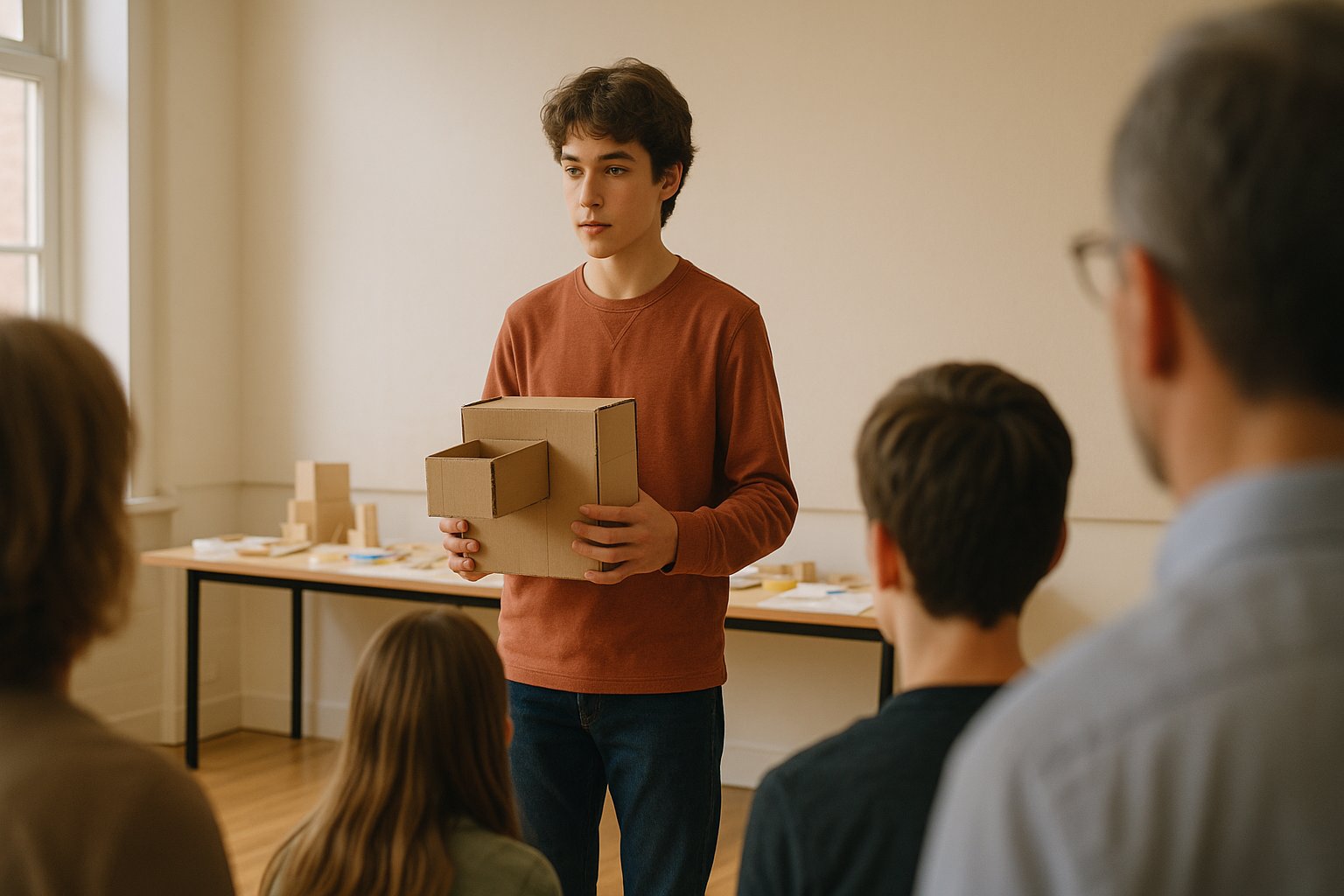
A qualitative study from Nova Southeastern University examined how leadership developed through collaborative project work. The finding was specific and worth understanding: leadership did not grow during the easy parts of a project. It grew during the most challenging steps. The moments requiring higher-order thinking, emotional navigation, and shared decision-making under uncertainty.
This is the mechanism that matters. When a group of students hits a genuine obstacle. A prototype that fails, a community partner who pushes back, a presentation that needs to be rebuilt two days before it goes public. Someone has to step up. Someone has to reorganize the team. Someone has to communicate what went wrong and what comes next. That someone is not assigned. They emerge. And they emerge differently each time, because different challenges surface different students.
This is not a metaphor for leadership development. It is the actual process by which leadership is built. Through real responsibility for outcomes that matter to people beyond the classroom.
Leadership is not taught through instruction about leadership. It is built through real responsibility for outcomes that matter.
What the Evidence Shows About Academic Outcomes
One of the most persistent objections to PBL. And one that intentional parents in South Orange County are right to take seriously. Is whether it comes at the cost of academic rigor. The research addresses this directly.
Multiple randomized controlled trials, including studies conducted through the Lucas Education Research initiative, found that students in well-designed PBL programs outperformed students in traditional instruction on standardized measures of academic content. Not just on measures of collaboration or engagement. In one study of elementary social studies, PBL students demonstrated significantly stronger content knowledge than their traditionally taught peers. In another examining high school economics, the same pattern held.
The key phrase in all of this research is "well-designed." PBL that lacks academic rigor, clear standards alignment, and explicit instruction in collaboration skills does not produce these outcomes. The design is not incidental. It is the intervention. A project that is merely fun is not PBL in the research sense. A project that is complex, public, and connected to real stakes is.
This is why the curriculum architecture at a school matters as much as the philosophy. Families evaluating micro-schools, alternative K-12 programs, and student-led options anywhere in South Orange County. From Laguna Hills to Mission Viejo, from Ladera Ranch to San Juan Capistrano. Should ask not just whether a school does projects, but how those projects are designed, what standards they address, and who the audience is.
The Leadership Skills PBL Builds. Specifically
Because "leadership" as a single outcome is still being formalized in K-12 research, it is worth naming the specific capacities that the evidence supports most strongly.
Collaboration under pressure. Students in PBL contexts consistently demonstrate stronger ability to work through disagreement, distribute responsibility, and maintain shared direction when things go wrong. This is not socialization. It is a learnable skill that requires repeated practice in high-stakes conditions.
Communication with a real audience. PBL requires students to explain, persuade, and present to people who were not in the room when the work was done. This is categorically different from answering a teacher's question. It builds the kind of communication that matters in every professional and civic context a young person will eventually inhabit.
Initiative and self-management. When students have genuine voice and choice in how they pursue a problem, they cannot wait to be told what to do next. They have to decide. Researchers consistently find that PBL students develop stronger metacognitive habits. The ability to monitor their own understanding, adjust their approach, and manage their time. Than students in directive instructional models.
Entrepreneurial thinking. The overlap between PBL and entrepreneurship education is not accidental. Both require students to identify a problem worth solving, design a response, test it against reality, and revise. Both require tolerance for ambiguity and the capacity to move forward without certainty. Both produce students who understand that the world is not a fixed answer key.
Why Most Schools Cannot Actually Deliver This
The research on PBL is clear enough. So why do most K-12 students. Including students at well-resourced private schools across Orange County. Never experience it in any meaningful form?
The honest answer is structural. Traditional schooling is organized around predictability: fixed periods, standardized content, measurable outputs that can be assessed quickly and reported easily. PBL is organized around uncertainty: extended timelines, emergent questions, products that cannot be scored with a rubric in forty-five minutes. These two structures are not just different. They are in tension. You cannot run authentic, extended project work inside a schedule built for lecture and test.
This is why the micro-school model matters beyond its small class sizes. The capacity to deliver genuine PBL depends on having the structural freedom to build the school day around the work rather than around the bell. It depends on teachers who function as mentors and coaches rather than content deliverers. It depends on a community of families who understand that a messy, uncertain project that fails publicly is not a failure of the school. It is exactly what the research says should happen.
For families in Laguna Hills, Mission Viejo, Aliso Viejo, Dana Point, San Clemente, Rancho Santa Margarita, Laguna Niguel, Lake Forest, Newport Coast, Coto de Caza, Ladera Ranch, Trabuco Canyon, Portola Hills, Las Flores, and across South Orange County who are weighing their options, the question is not whether PBL works. The research has answered that. The question is whether the school you are considering is actually structured to deliver it. Or whether it uses the language of project-based learning while preserving the architecture of a traditional classroom.
What This Looks Like at Wonderstorm Academy
At Wonderstorm Academy in Laguna Hills, the three core lenses. Leadership, Entrepreneurship, and Powerful Communication. Are not electives or enrichment. They are the framework through which every project, every Life Skills Lab, and every real-world apprenticeship is designed. Students do not learn about entrepreneurship. They build, pitch, and operate actual ventures for live community audiences at Kid's Market events. They do not study leadership concepts. They exercise leadership in the daily structure of a student-led campus where voice, choice, and real responsibility are built into the model.
This is what the research describes as the necessary condition for PBL outcomes: authentic complexity, real audiences, and genuine stakes. It is not a curriculum add-on. It is the school.
If you are a parent in South Orange County who has spent time researching project-based learning, questioning whether the evidence is real, and wondering whether a micro-school can actually deliver what traditional schooling cannot. The research gives you a clear foundation. And the next step is to see it in person.
Schedule your campus tour at Wonderstorm Academy and watch what happens when a room full of students is working on something real.
Research sources20
Live web research informed this article. These are the sources it drew on.
- Project-based learning as a catalyst for 21st-Century skills and ... - NIHpmc.ncbi.nlm.nih.gov2024-11-15
- Project-based learning: A review of the literature - Dimitra Kokotsaki, Victoria Menzies, Andy Wiggins, 2016journals.sagepub.com2016-11-10
- Project-Based Learning: A Promising Approach to ...mdrc.org2018-01-01
- A study of the impact of project-based learning on student ...pmc.ncbi.nlm.nih.gov2023-07-17
- "Enhancing Student Leadership Skills through Project-Based ...nsuworks.nova.edu2023-05-15
- Scaling High-Quality Project Based Learning for Deeper ...pblworks.org
- Empowering Principals to Lead Project-Based Learning with ...scholarworks.iu.edu2025-01-14
- Project-Based Learning (Pjbl) in Three Southeastern Public Schools: Academic, Behavioral, and Social-Emotional Outcomesdocs.lib.purdue.edu2019-08-30
- Project-Based Learning Research Reviewedutopia.org2012-12-03
- Engaging and Empowering Our Students for Future Successpblworks.org2021-07-16
- Project-Based Learning Research: Annotated Bibliographyedutopia.org2012-12-03
- Enhancing Student Leadership Skills through Project-Based Learning in the Postgraduate Research Experiencensuworks.nova.edu
- Project-Based Learningmdrc.org
- [PDF] Project Based Learning - ERICfiles.eric.ed.gov
- Research Publicationspblworks.org
- Project Based Learning & Student Achievement: ...eric.ed.gov2018-01-01
- A review of project-based learning in higher educationsciencedirect.com
- Key Principles for Project-Based Learninglucasedresearch.org
- A REVIEW OF RESEARCH ON PROJECT-BASED ...pblworks.org
- A new research base for rigorous project-based learningkappanonline.org2022-01-24