Why Your Straight-A Student Still Feels Lost
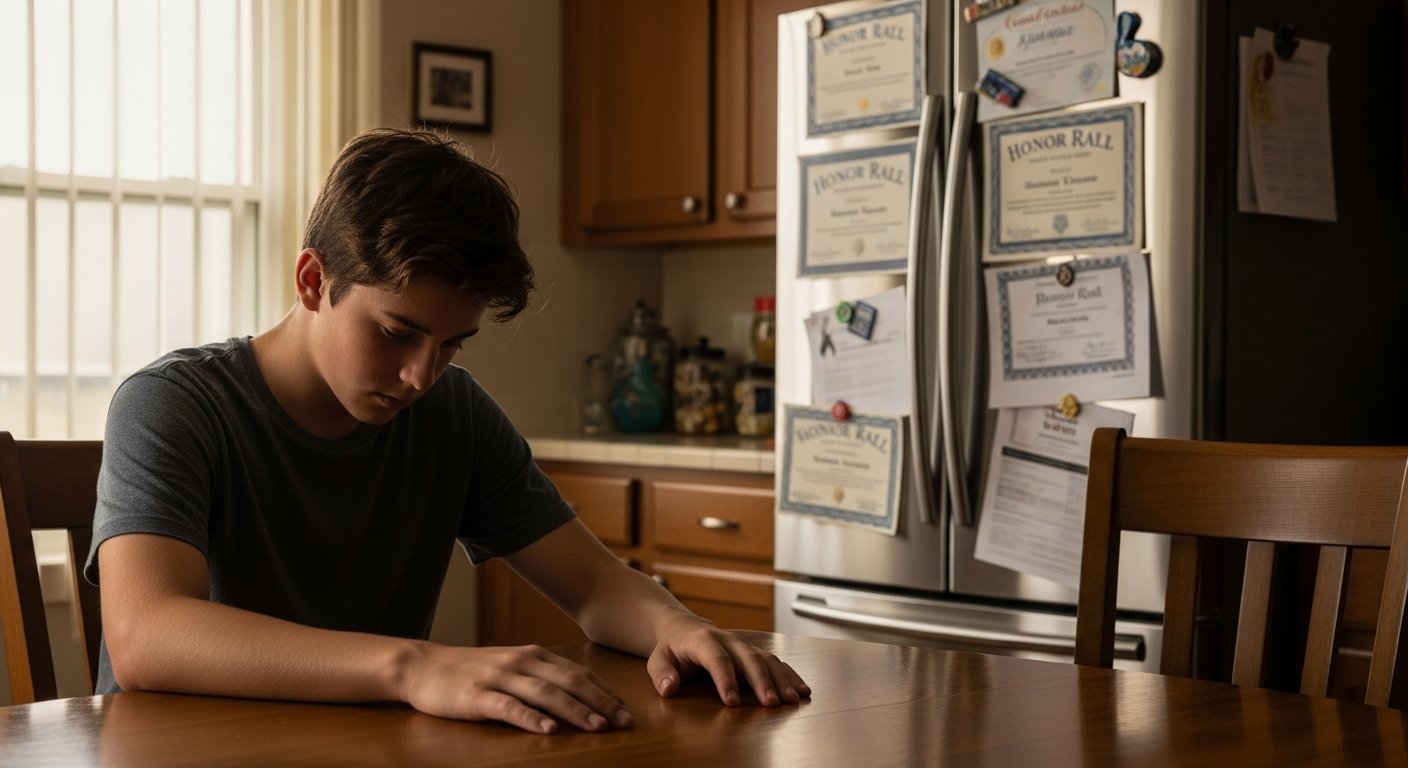
Your child has done everything right. Honors classes, high test scores, a transcript that looks exactly the way the system promised it should look. And yet, when you ask them what they want to do with their life, or how they would handle a real problem, or what they are actually good at building, you get a long silence.
That silence is not a character flaw. It is the predictable output of a system that was never designed to produce self-directed, capable human beings.
The Report Card Illusion
Grades measure one thing with precision: how well a student can absorb, retain, and reproduce information on a schedule set by someone else. That is a real skill. It is also an increasingly narrow one. The student who earns straight A's has demonstrated an extraordinary capacity for compliance, for decoding what the teacher wants, and for delivering it on time. What the report card cannot measure is whether that same student knows how to initiate something, lead a group through disagreement, communicate an idea to a skeptical audience, or recover from a failure they caused themselves.
A grade tells you how well your child followed the instructions. It tells you almost nothing about what they can build without them.
This is not an argument against academic rigor. Rigor matters enormously. The problem is that the version of rigor most private k-12 schools and traditional public schools practice is almost entirely retrospective. It rewards students for mastering content that already exists. It does not ask them to create anything new, defend anything original, or lead anyone anywhere. And so a student can accumulate a decade of excellent marks and still arrive at eighteen without a single experience of genuine agency.
Parents in Orange County are discovering this gap in large numbers. The search for alternative K-12 education in Laguna Hills and surrounding communities is accelerating not because families are anti-education, but because they are pro-child. They want the rigor and they want the preparation for real life, and they are learning that most schools only deliver one of those two things.
What Real Preparation Actually Looks Like
The skills that determine whether a young adult thrives in an AI-driven, entrepreneurially demanding world are not mysterious. They are Leadership, Entrepreneurship, and Powerful Communication. These are not soft skills tacked onto a real curriculum. They are the curriculum. They are the capacities that allow a person to identify a problem worth solving, assemble people and resources to address it, and then articulate the solution in a way that moves others to act.
A student who graduates with these three lenses fully developed is not just college-ready. They are life-ready. They know how to run a meeting, how to pitch an idea to a skeptical room, how to fail at something and extract the lesson rather than the shame. They have practiced these things repeatedly in real contexts, not in simulated classroom exercises.
The distinction matters. Simulated leadership is to real leadership what reading about swimming is to swimming. You can describe the strokes with perfect accuracy and still drown in three feet of water. Entrepreneurship education for kids that is embedded in daily practice, in actual projects with actual stakes and actual audiences, produces something categorically different from a unit on business vocabulary in a high school elective.
At Wonderstorm Academy, a private K-12 microschool in Orange County operating within the Apogee Strong network, these three lenses are not electives and they are not extracurriculars. They are woven into every academic day from age four through twelfth grade. A kindergartner is not too young to learn what a leader does when the group disagrees. A third grader is not too young to build a product, set a price, and sell it to a live community audience at a Kid's Market event. These experiences compound across years in the same way that academic knowledge compounds, except the output is a person who knows how to act, not just a person who knows a great deal.
The 15,000-Hour Question
By the time a child graduates from a traditional K-12 school, they have spent approximately 15,000 hours inside that institution. That number is not a criticism. It is a design question. What was that time building? If the answer is primarily test scores and transcripts, then the institution made a choice, whether consciously or by default, to optimize for one narrow outcome at the expense of several more important ones.
The question is not whether your child is smart. The question is whether 15,000 hours of schooling made them capable.
Parents who are exploring school choice and ESA options in California are asking this question with increasing urgency. They are not radicals. They are not abandoning academics. They are people who have watched a bright, curious child enter the traditional system and emerge, years later, technically credentialed but practically hollow. They have watched their child learn to perform for grades rather than learn to build for life. And they are looking for a learning center, a campus, a community where the hours mean something different.
The microschool movement, particularly in communities like Orange County, is a direct response to this reckoning. Families are not choosing micro schools because they are cheaper or more convenient. In most cases they are neither. They are choosing them because the model places the child at the center of their own education rather than at the receiving end of it.
Why Entrepreneurship at Age Four Is Not What You Think
One of the most common hesitations parents bring to an enrollment conversation at a school like Wonderstorm is this: if you are spending time on entrepreneurship and leadership, are you shortchanging the fundamentals? Is my child going to fall behind in math and reading while they are busy running a pretend business?
The premise contains a false binary. Entrepreneurial thinking does not replace foundational academics. It activates them. A child who is building something real has an urgent reason to read, to calculate, to write, to communicate. The motivation is intrinsic rather than coerced. Research on self-directed learning environments consistently shows that when children pursue mastery in service of something they care about, they learn faster and retain more than children who are absorbing content for its own sake.
The Apogee Strong network, within which Wonderstorm operates as part of a nationally recognized model of K-12 innovation, has documented this across multiple campuses. Academic benchmarks are met. In many cases they are exceeded. But the mechanism is different. The child is not a passive recipient of instruction. They are an active agent in their own formation, guided by adults who function as mentors rather than content delivery systems.
This is what distinguishes a genuinely alternative K-12 education in Laguna Hills from a school that simply has smaller class sizes or a different logo. The philosophical architecture is different. The relationship between the student and their own learning is different. And the outcome, measured not just in test scores but in the kind of person who walks across the graduation stage, is categorically different.
The Straight-A Student Who Could Not Introduce Herself
A parent who recently toured Wonderstorm's Laguna Hills campus described her daughter this way: straight-A student, genuinely bright, deeply anxious, unable to look an adult in the eye during a conversation. She had mastered every academic expectation placed in front of her and had never once been asked to lead anything, communicate under real pressure, or make a decision that mattered. The system had rewarded her for following. It had given her no practice in initiating.
This story is not unusual. It is, in fact, the median outcome of a traditional private school or public school education for a conscientious, high-achieving child. The system selects for compliance and rewards it lavishly. The child who follows instructions precisely, who studies what she is told to study and tests well, accumulates a credential that looks excellent from the outside and leaves her quietly terrified of any situation that does not come with clear instructions.
The antidote is not to stop caring about academics. It is to build an environment where academics are the foundation of something larger. Where the student is the hero of her own story, not the audience for someone else's curriculum. Where Leadership, Entrepreneurship, and Powerful Communication are practiced daily, from the earliest years, so that by the time she is seventeen she has a decade of real experience leading, building, and communicating behind her.
What to Look For in a Real Alternative
If you are evaluating school choice options in California, whether through ESA frameworks, private tuition, or a combination, here is a practical framework for assessing whether an alternative school is genuinely different or simply different-looking.
First, ask what the student actually produces. Not what they learn, not what units they complete, but what they build, create, defend, and ship. A school that cannot answer this question concretely is still operating inside the traditional model regardless of its branding.
Second, ask how conflict and failure are handled. A school that protects students from difficulty is not preparing them for life. Real development happens at the edge of capability, in the presence of a skilled guide who helps the student extract the lesson rather than avoid the experience.
Third, ask whether the three core competencies of Leadership, Entrepreneurship, and Powerful Communication are embedded in daily practice or offered as occasional enrichment. The difference is everything. A school that teaches a unit on entrepreneurship once a year is not an entrepreneurship school. A school where every project, every peer interaction, every community event is structured around developing these capacities is something fundamentally different.
Wonderstorm Academy, as a private K-12 microschool in Orange County aligned with the Apogee Strong network, meets all three of these tests. Life Skills Labs are not optional. Real-world apprenticeships are not extracurricular. The Kid's Market, where students build actual businesses and sell to a live community audience, is not a field trip. These are the curriculum.
Your Child Is Not the Problem
If your straight-A student feels lost, underprepared, or quietly anxious about what comes after graduation, the most important thing to understand is this: the system worked exactly as designed. It produced a student who is excellent at school. It was not designed to produce a person who is excellent at life.
You have the ability to choose something different. Orange County has a growing community of intentional, values-driven families who have made this choice and are watching their children transform. Not from struggling students into high achievers, but from passive recipients of education into active architects of their own futures. The transformation is not about grades. It is about agency, confidence, and the lived experience of knowing that you can build something, lead someone, and communicate your way through an unscripted problem.
Wonderstorm Academy exists because these outcomes are achievable, in a small, intentional, founder-led campus environment, for every child from age four through twelfth grade. The enrollment process is designed to be a genuine conversation, not a sales funnel. You book a call, tour the campus, meet the guides, and see the model in action. Then you decide.
If you have been sensing that something is missing from your child's current education, you are probably right. Come see what is possible instead. Book your family's campus tour at Wonderstorm Academy in Laguna Hills and find out whether this is the community your child has been waiting for.
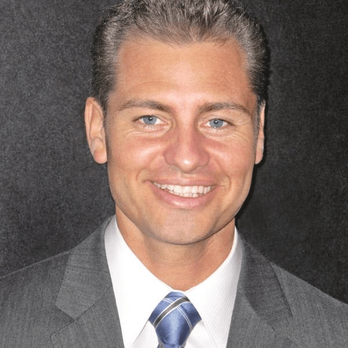
David Yarbrough
Co-Founder
Dave Yarbrough is the founder of Wonderstorm Academy, a devoted husband and father of six, and a lifelong student of human potential. For more than 25 years, he has explored how education can help children flourish intellectually, socially, and personally. His vision is to create a new model of learning that expands what is possible for children and for education as a whole. Dave holds a Bachelor of Arts in Philosophy from UC Santa Barbara.
More from David Yarbrough →