Your Creative Child Doesn't Fit. That's the Point.
Somewhere between kindergarten and fifth grade, a lot of creative kids learn a lesson nobody intends to teach them: that curiosity is a problem, and that fitting in means slowing down. If your child is one of them, the question isn't what's wrong with them. The question is whether the school was ever built for them in the first place.
The Mold Was Never Designed for Creative Minds
The standard classroom model was engineered for a specific outcome: a student who can absorb information, reproduce it on a test, and advance to the next grade. For a certain kind of student, that system works reasonably well. For a creative child. One who thinks in connections rather than sequences, who needs to make something to understand it, who asks why before they accept what. It is a slow and systematic mismatch.
A child who needs to build something to understand it cannot be educated by a system that rewards sitting still and repeating back.
This is not a criticism of teachers, most of whom are doing extraordinary work inside a structure that ties their hands. It is an observation about architecture. A building designed for one purpose cannot be renovated into another simply by working harder inside it. The same is true of a curriculum built around standardized outcomes. You can add enrichment programs, differentiated instruction, and gifted tracks, and you will still be working within a frame that was not built for the child sitting in front of you.
Families across South Orange County. In Mission Viejo, Aliso Viejo, Rancho Santa Margarita, Laguna Niguel, Lake Forest, Dana Point, San Juan Capistrano, San Clemente, Laguna Beach, Newport Coast, Coto de Caza, Las Flores, Trabuco Canyon, Ladera Ranch, Portola Hills, and Laguna Hills. Are arriving at this realization in increasing numbers. They are not anti-school. They are pro-child. And they are looking for a real alternative, not a workaround.
What a Creative Child Actually Needs
Before looking at specific options, it helps to name what creative children actually require from an educational environment. Because the list is more concrete than it might seem.
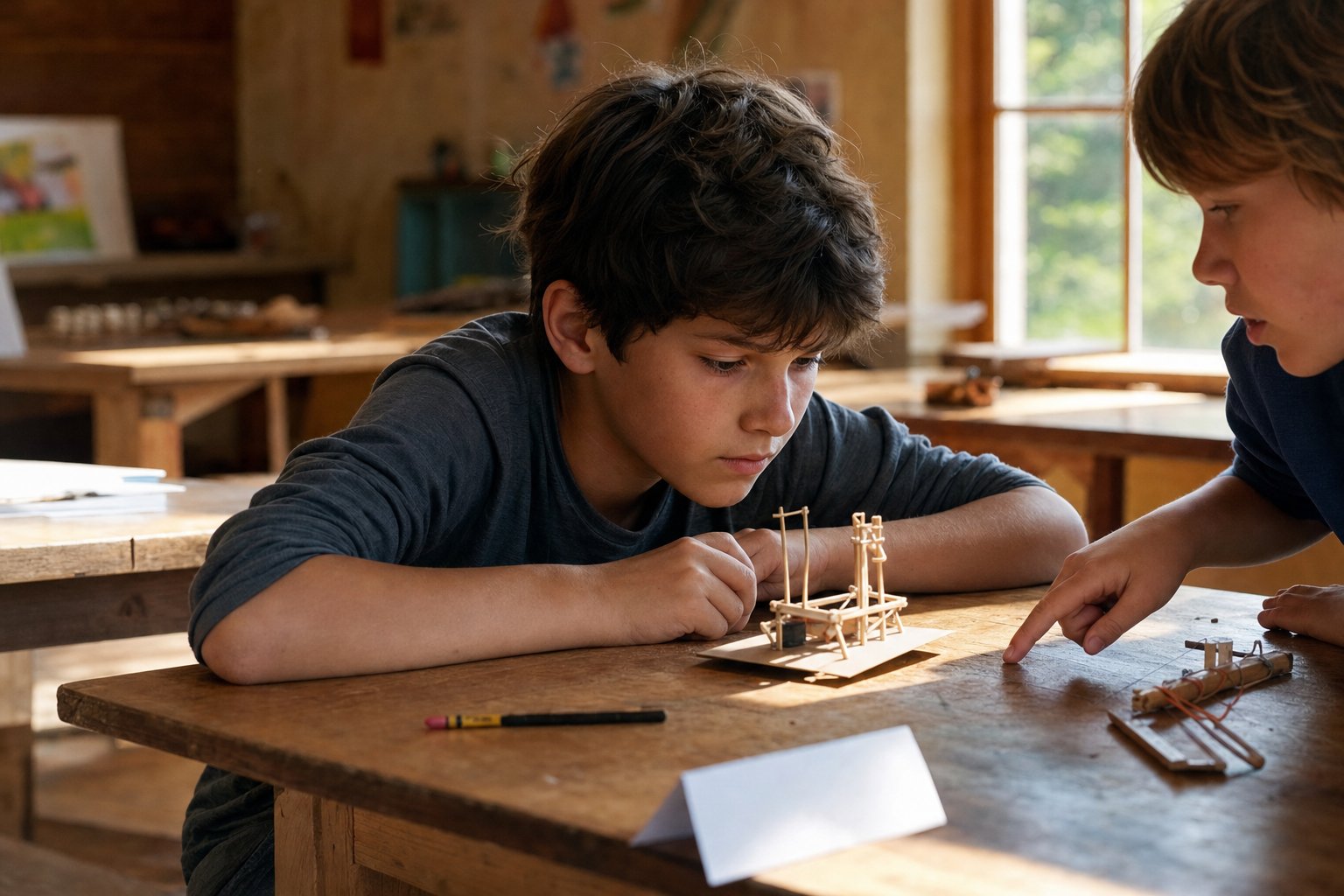
They need real problems to solve, not hypothetical ones. A creative mind engages when the stakes are genuine. A 10-year-old who is designing a product to sell at a live community market is doing mathematics with consequence. A student who is researching a historical decision and will have to argue a position in front of their peers is doing reading and writing with an audience. The work is the same. The engagement is entirely different.
They need to move between disciplines rather than within silos. Creative thinking is inherently cross-domain. A child who is simultaneously running the finances of a small student business, writing the pitch copy, and presenting to an audience is integrating mathematics, language arts, and communication in a way no worksheet can replicate.
They need an environment where their ideas are taken seriously. This is less about validation and more about structure. When a child knows their proposal will actually be built, their pitch will actually be heard, and their failure will actually have consequences they can learn from, they engage with a depth that passive instruction cannot produce.
And they need a community of peers who are equally invested. Creative children often feel most isolated not because they lack social skills but because they have nobody around them who shares their intensity. A small, intentional school community changes that dynamic entirely.
What Parents in South Orange County Are Actually Finding
For families in this region who have moved past the question of whether traditional schooling is working and are now asking what else exists, the landscape has expanded meaningfully in recent years.
Public charter options like project-based learning programs exist in the area, but they remain anchored to district structures, standardized testing requirements, and the constraints that come with public funding. They can offer more hands-on work than a conventional classroom, but they cannot reorganize their entire curriculum around a different set of outcomes.
Homeschooling co-ops offer flexibility but require a level of parent involvement that most working families cannot sustain, and they rarely provide the kind of structured, daily campus community that a child needs to develop genuine social skills and peer relationships.
Online and hybrid programs have multiplied, particularly since 2020. But for a creative child, screen-based learning often replaces one form of passivity with another. The medium changes; the engagement problem does not.
What many intentional parents in South Orange County are finding, through word of mouth more than any other channel, is that a small number of full-time, in-person private micro-schools have emerged that are built around a fundamentally different premise. Not a smaller version of a traditional school. A different kind of school entirely.
How Wonderstorm Academy Is Built for This Child
Wonderstorm Academy is a private K–12 micro-school in Laguna Hills, California, operating on a full-time, in-person campus at 25332 McIntyre St. It has been serving children ages 5 through 18 since 2018, and it draws families from across South Orange County. From Laguna Beach and Newport Coast to San Clemente and Coto de Caza.
The school's curriculum is organized around three core lenses that every academic subject passes through: Leadership, Entrepreneurship, and Powerful Communication. These are not electives. They are not enrichment add-ons offered on Friday afternoons. They are the architecture through which reading, writing, mathematics, science, and history are taught every single day, from kindergarten through 12th grade.
At Wonderstorm, the five academic subjects are not the finish line. They are the raw material. The lens is the actual curriculum.
What that looks like in practice is specific and concrete. Students do not study economics in the abstract. They price products, track margins, and watch a bad number eat their profit. They do not read about historical figures. They step into the decisions those figures faced and argue positions in front of their peers. They do not learn communication as a unit. They develop it through live social calibration exercises, public speaking, persuasion, and real-audience presentations that begin at age five and deepen in complexity through graduation.
For a creative child who has spent years being told, implicitly or explicitly, that their way of engaging with the world is a disruption, this environment is often disorienting at first. And then transformative.
Lindsey Jaleh, whose daughter has been attending Wonderstorm for a year, described the experience this way: "There is no expectation that everyone should learn the same thing at the same pace simply because they're the same age. Each child is encouraged to discover and develop their individual gifts, pursue subjects that excite them, and progress when they're truly ready."
That is not a marketing claim. It is a description of what the school's structure actually makes possible when you remove the grade-level standardization that forces every child through the same material at the same speed.
The Communication Pillar: Why It Matters for Creative Students Specifically
Of the three core lenses, Powerful Communication deserves particular attention for creative children, because it addresses the gap that most educational programs. Even good ones. Leave entirely open.
A creative child typically has no shortage of ideas. What they often lack is the architecture to make those ideas legible to other people. Public speaking, persuasion, social calibration, the ability to read a room and adjust in real time. These are skills that determine whether a creative mind becomes a force in the world or remains a private one.
At Wonderstorm, communication is taught through direct practice with real audiences and real feedback, not through instruction about communication. Students learn to disagree politely and to be completely at ease being disagreed with. They learn to write in a way that moves people to act. They participate in exercises like the Comedy Improv Battle Arena, which develops the ability to think on their feet, relax under pressure, and connect with people in unscripted situations.
For a parent whose creative child has always had a rich inner world but struggled to translate it outward, this pillar alone is often the deciding factor.
What the Path Forward Looks Like
Families who are considering Wonderstorm typically arrive with a version of the same question: will my child be academically prepared? The concern is understandable. Moving away from a traditional school model feels like a risk when the conventional markers. Grades, test scores, college admissions. Are what most people use to measure educational success.
It is worth being direct about what Wonderstorm offers on this front. The school is Montessori-informed and academically rigorous. Students cover all five core academic subjects with the same depth required by any serious educational institution. The difference is not whether academics are present. It is what the academics are in service of.
For families with college ambitions, Wonderstorm's college path offers a specific structural advantage. Students who complete the path arrive at 18 with an associate degree and all transfer coursework satisfied, then apply to the University of California through the transfer admissions door, where roughly one in four applicants is admitted. Compared to roughly one in eleven through freshman admissions. The same university. The same diploma. Significantly better odds, and approximately $70,000 to $90,000 in expenses they never have to carry.
For families whose ambitions for their child are not primarily college-bound, the Leadership, Entrepreneurship, and Powerful Communication framework produces a different but equally concrete outcome: a young adult who walks into any room. A job interview, a trade apprenticeship, a business pitch, a social situation. And connects with people effortlessly, leads without waiting for permission, and knows from direct experience that they can create value from nothing.
The enrollment process at Wonderstorm begins with a conversation, not a form. Families are invited to book a call and schedule a campus tour, because the school is designed to be experienced rather than described. A parent who has been searching for the right fit for their creative child will recognize it the moment they walk through the door.
Frequently Asked Questions
Will my creative child receive a rigorous academic education, or will the focus on entrepreneurship and communication come at the expense of core subjects? At Wonderstorm, all five core academic subjects. Reading, writing, mathematics, science, and history. Are taught with full rigor. The distinction is that they are taught through the lenses of Leadership, Entrepreneurship, and Powerful Communication rather than as isolated disciplines. A student who launches a real business to learn mathematics is developing both the academic skill and the applied capability simultaneously.
My child has struggled socially in traditional school. Will they find genuine community at a micro-school with a smaller student population? The smaller size is a feature, not a limitation. At Wonderstorm, every child is genuinely known by the adults and peers around them. The school's intentional community structure and communication-focused curriculum are specifically designed to develop social skills, and the mixed-age environment gives children opportunities to lead, mentor, and collaborate in ways that age-segregated classrooms rarely allow.
Is Wonderstorm Academy accredited, and will my child's credits transfer if we ever return to a traditional school? Wonderstorm Academy operates as a private K–12 micro-school and Montessori member school. For specific questions about accreditation status and credit transfer policies, families are encouraged to raise these directly during the enrollment conversation. The school's consultative process is designed to address exactly these practical questions honestly.
What does the typical school day look like for a child at Wonderstorm? Wonderstorm operates as a full-time, in-person campus. Not a hybrid or part-time program. The daily structure is built around project-based work, Socratic discussion, real-world business activities, physical fitness, and communication practice. Students from kindergarten through 12th grade work in an environment where the day is active, purposeful, and structured around real outcomes rather than passive seat time.
How do I know if Wonderstorm is the right fit for my family before committing to enrollment? The best answer is to come and see it. Wonderstorm's enrollment process begins with a call and a campus tour, specifically because the school is designed to be experienced firsthand. Families from Laguna Hills, Mission Viejo, Aliso Viejo, Rancho Santa Margarita, Lake Forest, Laguna Niguel, San Juan Capistrano, Dana Point, San Clemente, Laguna Beach, Newport Coast, Coto de Caza, Las Flores, Trabuco Canyon, Ladera Ranch, and Portola Hills are welcome to visit the campus at 25332 McIntyre St in Laguna Hills.
A Different Question to Ask
The families who find Wonderstorm and stay tend to share one thing: they stopped asking whether their child could be made to fit the existing system and started asking what the right system would look like for the child they actually have.
That is not a small shift. It requires letting go of the idea that the conventional path is the safe one, and recognizing that for a creative child, the conventional path carries its own risk. Thirteen years of being trained to comply, conform, and memorize, followed by a graduation that leaves them technically credentialed and genuinely unprepared.
^^The difference between the two versions of your child's future isn't potential. It's what their education was built around for the last thirteen years.
If that question has been sitting with you, the next step is a conversation.
Schedule your campus tour at Wonderstorm Academy
Research sources4
Live web research informed this article. These are the sources it drew on.
- Wonderstorm Academy - Laguna Hills, CA Patchpatch.com2026-08-19
- Wonderstorm Academy — Laguna Hills, CAmontessorischoolsnearme.app
- Merry & Bright Chamber Nightbusiness.lagunahillschamber.com2024-05-01
- Wonderstorm Academy - Mission Viejo, CAyelp.com2022-03-21