Your Expensive Private School Is Still Teaching the Wrong Things
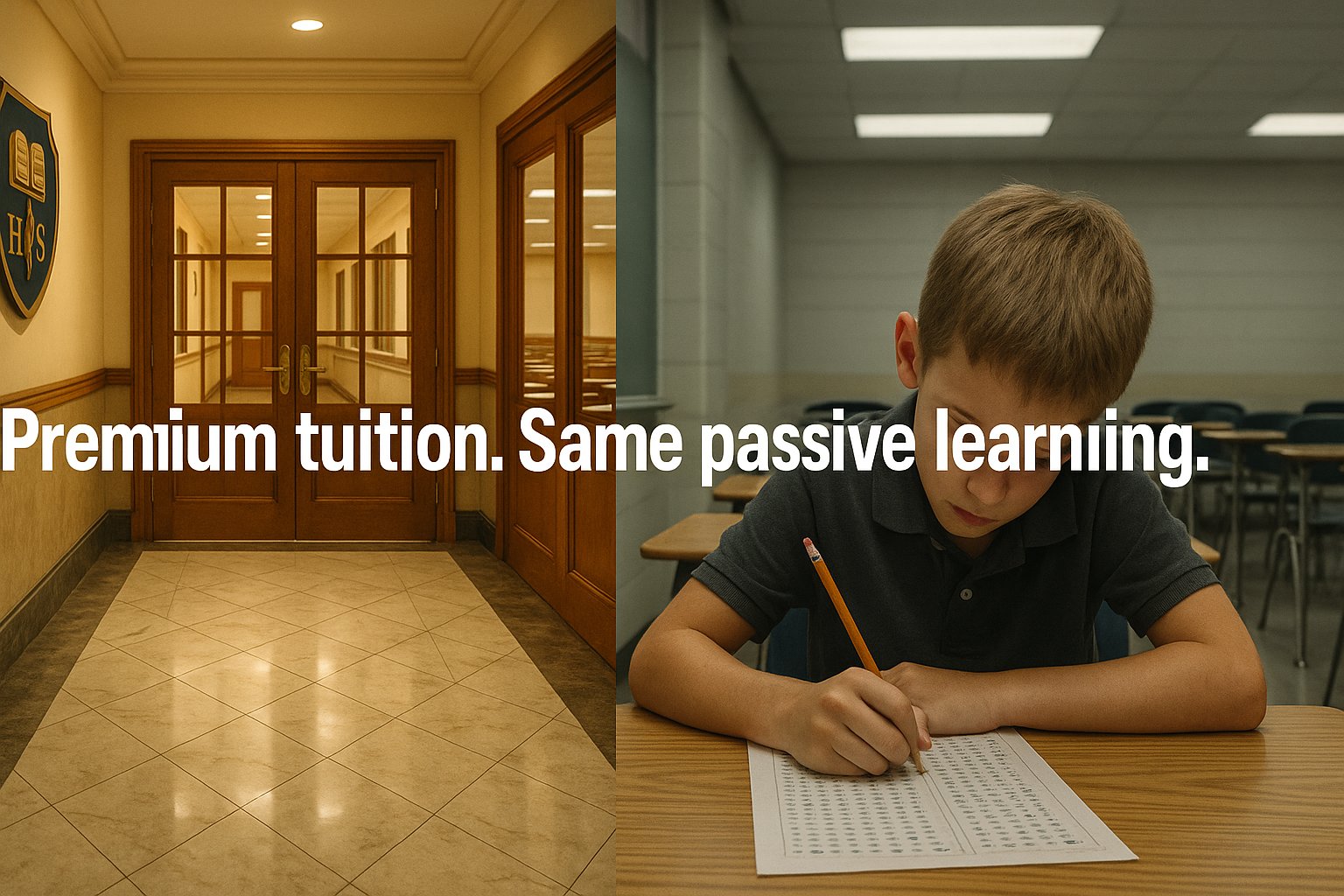
You looked at the brochure. You toured the campus. You saw the smaller class sizes, the newer computers, the manicured athletic fields. You made the sacrifice. Financial and logistical. Because you believed that paying more meant getting something fundamentally different for your child.
Here is the uncomfortable question nobody in the private school admissions office will ask you: different how, exactly?
Because if the answer is 'smaller classes and a nicer building,' you may have paid a premium for a repackaged version of the same model. The same passive instruction. The same standardized tests. The same fundamental assumption that a child's job is to sit still, absorb information, and perform on demand. That model does not change because the tuition goes up.
This is not an indictment of every private school in Orange County. Some are genuinely excellent. But it is a framework. A set of questions you deserve to ask. Before you assume that price equals transformation.
What 'Rigorous' Usually Means (And What It Doesn't)
The word 'rigorous' appears in virtually every private K-12 school brochure in Southern California. It is doing a lot of work for a very vague concept. When most schools say rigorous, they mean: harder tests, more homework, faster pacing through the same curriculum.
That is not rigor. That is acceleration.
True rigor. The kind that actually builds capability. Looks like a student who is required to defend their thinking in front of peers, revise their work after real feedback, and apply what they know to a problem that does not have a pre-printed answer key. It looks like a child who has failed at something meaningful and figured out how to iterate. That kind of rigor is uncomfortable and generative and almost entirely absent from conventional schooling, regardless of the price point.
The distinction matters enormously for what your child actually retains and can use. Research on learning retention consistently shows that passive instruction. Lecture, read, memorize, test. Produces the shallowest long-term learning. Active, project-based, applied learning produces the deepest. A private K-12 school that charges three times the cost of a learning center but delivers the same passive model is not giving you three times the outcome. It may be giving you the same outcome with a more impressive transcript attached.
The Entrepreneurship Education Gap in OC Private Schools
Here is a specific gap worth naming: almost no private school in Orange County offers a genuine, sustained entrepreneurship education for kids. Meaning a curriculum that builds entrepreneurial thinking, financial literacy, product development, and real-world communication from early childhood through graduation.
Most schools treat entrepreneurship as a senior-year elective, a one-week 'innovation week,' or a club that meets on Thursdays. That is not entrepreneurship education. That is entrepreneurship tourism.
The families who feel this gap most acutely are the ones who are themselves founders, operators, or independent professionals. They know what it actually takes to build something, lead a team, and communicate under pressure. They look at their child's school day. The worksheets, the test prep, the homework that reviews what was already reviewed in class. And they feel the mismatch viscerally. Their child is being trained for a career path that is already being automated, in a model designed for an economy that no longer exists.
Entrepreneurship education for kids is not about teaching six-year-olds to write business plans. It is about building the habits of mind that make a person capable of creating value in the world: identifying problems, proposing solutions, communicating ideas persuasively, handling failure without collapsing, and leading others through uncertainty. These are not soft skills. They are the hardest skills. And they take years of deliberate practice to develop.
What Alternative K-12 Education in Laguna Hills Actually Looks Like
Wonderstorm Academy is a private K-12 micro-school operating in Laguna Hills, serving children ages 4 through 18. It is part of the Apogee Strong network. Described by independent observers as a leading model of K-12 innovation in the United States. And operates within a nationally recognized learner-driven framework.
The curriculum is not organized around subjects and tests. It is organized around three interlocking lenses that run through every academic year, at every age level: Leadership, Entrepreneurship, and Powerful Communication.
Those three lenses are not electives. They are not enrichment programs. They are the organizing logic of the entire school day. A student studying history is simultaneously studying how leaders make decisions under constraint. A student working through a math problem is doing so in the context of a real project that requires the answer to mean something. A student presenting their work is developing Powerful Communication skills that will serve them in every professional and personal context for the rest of their life.
This is what alternative K-12 education in Laguna Hills looks like when it is done with full conviction: not a rejection of academics, but a reimagining of what academics are for.
The Micro-School Difference: Why Size Is a Structural Advantage
The microschool Orange County conversation has grown significantly in the past two years, and for good reason. A micro-school is not simply a small private school. It is a structurally different model.
In a conventional school. Public or private. The logistics of managing 500 or 1,000 students require systems that necessarily prioritize uniformity over individuality. Bell schedules, standardized curricula, age-based cohorts, and batch-processing of learning are not failures of vision. They are engineering solutions to the problem of scale. The problem is that those engineering solutions are fundamentally incompatible with learner-driven, project-based education.
A micro-school solves this by making smallness a feature rather than a limitation. When a school intentionally serves a small number of students, every child can be genuinely known. Their learning pace, their strengths, their edges, their emerging interests. Guides (not teachers in the traditional sense) can respond to the actual learner in front of them rather than delivering content to the average of a 30-person classroom.
At Wonderstorm, this is not an accident of enrollment numbers. It is a deliberate design principle. The school is small because the model requires it. The community is tight because the philosophy demands it. Parents do not just drop off their children. They join a community of families who share a conviction about what childhood and education should look like.
For families exploring school choice ESA California options or simply evaluating what their tuition dollars are actually buying, this structural distinction is worth understanding clearly. You are not choosing between a big school and a small school. You are choosing between two fundamentally different theories of how children learn and grow.
How to Evaluate Any School. Including This One
Before you book a call with any school, private or alternative, run this sequence of questions. They will tell you more than any brochure.
First: What does a student do on a Tuesday afternoon? Not in theory. What are their hands doing, what problem are they solving, and who is deciding what they work on? If the answer is 'following the teacher's lesson plan,' you are looking at a passive model regardless of how it is branded.
Second: What does a student produce over the course of a year? A portfolio of real work. Projects, presentations, ventures, written arguments. Is evidence of learning. A transcript of grades is evidence that a student performed on assessments. These are not the same thing.
Third: What happens when a student fails? A school's response to failure tells you everything about its philosophy. Does failure trigger remediation and retesting? Or does it trigger reflection, iteration, and a new attempt at something harder? The latter is the only model that builds resilience.
Fourth: What do graduates actually do? Not where they get accepted. What do they do in the first five years after graduation? Can they lead a meeting? Can they pitch an idea? Can they navigate a problem that does not have a pre-printed solution? These are the outcomes that matter for a life, and they are almost never on the school's marketing materials.
The School Choice Conversation OC Parents Are Actually Having
The school choice ESA California conversation has moved from the policy fringe to the mainstream parent conversation in Orange County. Public school enrollment in OC fell 1.7 percent in 2025 to 2026, continuing a multi-year decline. Families are not leaving because they found something worse. They are leaving because they found. Or are actively searching for. Something better.
The families who end up at Wonderstorm are not primarily families who had terrible experiences with traditional schooling. Many of them had fine experiences. Their children were doing 'well' by conventional metrics. But they noticed something: their child was not excited. Their child was compliant but not curious. Their child was performing but not building. And they realized that 'fine' and 'doing well on tests' is not the same as 'becoming the person they are capable of becoming.'
That realization is the beginning of the school choice conversation for most intentional families. And it is worth having clearly, with full information, before signing another enrollment contract.
What Your Child Should Be Building Right Now
Here is a concrete benchmark. By the time a student finishes elementary school at Wonderstorm, they have led real projects with real outcomes, participated in Kid's Market events where they built, priced, and sold actual products to a live community audience, and practiced Powerful Communication in front of peers and adults in high-stakes presentations.
That is not a summary of extracurricular activities. That is the curriculum. The academics are embedded in it, not separated from it.
A student who has done those things by age 10 has something that no standardized test score can measure and no conventional private school can manufacture: a lived experience of their own capability. They know they can build something. They know they can communicate under pressure. They know they can lead because they have already done it.
That is the outcome Wonderstorm is building toward. Not just for high school graduation, but from the first year of school through the last.
The Right Question to Ask Before Fall Enrollment
The back-to-school enrollment window is open right now. If you are evaluating options for the 2026 to 2027 school year. Whether you are considering a private K-12 school, a learning center, a micro-school, or continuing with your current option. The most important question is not 'What are their test scores?' or 'What colleges do their graduates attend?'
The most important question is: What will my child be able to do, and who will they be, because of the years they spent here?
If you cannot get a clear, specific, conviction-driven answer to that question from the school you are evaluating, that is your answer.
Wonderstorm Academy exists for families who are ready to ask that question out loud and act on the answer. The enrollment process starts with a single conversation: a call to find out whether this community is the right fit for your family.
Spots for the 2026 to 2027 school year are limited by design. The model requires it.
Book your call today and find out if Wonderstorm Academy is right for your child. Visit Wonderstorm Academy online or call to schedule your private campus tour in Laguna Hills.
David Yarbrough
Co-Founder
Dave Yarbrough is the founder of Wonderstorm Academy, a devoted husband and father of six, and a lifelong student of human potential. For more than 25 years, he has explored how education can help children flourish intellectually, socially, and personally. His vision is to create a new model of learning that expands what is possible for children and for education as a whole. Dave holds a Bachelor of Arts in Philosophy from UC Santa Barbara.
More from David Yarbrough →