Bright, Bored, and Disengaged: Your Orange County Options
Your child tested into the gifted range. Teachers say they have so much potential. And yet every afternoon they come home from school somewhere between defeated and absent. Not struggling, just profoundly, quietly checked out. If that sentence lands, this article is for you.
The Boredom That Doesn't Fix Itself
Bright children in conventional school settings are not bored because school is too hard. They are bored because it is too slow, too passive, and too disconnected from anything that feels real. The standard classroom model, a teacher at the front with students in rows absorbing information they will later reproduce on a test, was not designed to develop curiosity. It was designed to deliver compliance at scale.
That distinction matters, because it changes what you do next.
If boredom were simply a difficulty mismatch, the answer would be an honors track or a gifted program. But most parents who find their way to this article have already tried that. The gifted program offered more of the same material, faster. The honors class added workload without adding meaning. And the child who could explain quantum mechanics to their little sibling at age eight is still staring at the ceiling during social studies.
The problem is not your child's ability. The problem is what school is asking them to do with it.
Boredom at this level is not a phase. It is a signal. And the families who act on it early are the ones who later describe the decision as the best they ever made for their child.
What Orange County Parents Are Actually Looking For
When parents in South Orange County start searching for alternatives, they are rarely looking for a harder version of the same thing. What they describe wanting, when you ask them directly, sounds less like a school and more like a different philosophy of childhood.
They want their child to be known as an individual, not managed as one of thirty. They want learning to feel like something their child is doing, not something being done to them. They want afternoons where their child comes home with something to say. An idea they are working on, a problem they cannot stop thinking about, a real thing they built and can explain to you at the dinner table.
They also want academic rigor. Not less of it. A different kind of it. The kind that sticks because it was earned through application rather than memorized for a test.
For families across Laguna Hills, Mission Viejo, Aliso Viejo, Rancho Santa Margarita, Lake Forest, Laguna Niguel, Dana Point, San Clemente, San Juan Capistrano, Laguna Beach, Newport Coast, Coto de Caza, Las Flores, Trabuco Canyon, Ladera Ranch, and Portola Hills, that search increasingly leads to one category: private micro-schools built around project-based, student-centered education.
The Real Options Available to You Right Now
It helps to understand the landscape clearly before making any decision.
Traditional private schools offer smaller class sizes and, in some cases, stronger academics than public alternatives. But the model is largely identical. Lectures, tests, grades, and a college-prep orientation that measures success by GPA and standardized scores. If the issue is that your child's intelligence is not the problem but the format is, a traditional private school is unlikely to resolve it.
Homeschooling gives your child back their time and allows you to tailor every subject to their interests and pace. The tradeoff is real: it requires one parent to function as the primary educator, and many families find the social dimension. Peer community, collaborative projects, accountability to a group. Difficult to replicate at home alone.
Hybrid homeschool co-ops split the difference, but results vary dramatically by program. Some are genuinely excellent. Others are loosely organized enrichment rather than a structured educational environment. The community size also tends to limit what is possible socially and academically.
Project-based private micro-schools represent the newest and fastest-growing category in South Orange County's educational landscape. These are full-time, in-person campuses. Not online programs, not hybrid home arrangements. Built around a fundamentally different question than conventional schools ask. Rather than asking how to deliver content to children, they ask what kind of people those children are becoming through the act of learning.
The best of them integrate academic subjects as the raw material for real-world capability, rather than treating capability as an extracurricular add-on to academics.
What separates the strongest micro-schools from the rest is not their curriculum document. It is whether the children inside them are building anything real.
What Wonderstorm Academy Actually Does
Wonderstorm Academy is a private K–12 micro-school on a physical campus in Laguna Hills, at 25332 McIntyre St, serving children ages 5 through 18 from across South Orange County. It is a full-time, in-person school. Not a tutoring center, not a co-op, not an online program.
What makes it genuinely different from every other private option in the region is the architecture of its curriculum. At Wonderstorm, the five academic subjects, reading, writing, math, science, and history, are not the finish line. They are the raw material. Every subject is taught through three foundational lenses: Leadership, Entrepreneurship, and Powerful Communication.
This is not a branding decision. It is a structural one, and it changes everything about what a school day looks like.
A student does not learn math and then, separately, learn about money. They launch a real business, price their product, track their own margins, and watch a bad number eat their profit. That is when percentages stop being abstract. A student does not study history and then, separately, take a debate class. They step into the role of a historical figure at a pivotal decision point, argue the case with their peers, and defend their position in front of a real audience. That is when critical thinking becomes a felt experience rather than a vocabulary word.
Kathryn Badir, whose son has attended Wonderstorm for two years, described it this way: "My husband and I always knew the traditional public school model wasn't the right fit for our family. We wanted something that focused on more than academics alone."
That shift in what school is organized around, from content delivery to capability development, is what families in South Orange County are increasingly choosing, and what the conventional school system, including its most prestigious private versions, is not built to provide.
The difference isn't your child's potential. It's what their education is built around.
The three lenses are not electives. They are not after-school programs. They are the actual method through which all learning occurs, from kindergarten through 12th grade.
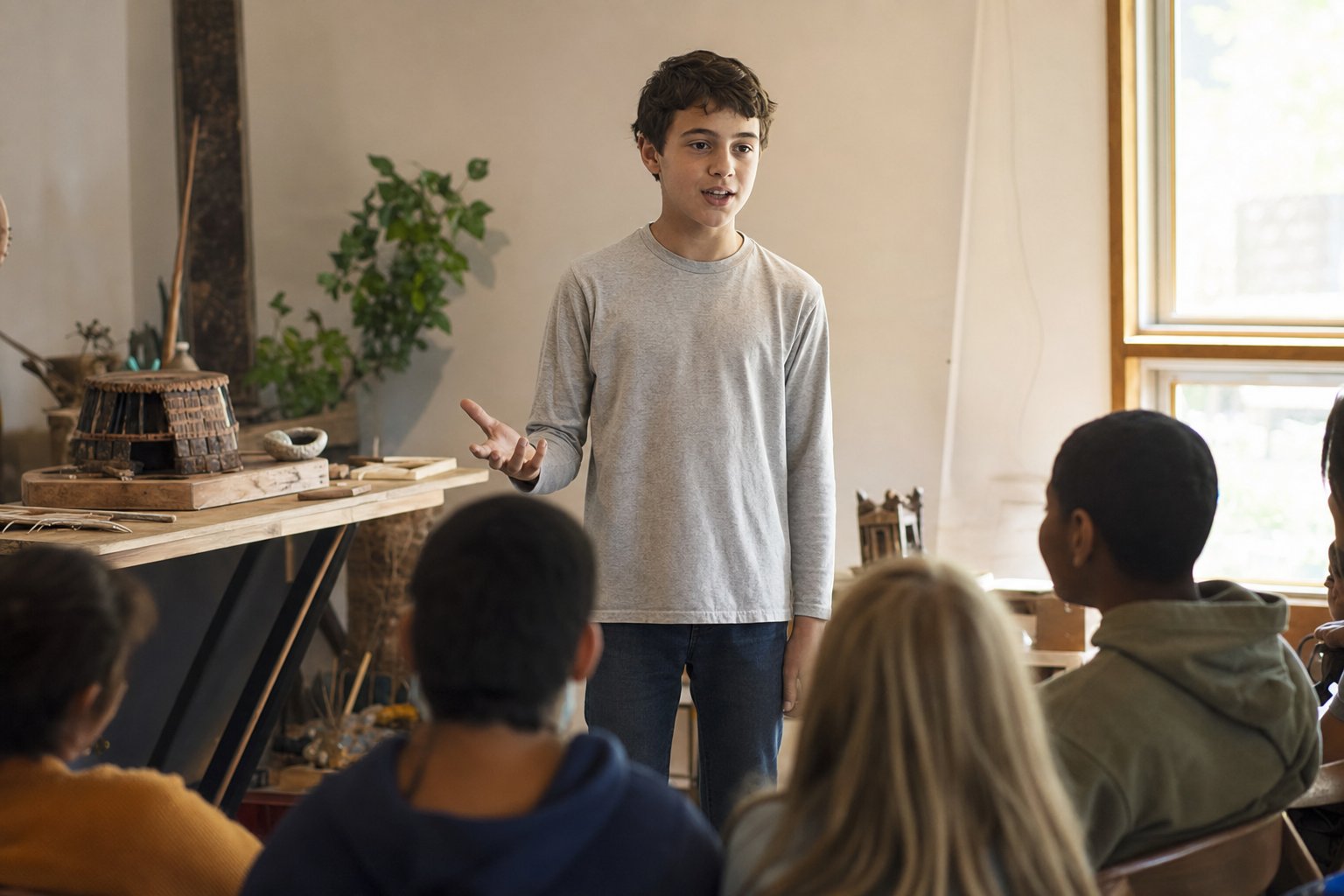
In Powerful Communication, students build public speaking, persuasion, charisma, and real social fluency. Not through instruction about communication, but through live social calibration exercises, Socratic debate, and real interactions with real feedback from real audiences. This begins at age five and deepens in complexity through every grade.
In Leadership, they build self-awareness, goal-setting, follow-through, grit, and the ability to make decisions under uncertainty. Leadership is developed through real responsibility with real stakes. Older students mentor and lead younger ones, and accountability is never simulated.
In Entrepreneurship, they learn to identify real problems, create real products, write copy that sells, understand pricing and margin, and pitch to a live community audience. The governing principle: financial abundance is earned by making other people's lives measurably better. Students know they can create value from nothing because they have done it, repeatedly, year after year.
Maja Pesevic, whose daughter eventually moved two grade levels ahead after finding her rhythm at Wonderstorm, noted: "She returned to school not just academically stronger, but changed in ways that had nothing to do with grades. She re-emerged as herself."
The Question Every Parent Asks
At some point in every enrollment conversation, a parent asks a version of the same question: but what about college?
It is the right question, and Wonderstorm's answer is worth understanding precisely.
For families whose children are headed toward the University of California system, there are two admission paths. The first is the one most families know: four years of competing against tens of thousands of high school seniors for a 9% acceptance rate, followed by four full years of university expenses. The second is the Wonderstorm college path, which allows a student to complete an associate degree and all transfer coursework by age 18, then apply through the transfer door where 1 in 4 applicants is admitted, and enter as a junior. Same university. Same diploma. Roughly 2.5 times the admission odds, and approximately $70,000 to $90,000 they never have to spend.
For families whose children are not college-bound, the value proposition is, if anything, clearer. A young person who can walk into any room and connect effortlessly, who has already built multiple businesses, and who knows how to lead a team and communicate with conviction does not need a credential to create a remarkable life. They already know how.
Jeff Janke, whose daughter's confidence visibly changed within her first year at Wonderstorm, put it plainly: "Dave and Holly have built something rare: a place where parents who truly care about their children's character, not just their curriculum, will find exactly what they're looking for."
What the Enrollment Process Looks Like
Wonderstorm does not process applications like a conventional school. The enrollment path is consultative by design, because the school is intentionally small and every family admitted becomes part of a tight-knit community.
The sequence is straightforward: book a call first, so the school can understand your child and your family's goals. If there is alignment, you schedule a campus tour, an in-person visit to the Laguna Hills campus where you can see the environment, meet the staff, and watch the model in motion. Enrollment follows from there.
This is not a barrier. It is a filter that works in both directions. Families who tour Wonderstorm and find it is not the right fit leave with a clearer picture of what they are looking for. Families who find it is the right fit rarely describe the decision as difficult.
The school draws families from across the South Orange County region: Laguna Hills, Mission Viejo, Aliso Viejo, Rancho Santa Margarita, Lake Forest, San Clemente, Dana Point, San Juan Capistrano, Laguna Beach, Newport Coast, Coto de Caza, Las Flores, Trabuco Canyon, Ladera Ranch, and Portola Hills. If you live anywhere in that footprint, the campus is accessible.
Frequently Asked Questions
Is Wonderstorm Academy accredited and will my child be prepared for college? Wonderstorm Academy is a private K–12 school in Laguna Hills serving children ages 5–18. For families pursuing the University of California system, the school offers a structured college path that allows students to complete an associate degree and all transfer coursework by age 18, then apply as a transfer student where admission rates are approximately 2.5 times higher than freshman admission, and enter as a junior. Families should contact the school directly to discuss their child's specific academic goals and college timeline.
How is Wonderstorm different from other private schools in South Orange County? Most private schools in Orange County, including the most academically rigorous ones, use the same delivery model as public schools: lectures, tests, and grades organized around content coverage. Wonderstorm is the only full-time K–12 private school in the region where all five academic subjects are taught through the three foundational lenses of Leadership, Entrepreneurship, and Powerful Communication. Not as extracurricular programs, but as the actual method through which learning occurs every day.
What does a typical day look like for a student at Wonderstorm? Rather than a lecture-and-worksheet format, students work through real, collaborative projects that integrate academic content with applied skills. A student might spend part of the morning in a Socratic discussion about a pivotal historical decision, then move into a business project where they are pricing a product, writing copy, and preparing a pitch for a real community audience. Physical fitness, social skills development, and character-building are woven into the daily environment, not treated as separate programs.
My child is in elementary school. Is it too early to think about this? Wonderstorm's model begins at age five, and the families who see the most dramatic transformation are often those who enroll early. The communication, leadership, and entrepreneurship lenses are introduced in age-appropriate ways from the start, which means a child who spends their foundational years inside this environment develops habits of thinking, communicating, and creating that compound over time. Families from kindergarten through 12th grade are welcome to begin the enrollment conversation.
How do I find out if Wonderstorm is the right fit for my child? The first step is a call. Not an application form, not a waitlist, but a real conversation about your child and what you are looking for. From there, a campus tour at 25332 McIntyre St in Laguna Hills lets you see the environment in person and ask every question you have. You can reach the school at (949) 990-6188 or start the conversation online.
The Decision Most Parents Describe as Overdue
Every parent who enrolls a child at Wonderstorm describes a version of the same feeling afterward: the sense that they wish they had done it sooner. Not because the years before were wasted, but because watching a previously disengaged child come alive, curious again, building things, speaking with confidence, and genuinely excited to go to school, makes the years of watching them drift feel like something that could have been avoided.
Your child's boredom is not a phase. It is not a teacher problem or a grade-level problem or a problem that resolves itself at middle school. It is a structural mismatch between what a curious, capable child needs and what the conventional school model is built to provide.
The good news is that in South Orange County, the alternative exists. It has a campus, a community, and a track record of children who came in checked out and left able to walk into any room and own it.
If that is the version of your child you are trying to find, the next step is a conversation.
Schedule your campus tour at Wonderstorm Academy