Micro School vs. Montessori: Which Is Right for Your Child?
You've been searching both terms for weeks. The more you read, the less clear the answer gets. Here's what most comparison articles won't tell you: Montessori and micro school aren't competing options on the same list. They describe completely different things. And understanding the difference changes everything about how you choose.
What Each Term Actually Means
A micro school is a structural description. It tells you about size, shape, and philosophy of organization: a small, intentionally designed private school with a limited enrollment, mixed-age groupings, and a strong emphasis on real relationships between students and adults. The defining feature of a micro school is that every child is genuinely known by every adult in the building. Nobody disappears into a crowd of thirty.
A Montessori school, by contrast, is a pedagogical description. It tells you about how children learn, not how many of them there are. The Montessori method, developed by Dr. Maria Montessori over a century ago and now backed by a substantial body of research, centers on self-directed work, carefully prepared materials, multi-age classrooms, and the conviction that children learn best when they are given real agency over their own progress. A Montessori school can be large or small, structured or loose, rigorous or relaxed.
Here is the important thing: these two descriptions are not mutually exclusive. A school can be both a micro school in its structure and Montessori in its foundation. The question is not which one you pick. The question is whether the school you're looking at has genuinely integrated the best of both, or is using one label to paper over the absence of the other.
The question is not which one you pick. The question is whether the school you're looking at has genuinely integrated the best of both.
What the Research Actually Says About Montessori
Before comparing models, it's worth understanding why Montessori is worth taking seriously in the first place. This isn't a philosophy built on sentiment. The evidence is real and specific.
A 2023 Campbell Collaboration systematic review is one of the most rigorous in the field. It analyzed 32 studies and concluded that Montessori education produces a meaningful, positive impact on both academic and non-academic outcomes compared to traditional methods. The average academic effect size was roughly 0.25 standard deviations, which researchers describe as approximately equivalent to one additional year of learning relative to peers in conventional classrooms. The non-academic findings were equally significant: stronger executive function, better self-regulation, and higher levels of intrinsic motivation.
This matters for parents in South Orange County who are comparing options. When you hear that a school is "Montessori-based" or "integrates Montessori principles," you're not hearing a marketing phrase. You're hearing a reference to a documented, evidence-backed approach to human development that has been tested across cultures, income levels, and decades.
The question worth asking any school is: which specific Montessori practices are actually present in the daily life of students, and how deeply are they embedded?
What a Micro School Adds That Montessori Alone Doesn't Always Deliver
Montessori is a powerful pedagogical foundation. But even the best Montessori program, if it stops there, leaves something significant on the table: explicit preparation for the real-world demands of the 21st century.
Traditional Montessori programs are most developed and most researched at the early childhood and elementary levels. The method was designed around the observation of young children, and its materials and practices reflect that origin. Many Montessori schools thin out considerably in middle and high school, either reverting to more conventional instruction or simply becoming less distinctive as students age.
A micro school that is built on a Montessori foundation and extends it through a full K–12 arc addresses this gap directly. The small scale, the mixed-age structure, and the emphasis on self-direction carry forward. But the curriculum expands to meet the actual complexity of adolescent development and the genuine demands of adult life.
This is where the three frameworks that define a school like Wonderstorm Academy become the real differentiator: Leadership, Entrepreneurship, and Powerful Communication. Not as electives. Not as after-school programs. As the actual lenses through which every academic subject is taught, every day, from kindergarten through twelfth grade.
A student who has spent years in a strong Montessori environment learns to focus, to persist, and to love learning. Picture a student who has also spent those years building real businesses, standing in front of live audiences to pitch their ideas, and developing the communication skills to walk into any room and hold it. That student has something qualitatively different. The foundation is the same. The architecture built on top of it is what changes the outcome.
Picture a student who has also spent those years building real businesses, standing in front of live audiences to pitch their ideas, and developing the communication skills to walk into any room and hold it. That student has something qualitatively different.
How These Models Play Out in Daily Life
It is one thing to describe two educational philosophies in the abstract. It is another to understand what a child's actual day looks like inside each one.
In a conventional Montessori classroom at the elementary level, a child moves through a prepared environment at their own pace, choosing work from materials arranged on shelves, building concentration and independence. An adult observes and mentors but rarely lectures. The work is largely individual, the progress is self-directed, and the child develops a genuine relationship with learning rather than a performance-driven relationship with grades.
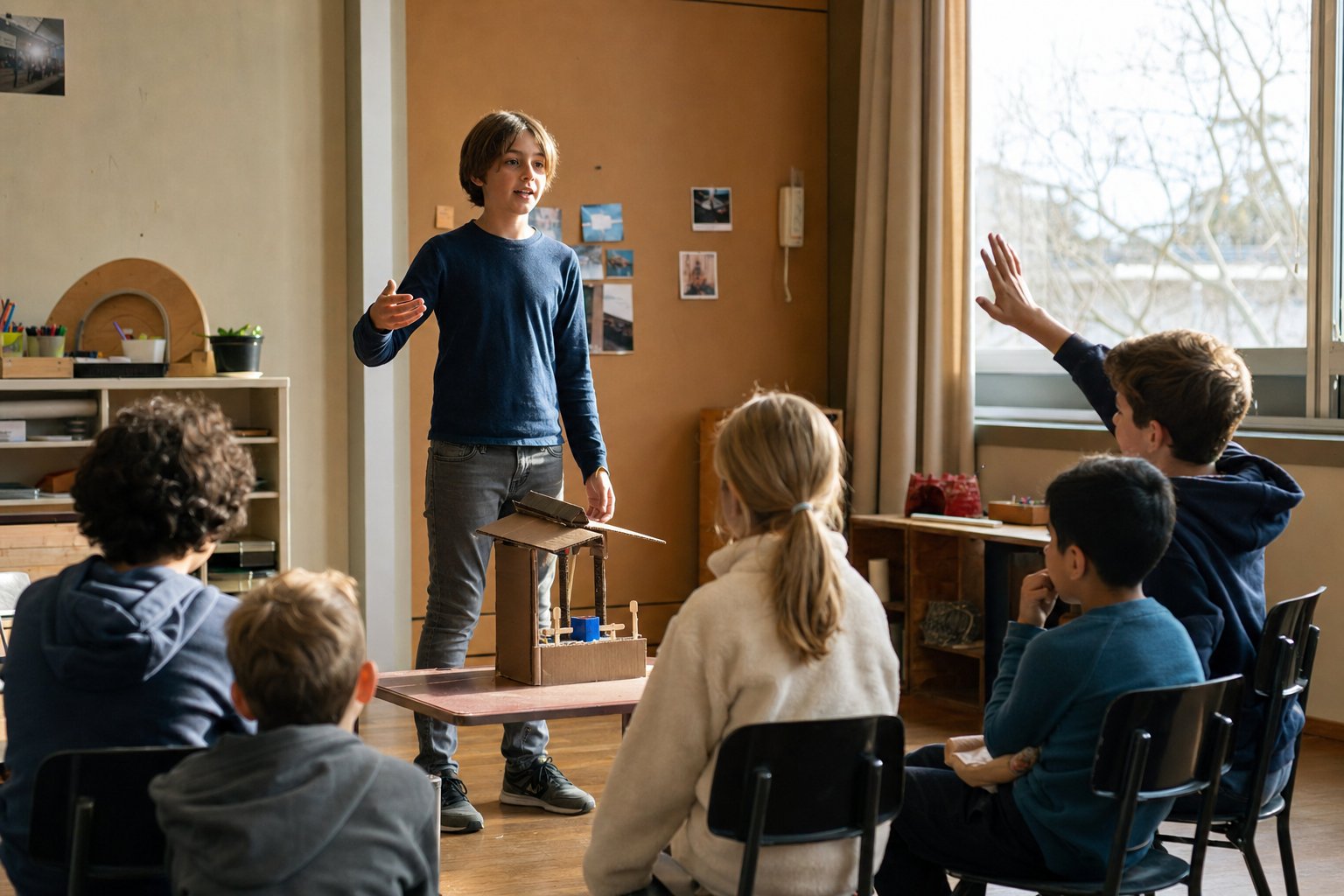
In a micro school like Wonderstorm Academy in Laguna Hills, that same self-direction is present. But the work is more likely to involve building something, pitching something, or solving a real problem for a real audience. A ten-year-old might be pricing a product, tracking margins, and preparing to present her business to a live community audience at a Kids' Market event. A thirteen-year-old might be leading a Socratic discussion about a pivotal decision in history, defending a position, and learning in real time how to hold a room under pressure.
The child in both environments is developing agency. The child in the second environment is also developing the specific capabilities to communicate, to lead, and to create value. Those capabilities will determine the shape of their adult life in ways that no standardized test will ever measure.
Parents from Aliso Viejo, Rancho Santa Margarita, Lake Forest, San Juan Capistrano, Dana Point, San Clemente, Laguna Niguel, Laguna Beach, Newport Coast, Coto de Caza, Las Flores, Trabuco Canyon, Ladera Ranch, Portola Hills, and across South Orange County are increasingly asking not just "what will my child learn" but "who will my child become." That shift in the question is what drives families toward a model that takes both Montessori's developmental wisdom and the micro school's structural intimacy seriously and then builds something more ambitious on top of both.
The Objection Worth Taking Seriously: What About College?
The college question is the most common hesitation parents voice when they consider a non-traditional school, whether it is Montessori, a micro school, or both. Will my child be prepared? Will they be competitive?
It is a fair question and it deserves a direct answer.
First, the developmental research is clear: children who spend their early years building executive function, intrinsic motivation, and genuine mastery of material are better equipped for the demands of university-level work than children who spend those years performing compliance for grades. The Montessori outcomes research on executive function is particularly strong here.
Second, and more specifically to the Wonderstorm model: there are two doors into the University of California system. The first is the conventional path. Students spend four years competing with more than 40,000 high school seniors for a roughly 9 percent acceptance rate at the most selective campuses, then pay four full years of university expenses. The second is completing a college path that arrives at age 18 with an associate degree and all transfer coursework satisfied, then applying through the transfer door where approximately one in four applicants is admitted. Same university. Same diploma. Roughly 2.5 times the odds of admission and somewhere between $70,000 and $90,000 that never needs to be spent.
The question is not whether a project-based, Montessori-informed micro school can prepare a child for college. The question is whether the path you're on is actually the most effective one.
The difference isn't your child's potential. It's what their life is built around over the next 13 years.
What to Look for When You Visit a School
If you are evaluating schools anywhere in South Orange County, from Mission Viejo to Laguna Hills to Ladera Ranch, here is what to look for beyond the label on the website.
Ask what the students are actually doing at any given moment during the school day. Not what the curriculum says they are doing. What are they physically doing, building, saying, deciding? A school that has genuinely integrated Montessori principles and micro school structure will show you children who are engaged, self-directed, and doing work that has real stakes.
Ask what the graduates look like. Not their test scores. What do they do when they encounter a problem nobody has prepared them for? Do they wait for instruction, or do they move? Can they walk into a room of unfamiliar adults and hold a conversation with confidence and warmth? Can they pitch an idea, defend a position, and recover gracefully when challenged?
Ask whether the school's three to five most important capabilities for students are the same three to five that you, as a parent, believe will determine the shape of your child's adult life. If the answer is yes, you're in the right conversation.
Frequently Asked Questions
Is Wonderstorm Academy a Montessori school, a micro school, or both? Wonderstorm Academy is a full-time K–12 private micro school in Laguna Hills built on a Montessori foundation, serving children ages 5 to 18 across South Orange County. The school integrates Montessori materials and methods within a project-based, leadership-focused curriculum organized around three core lenses: Leadership, Entrepreneurship, and Powerful Communication. It draws on those methods particularly for their documented impact on independence, concentration, and intrinsic motivation. It is not a choice between the two models. It is a school that takes the strongest elements of both and builds something more complete.
How does a micro school handle academic rigor? Will my child fall behind in core subjects? At Wonderstorm, all five core academic subjects are taught rigorously: reading, writing, math, science, and history. The difference is that these subjects are not the finish line. They are the raw material. A student does not just study math; they launch a real business and discover that pricing, margins, and unit economics make abstract percentages immediately concrete. Academic depth is preserved. The delivery is fundamentally different, and the retention and application are demonstrably stronger as a result.
What is the social experience like at a micro school compared to a larger private or public school? The small scale that defines a micro school is one of its most significant advantages, not a limitation. Every child is genuinely known by every adult. Mixed-age groupings mean older students develop leadership and mentorship skills while younger students accelerate by proximity to more capable peers. The peer community is intentional and tight-knit. Multiple families across South Orange County, from Laguna Niguel to San Clemente, have described the community at Wonderstorm as one of the primary reasons they stay.
What ages does Wonderstorm Academy serve, and can a child enroll mid-year? Wonderstorm Academy serves children ages 5 to 18, spanning the full K–12 range, at its campus at 25332 McIntyre St, Laguna Hills, CA 92653. Enrollment is handled through a consultative process that starts with a conversation and then a campus visit, so the school and the family can be sure they are genuinely aligned before a child joins the community. The best first step is scheduling a call or a campus tour.
How do I know if Wonderstorm is the right fit for my child specifically? The enrollment process is designed to answer exactly that question. It begins with a conversation, not an application form, because the fit matters more than the paperwork. Families from Mission Viejo, Aliso Viejo, Rancho Santa Margarita, Lake Forest, San Juan Capistrano, Dana Point, Laguna Beach, Newport Coast, Coto de Caza, Las Flores, Trabuco Canyon, Ladera Ranch, Portola Hills, and across South Orange County are welcome to start that conversation at any point.
The Question Beneath the Question
When a parent asks "micro school or Montessori," what they are really asking is this: what kind of person do I want my child to become, and which environment will actually build that person?
The answer is not a label. It is a daily experience, repeated across 15,000 hours of a child's life, that either builds the internal architecture of a capable, self-directed, confident young adult or fails to.
Kati, a parent who moved to Orange County from San Francisco and enrolled her children at Wonderstorm, described what she found: "Over the past three years, Wonderstorm has provided a safe, nurturing foundation where I've watched not only my own children, but the entire community, grow in confidence, curiosity, and kindness."
Jeff Janke, whose daughter has been at Wonderstorm for over a year, put it this way: "She carries herself with a light and a confidence we hadn't seen before, and it shows most in how she treats our family and friends. She is more present, more kind, more herself."
That is the outcome worth choosing a school for. Not a methodology. Not a size. The person on the other side of the education.
If you're ready to see what that looks like in practice, the next step is simple.
Schedule your campus tour or book a call to see if Wonderstorm is the right fit for your family
Research sources6
Live web research informed this article. These are the sources it drew on.
- Montessori education's impact on academic and nonacademic outcomes: A systematic reviewonlinelibrary.wiley.com
- Wonderstorm Academy - Laguna Hills, CA Patchpatch.com2026-08-19
- WONDERSTORM ACADEMY - Updated September 2026yelp.com
- Publications | Montessori Science Program - OpenScholaruva.theopenscholar.com
- Does Montessori work?campbellcollaboration.org2023-08-09
- MPW Public Montessori Outcomes_2024static1.squarespace.com