Your Teenager Is Not Broken: The System Is.
Something happens to a lot of bright, curious kids somewhere around middle school. The child who used to ask why about everything starts asking how little they can do and still pass. If you are watching that shift happen in your own teenager, the question you are probably carrying is: is this just adolescence, or is something actually wrong?
The honest answer is that for many teenagers in South Orange County and across the country, the disengagement is not a phase. It is a rational response to a system that was never designed for them.
The Motivation Problem Nobody Talks About Honestly
Conventional high school is built around a specific transaction: sit still, absorb information, demonstrate it back on a test, repeat for four years. For students who are wired to move, to build, to argue, to lead, to create, that transaction is not just boring but actively depleting.
"My child is bored out of his mind every single day" is one of the most common sentences parents use when they finally start talking about why they are looking for something different.
The research behind student motivation is not complicated. People, including teenagers, stay engaged when they have genuine agency over their work, when the work connects to something real, and when they are trusted to handle real stakes. Conventional schooling systematically removes all three. It replaces agency with compliance, real work with worksheets, and real stakes with grades that measure only how well a student can memorize and repeat.
When a teenager loses motivation in that environment, they are not failing. They are responding accurately to what the environment is asking of them.
What "Alternative School" Actually Means in South Orange County
For parents in Laguna Hills, Mission Viejo, Aliso Viejo, Rancho Santa Margarita, Lake Forest, Laguna Niguel, San Clemente, Dana Point, San Juan Capistrano, Laguna Beach, Newport Coast, Coto de Caza, Las Flores, Trabuco Canyon, Ladera Ranch, and Portola Hills, the phrase "alternative school" covers a wide range. There are online programs. Hybrid homeschool co-ops. Montessori schools that stop at elementary age. Faith-based academies. Charter schools with flexible scheduling.
None of those is the same thing, and the differences matter enormously for a teenager who is already disengaged.
What a genuinely disengaged teenager usually needs is not a more flexible version of the same system. They need a fundamentally different question at the center of their education. Not "how do we get this student to comply?" but "what is this student actually capable of, and how do we build an environment where they can find out?"
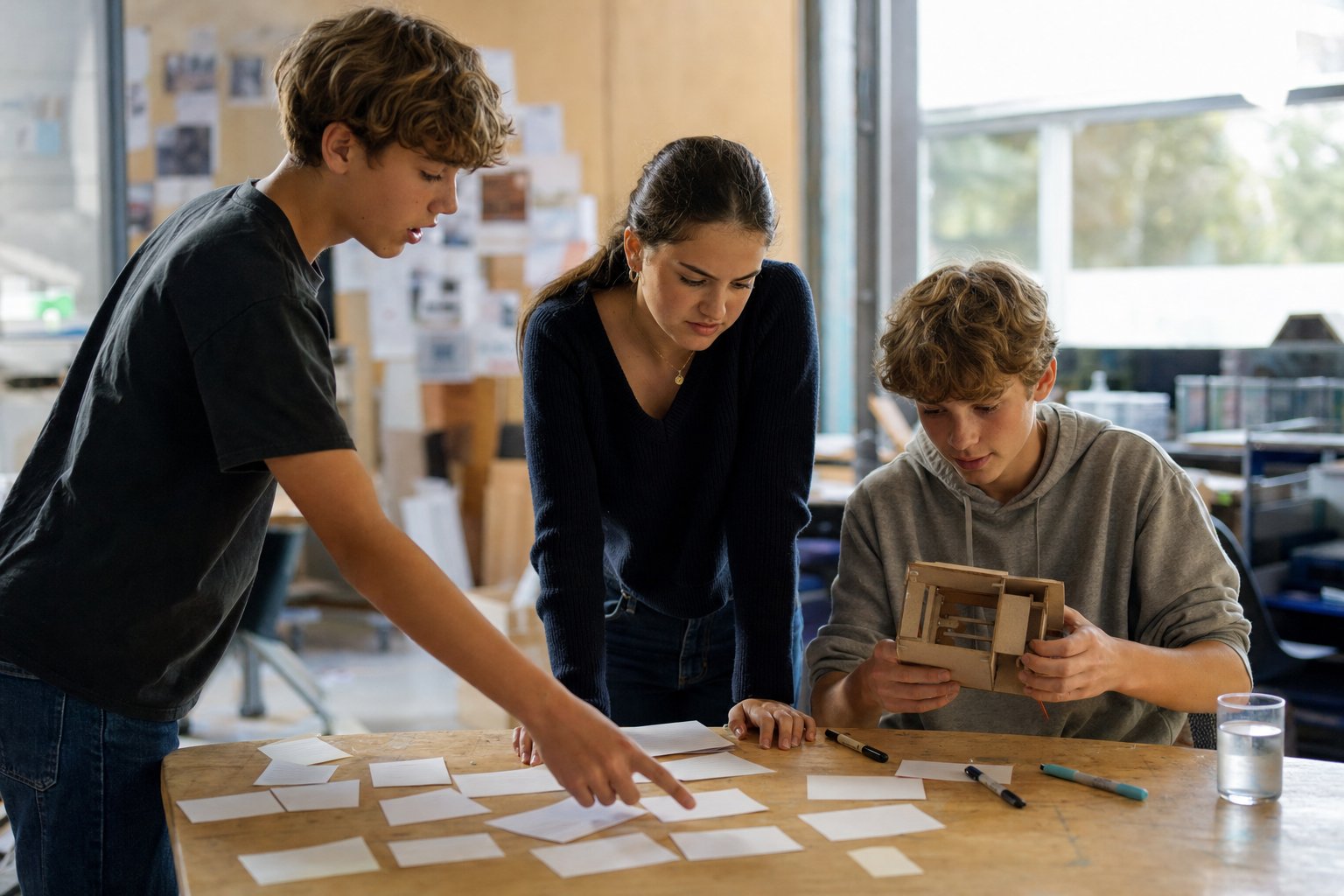
That question is the one Wonderstorm Academy was built around. Located at 25332 McIntyre St in Laguna Hills and serving families throughout South Orange County, Wonderstorm is a full-time, on-site private school for students ages 5 through 18. It is not a tutoring center, not an online program, and not a homeschool co-op. It is a campus school organized around a fundamentally different curriculum architecture, one built on three core lenses that run through every academic subject, every year, from kindergarten through twelfth grade.
Those three lenses are Leadership, Entrepreneurship, and Powerful Communication.
Why Three Lenses Change Everything
Most schools treat leadership, entrepreneurship, and communication as extracurricular add-ons. A speech class here. A student council there. A business elective in senior year if there is room in the schedule.
At Wonderstorm, those three capabilities are not the decoration on top of the curriculum. They are the curriculum itself. The lenses through which every academic subject is taught, from the first day of kindergarten through graduation.
Here is what that looks like in practice.
A student does not just study history. They step into the role of a historical decision-maker at a pivotal moment and argue, in front of their peers, for the choice that person faced. They have to understand the facts well enough to defend a position under pressure. Which means they actually understand the facts, rather than memorizing them for a test they will forget the following week.
A student does not just learn math through worksheets. They price a real product, track their own margins, discover what happens to their profit when a number goes wrong, and present their findings to a live audience. They understand percentages because they have felt what a bad one costs them.
A student learning to communicate does not sit through a lecture about public speaking. They do it. Repeatedly. In front of real people, with real feedback, in real social situations that require them to read a room and adjust in the moment. The school uses tools like the Comedy Improv Battle Arena, a structured, high-energy exercise that builds the ability to think on your feet, stay relaxed under pressure, and connect with people in real time.
This is not soft-skills programming bolted onto a real curriculum. The academic subjects are all there. Reading, writing, math, science, history. Taught rigorously. But they are the raw material. The three lenses are what the student is actually becoming.
What Happens to a Disengaged Teenager in This Environment
The transformation that families describe at Wonderstorm is not subtle, and it tends to happen faster than parents expect.
Jeff Janke, whose daughter enrolled at Wonderstorm, described it this way: "She carries herself with a light and a confidence we hadn't seen before, and it shows most in how she treats our family and friends. She is more present, more kind, more herself. The version we love."
Colleen Chapman-Janke described a daughter navigating serious peer anxiety before enrolling: "She has become more confident, independent, and secure in herself than we ever imagined possible. Most importantly, she's building strong, healthy relationships and has found a genuine sense of community."
What these families are describing is not academic improvement alone, though that happens too. One family reported their daughter moved two grade levels ahead after finding her footing at Wonderstorm, following a period away from conventional schooling. But the parents consistently name something larger than grades: a teenager who knows who they are, who is genuinely excited about their days, and who has started to see themselves as someone capable of building a life rather than waiting to be told what to do next.
That is the destination Wonderstorm is organized around. Not a better GPA. A better human.
There is a version of your teenager at nineteen who walks into a room and owns it. Who has already built real things, led real teams, and doesn't wait for permission. The difference between that version and the one sitting blank-faced in a conventional classroom right now is not potential. It is what the next four years are built around.
The College Question (Because Every Parent Has It)
One of the most common hesitations parents bring to this conversation is the college question. Will a non-traditional school hurt my child's chances of getting into a good university?
It is a fair question, and the honest answer is that Wonderstorm has a specific answer to it, one that challenges the assumption underneath the question itself.
For families whose goal is a University of California degree, there are two paths in. The conventional path sends a student to compete as one of more than 40,000 high school seniors for a 9% acceptance rate at the most selective UC campuses, then pays four full years of university expenses.
The Wonderstorm college path works differently: a student completes their high school years with an associate degree and all transfer coursework already satisfied, then applies to the UC system through the transfer pathway, where roughly 1 in 4 applicants is admitted. Same university. Same diploma. Approximately 2.5 times the odds of admission, and roughly $70,000 to $90,000 in savings from the two years of university they no longer need to pay for.
For students who are not college-bound, the case is even more direct. A young person who graduates with genuine leadership capability, the ability to walk into any room and connect with people, and a demonstrated history of building real businesses and solving real problems has an advantage that no credential can replicate. Whether they go into trade work, start a company, or build a career in any field, they are the person everyone wants to work with.
What to Do If Your Teenager Is Losing Motivation Right Now
If you are a parent in South Orange County watching a capable teenager slowly check out of school, the most important thing you can do is resist the assumption that this is a phase to wait out.
Disengagement at the high school level tends to compound. A student who stops caring in ninth grade does not usually rediscover motivation in eleventh. What they tend to do is get very good at performing the minimum required to pass, while the real parts of who they are, the curiosity, the ambition, the willingness to try hard things, go quiet from lack of use.
The question worth asking is not "how do I get my teenager to care about school again?" The question is "is the school worth caring about?"
If you are in Laguna Hills, Mission Viejo, Aliso Viejo, Rancho Santa Margarita, Lake Forest, Laguna Niguel, San Clemente, Dana Point, San Juan Capistrano, Laguna Beach, Newport Coast, Coto de Caza, Ladera Ranch, Las Flores, Trabuco Canyon, or Portola Hills, Wonderstorm Academy is worth a conversation.
Not because it is a perfect fit for every family. It is not, and the enrollment process is designed to find out whether it is right for yours. But because a campus visit tends to answer the question that no amount of reading about alternative education can answer: what does a room full of teenagers who are actually engaged look like, and could my child be one of them?
The answer, for the right family, is yes.
Frequently Asked Questions
Is Wonderstorm Academy only for elementary-age students, or does it serve teenagers? Wonderstorm serves students from age 5 through 18, which means it is a full K–12 school. Teenagers are very much part of the campus community, and the Leadership, Entrepreneurship, and Powerful Communication curriculum deepens in complexity through the high school years. Older students take on real mentorship roles and work on increasingly sophisticated real-world projects.
Will my teenager be academically prepared for college if they attend Wonderstorm? Yes. All five core academic subjects, reading, writing, math, science, and history, are taught rigorously at Wonderstorm. The difference is that those subjects are taught through the three core lenses rather than through passive memorization. For families with UC admission as a goal, Wonderstorm offers a specific college pathway that results in an associate degree at graduation and a transfer application route where approximately 1 in 4 applicants is admitted, compared to a 9% acceptance rate through the conventional freshman pathway.
How large are the classes, and will my teenager get lost in the crowd? Wonderstorm is a micro-school by design, which means small student populations are a core feature of the model rather than a limitation. Every student is known individually, challenged as an individual, and coached rather than managed. Families consistently describe their children as feeling genuinely seen and supported in a way that is not possible in a large conventional high school.
My teenager has struggled socially at their current school. Would Wonderstorm be a different experience? Social skills development is one of the three core pillars of the Wonderstorm curriculum, not an afterthought. Students work in real social situations with real feedback from the beginning, learning to read a room, communicate under pressure, lead peers, and build genuine relationships. Multiple families have specifically described teenagers who struggled socially at conventional schools finding a real sense of community and belonging at Wonderstorm.
How do I find out if Wonderstorm is the right fit for my family? The enrollment process begins with a conversation. Wonderstorm uses a consultative approach: a call to understand your family's situation and goals, followed by a campus visit so you can see the environment and the students firsthand. Tuition is discussed during that conversation rather than advertised publicly, because the right conversation starts with fit, not price.
If your teenager is losing motivation and you are ready to find out whether a different kind of school could change that, the first step is a conversation.
Schedule your campus tour and see what engaged teenagers actually look like
Research sources1
Live web research informed this article. These are the sources it drew on.
- Wonderstorm Academy - Mission Viejo, CAyelp.com2022-03-21