The School Built for Real Life
Your bright, curious child is disengaged, and you already know the building they are sitting in is not the problem. Something structural is. If you have started searching for a student-led school, a microschool in Orange County, or simply “alternatives to public school that actually prepare kids for life,” you are not being dramatic. You are being perceptive.
The Moment Most Parents Recognize
There is a specific moment that brings South Orange County parents to Wonderstorm Academy. It is not a single bad grade or a single hard year. It is the slow realization that the child who used to ask questions about everything, who built things, invented things, and narrated elaborate stories about how the world worked, has quietly learned to stop.
Not because something is wrong with them. Because the system around them rewards compliance more than curiosity. It rewards the right answer more than the brave question. And over time, most children learn to give the system what it wants.
“The child who used to ask questions about everything has quietly learned to stop, not because something is wrong with them, but because the system around them rewards compliance more than curiosity.”
This pattern repeats across Laguna Hills, Mission Viejo, Laguna Niguel, and Rancho Santa Margarita. Parents who are themselves successful, entrepreneurial, and deeply intentional watch their children move through schools that were designed for a different century and a different economy. They feel the friction of that mismatch every single day.
The average K–12 student will spend approximately 15,000 hours in formal schooling. That is not a small investment of time. It is a childhood. The question worth sitting with is not whether your child is learning. It is what, exactly, those 15,000 hours are building in them.
What “Real-World Skills” Actually Means
When parents search for schools that teach real-world skills, they are often imagining something vague: a bit more hands-on, maybe some group projects, perhaps a coding elective. What they are actually describing, when pressed, is something far more fundamental.
Real-world skills are not a curriculum add-on. They are a different theory of what school is for.
At a student-led microschool like Wonderstorm Academy, entrepreneurship is not a club that meets on Thursdays. It is the medium through which children learn mathematics, communication, resilience, and self-knowledge. A student who is designing a product, pitching it to a real audience, managing a budget, and responding to genuine feedback is not doing an enrichment activity. They are doing the most rigorous academic and character work available to a young person.
The World Economic Forum has identified complex problem-solving, critical thinking, creativity, and people management as the defining skills of the coming decade. These are not soft skills. They are the hardest skills to develop, and they cannot be developed through passive note-taking and standardized tests. They require real stakes, real audiences, and real consequences.
Agency is not a reward for good behavior. It is the condition under which genuine learning becomes possible.
Why Microschool Scale Changes Everything
There is a reason the microschool model is spreading rapidly through intentional parent communities in South Orange County and beyond. It is not nostalgia for a simpler time. It is a structural insight: the things that matter most in education, including deep mentorship, personalized pacing, genuine relationships, and real-world projects, are not scalable. They require smallness.
In a traditional school of 400 or 800 students, a child can disappear. Not maliciously. Structurally. The sheer volume of students, the pressure of standardized benchmarks, and the administrative demands on teachers make genuine individual attention a luxury rather than a design principle.
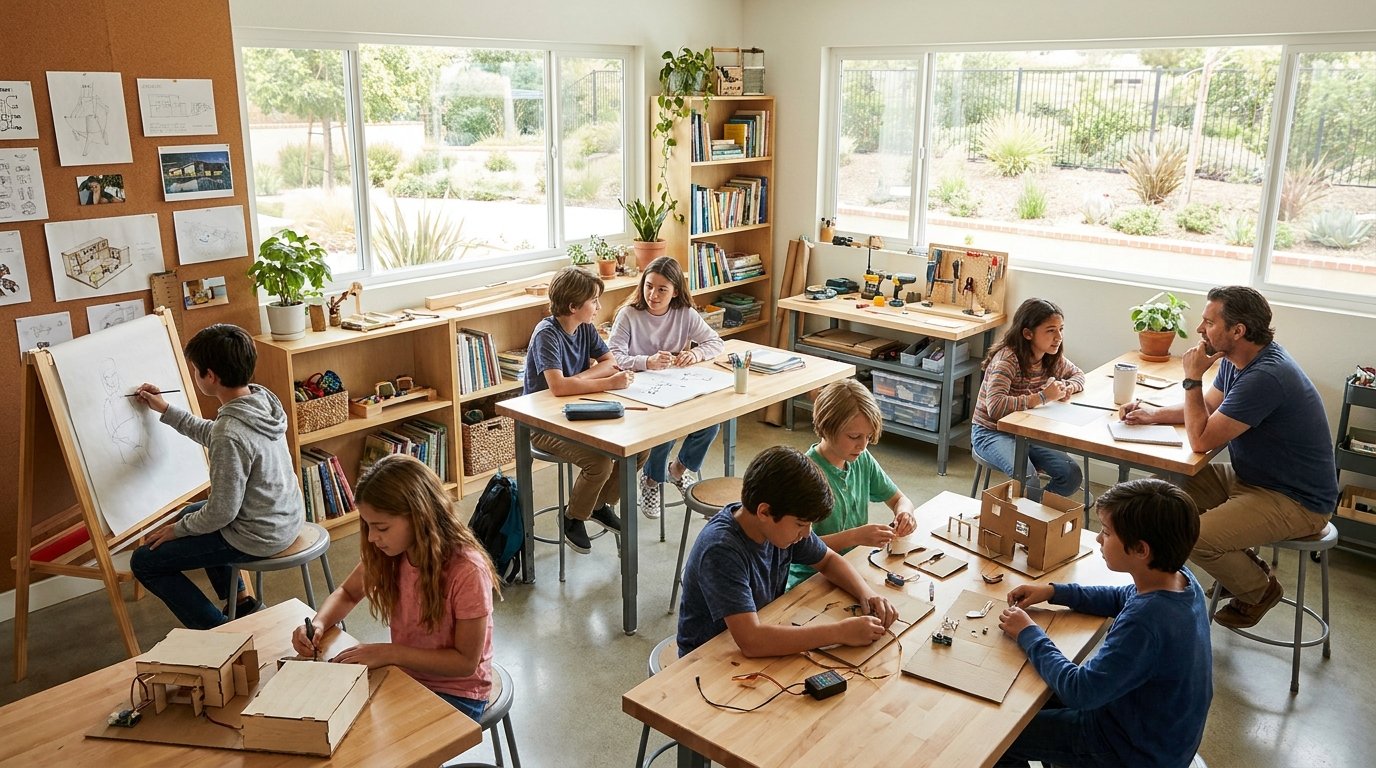
In a microschool, every child is known. Not just their name and their grade, but their interests, their frustrations, their emerging strengths, and the specific ways they come alive. That kind of knowing is not a nice-to-have. It is the prerequisite for a child developing a real sense of identity and agency.
At Wonderstorm Academy in Laguna Hills, cohort sizes are intentionally small. Students work in mixed-age learning spaces rather than age-segregated classrooms. They rotate through leadership roles, collaborate on real ventures, and present their work publicly. The architecture of the school day is designed to make agency and initiative unavoidable, not occasional.
Entrepreneurship as the New Core Curriculum
The most common objection from parents exploring alternative K-12 education near Irvine and South Orange County is a reasonable one: Will my child be academically prepared? Will they be able to get into a strong university if they want to?
“Entrepreneurship is not a subject at Wonderstorm. It is the lens through which every subject becomes alive, urgent, and genuinely worth mastering.”
The answer requires reframing the question. Academic preparation is not the same as academic compliance. A student who has launched a real micro-venture, wrestled with a real budget, written a real pitch, navigated a real setback, and presented findings to a real audience has developed more transferable intellectual capability than a student who has memorized the correct answers to 200 practice test questions.
Entrepreneurship at Wonderstorm is not a subject. It is the lens through which every subject becomes alive, urgent, and genuinely worth mastering. Math has stakes when it is your budget. Writing has stakes when your pitch depends on it. Communication has stakes when you are standing in front of people who will tell you honestly whether your idea works.
By graduation, Wonderstorm students do not just have transcripts. They have portfolios containing evidence of ventures launched, problems solved, communities served, and leadership exercised under real conditions. That is not a weaker preparation for the future. It is a stronger one.
The Values Question Every Intentional Parent Is Really Asking
Behind every search for a private microschool in Laguna Hills or a hands-on learning school in South Orange County, there is a values question that rarely gets asked out loud: What kind of person do I want my child to become?
Not what career. Not what college. What kind of person.
Parents who find Wonderstorm are not primarily driven by anxiety about their child’s future employment. They are driven by a vision. They want a child who is curious and courageous. Who knows how to collaborate and how to lead. Who has a strong sense of their own character and a genuine desire to contribute something to the world around them. Who has not been optimized for compliance at the expense of personhood.
That vision is not naive. It is, in fact, the most rigorous standard a school can be held to. It is also the standard that values-driven families in Orange County are increasingly unwilling to compromise on, regardless of how prestigious the alternative might be.
Wonderstorm Academy exists because a group of educators and parents looked at that standard and decided to build a school around it rather than around the metrics that are easiest to measure.
What Investigative Parents Should Ask Any School
A recent ProPublica mentor coached parents to research private schools the way investigative journalists research institutions. That means examining governance, finances, discipline policies, curriculum philosophy, and real outcomes rather than taking marketing materials at face value. That instinct is exactly right.
If you are exploring student-led schools, microschools, or alternative private K-12 education near Mission Viejo, Irvine, or Laguna Hills, here are the questions worth asking every school on your list.
Ask them to show you a student’s typical day, not a curated tour day, but a Tuesday in October. Ask what happens when a student struggles with motivation or a project fails. Ask how students develop leadership skills and what that looks like concretely in the daily schedule. Ask what a graduate’s portfolio contains and what a family can expect their child to be able to do that they could not do at enrollment. Ask how the school handles disagreements between families and leadership. Ask who the school is accountable to and how that accountability works in practice.
A school with nothing to hide will answer all of these questions specifically and without defensiveness. A school worth choosing will answer them with pride.
The Choice That Is Not Actually a Choice
The false tension that keeps intentional parents stuck is the belief that they must choose between academic rigor and genuine development. Between a “good school” and a good childhood. Between preparation for the future and presence in the present.
That tension is a product of the traditional schooling model, not an inherent feature of education itself. A student-led microschool built around entrepreneurship, leadership, and real-world projects does not ask families to sacrifice one for the other. It dissolves the choice entirely.
Your child can be academically capable and entrepreneurially alive. They can be rigorously prepared and deeply known. They can spend their school years building something real rather than waiting for real life to begin.
If that is the school you have been looking for, whether in Laguna Hills, South Orange County, or anywhere near Irvine, Wonderstorm Academy exists for your family.
We offer open learning space visits where you can watch students at work on a real day, not a performance. We offer honest conversations about what our model can and cannot do. And we offer a community of families who have already made the choice you are considering and are glad they did.
The first step is simple: schedule a visit and see what a student-led school actually looks like when it is working. Your child’s 15,000 hours are already counting.